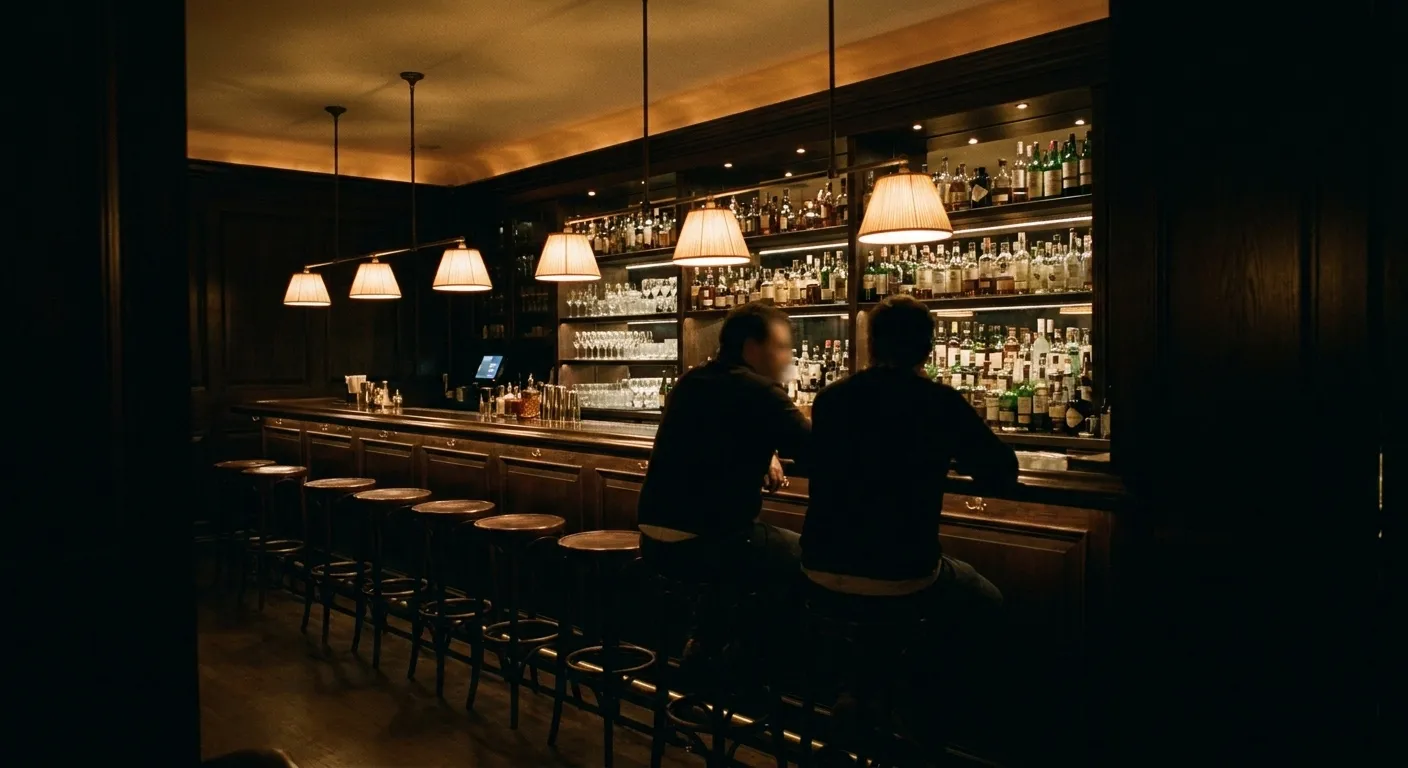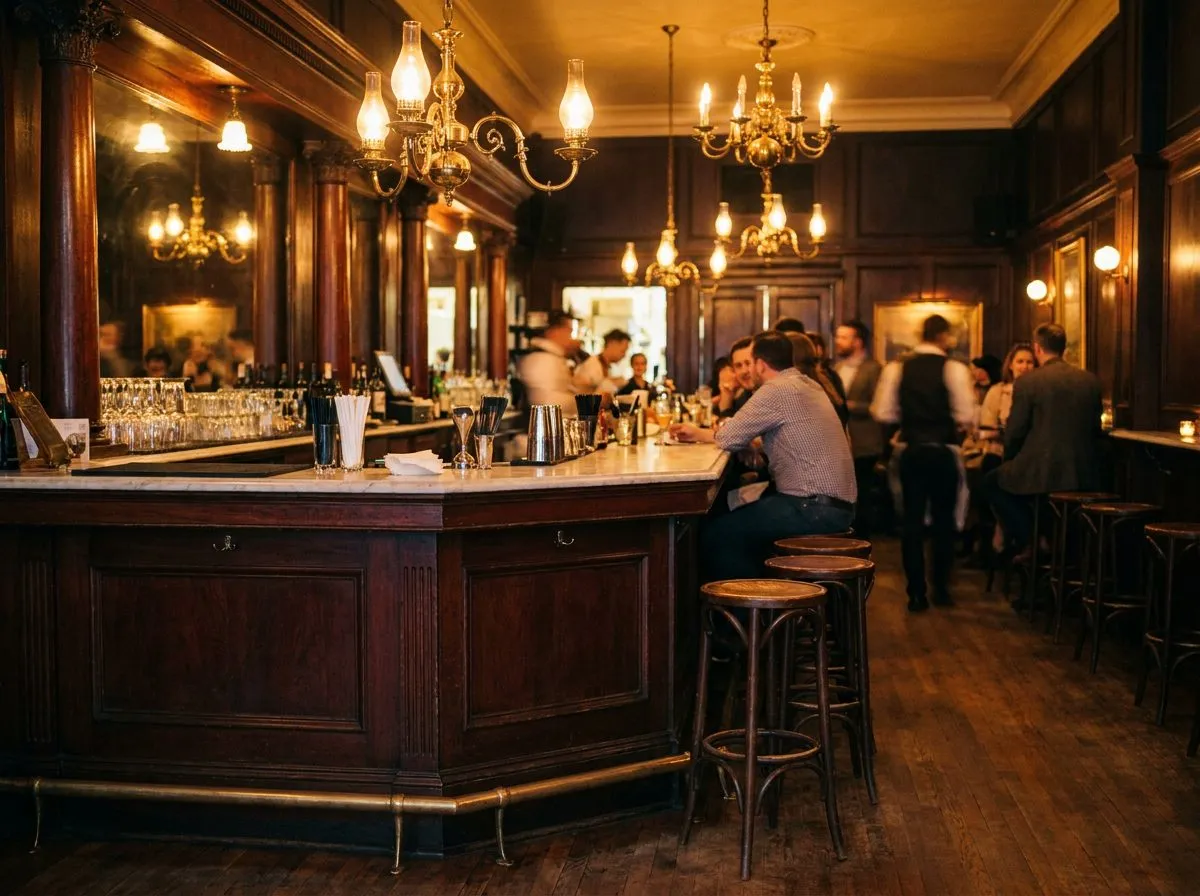
There's a particular kind of quiet that settles over a bar lit by gas flame instead of Edison bulbs. It's warmer, less insistent. The light doesn't announce itself. At Gage & Tollner, the 1892 oyster palace that spent decades dark before its meticulous 2021 reopening, that quiet pools most noticeably at the corner stool nearest Fulton Street. Slide onto the mahogany perch, and you're sitting directly beneath one of the last working gaslight fixtures in New York City—not a reproduction, not a retrofitted conversation piece, but the real article, fed by the original line laid when Grover Cleveland was president.
The last flame on the original line
The dining room glows with dozens of gas fixtures, all painstakingly restored to working order. But the corner stool holds a distinction the others don't. While most of the sconces were reconnected to modern feed lines during the restoration, this single fixture—the one casting its amber light onto your Gibson and oysters—still draws from the 1892 gas line that once supplied the entire room. Bartenders will confirm it if you ask, though they rarely volunteer the detail unless you've claimed the seat more than once.
The flame flickers with the building's breathing. When the subway rumbles beneath Fulton Street, the light shivers. It's a small tell, the kind of thing you notice only when you're paying attention, or when you've been sitting long enough that the marble counter has chilled your forearms. The rhythm of it becomes hypnotic after a while—the steady glow punctuated by those brief tremors, a pulse that connects the room to the infrastructure beneath it, to the city's constant movement underfoot.
Cold storage
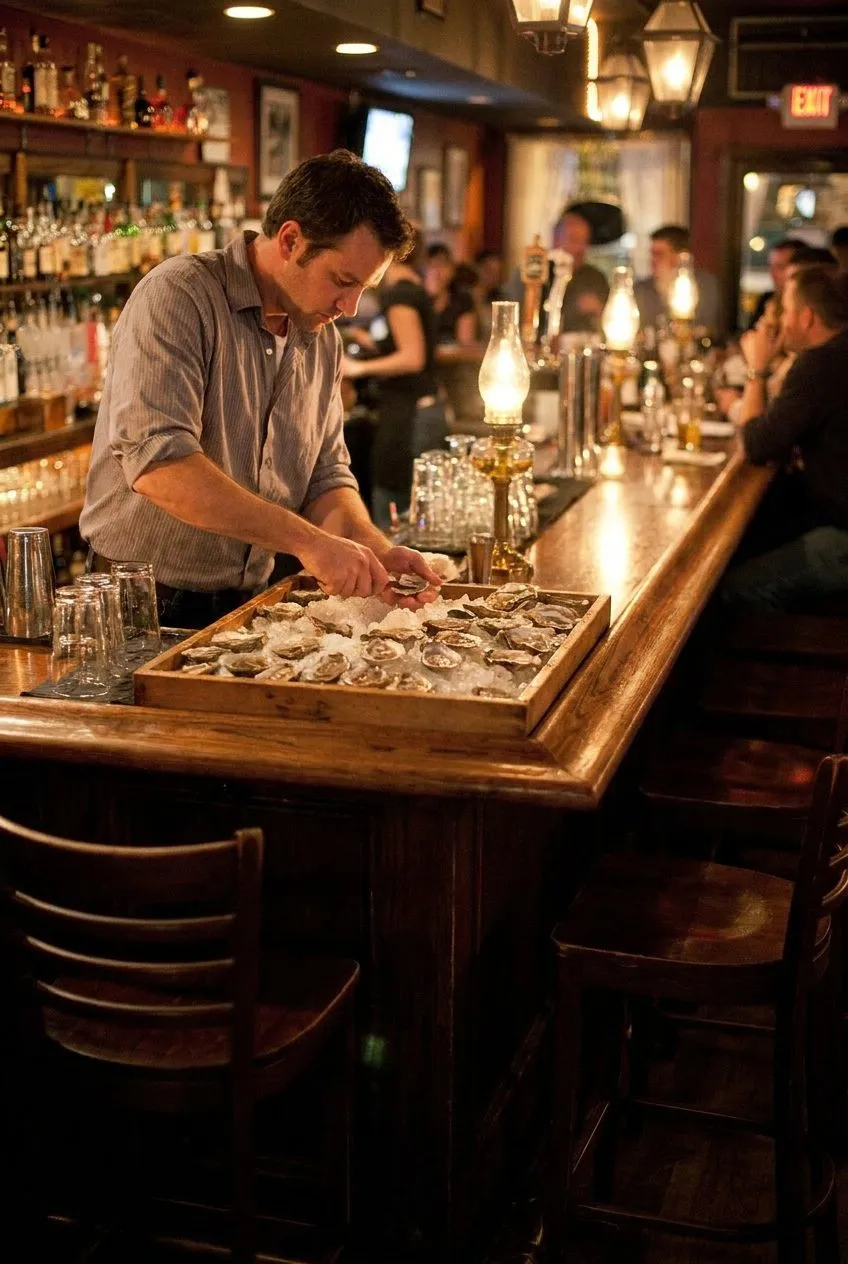
That chill isn't incidental. The mahogany bar runs the length of the room, a gorgeous expanse of wood and brass, but the corner section where the stools cluster is topped with marble slabs salvaged from the original installation. Bartenders have a nickname for it: cold storage. The stone stays eight to ten degrees cooler than the wood bar, a vestige of the days when marble wasn't decorative but functional, keeping shellfish and butter from turning in the summer heat.
Order oysters here and the plate arrives already at temperature. Your hands rest on stone that remembers a century of elbows, of gloved women and shirtsleeve men, of gaslights guttering at closing time. The marble bears the faintest wear patterns if you look closely—smooth depressions where countless forearms have rested, slight discoloration near the bar's edge where spills and condensation have marked the stone over decades. The mirror behind the bar is original too, silvered and slightly warped, reflecting the room with the soft distortion of old glass. You see yourself the way a patron in 1910 might have—a little hazy, a little forgiving.
The five o'clock window
Timing matters if you want the corner stool without a wait. Weekday evenings between five and six o'clock offer the quietest hour, when the dining room is still setting up and the bar belongs mostly to solo drinkers and early arrivals. By seven, the scene shifts. Brooklyn Heights regulars fill the stools three-deep, voices rising, the bartenders moving in that efficient dance of people who know exactly how many seconds a proper pour takes.
The five o'clock hour has a different quality. The gas flames are brighter against the late-afternoon light slanting through the Fulton Street windows. You can hear the clink of ice, the low murmur of the kitchen prepping for service. It's the moment when historic bars like this one feel less like destinations and more like functioning rooms, places that happen to have been doing this for a very long time. There's a particular intimacy to being among the first arrivals, settling in before the crowd, watching the space transform from quiet preparation to full evening bloom.
What to order
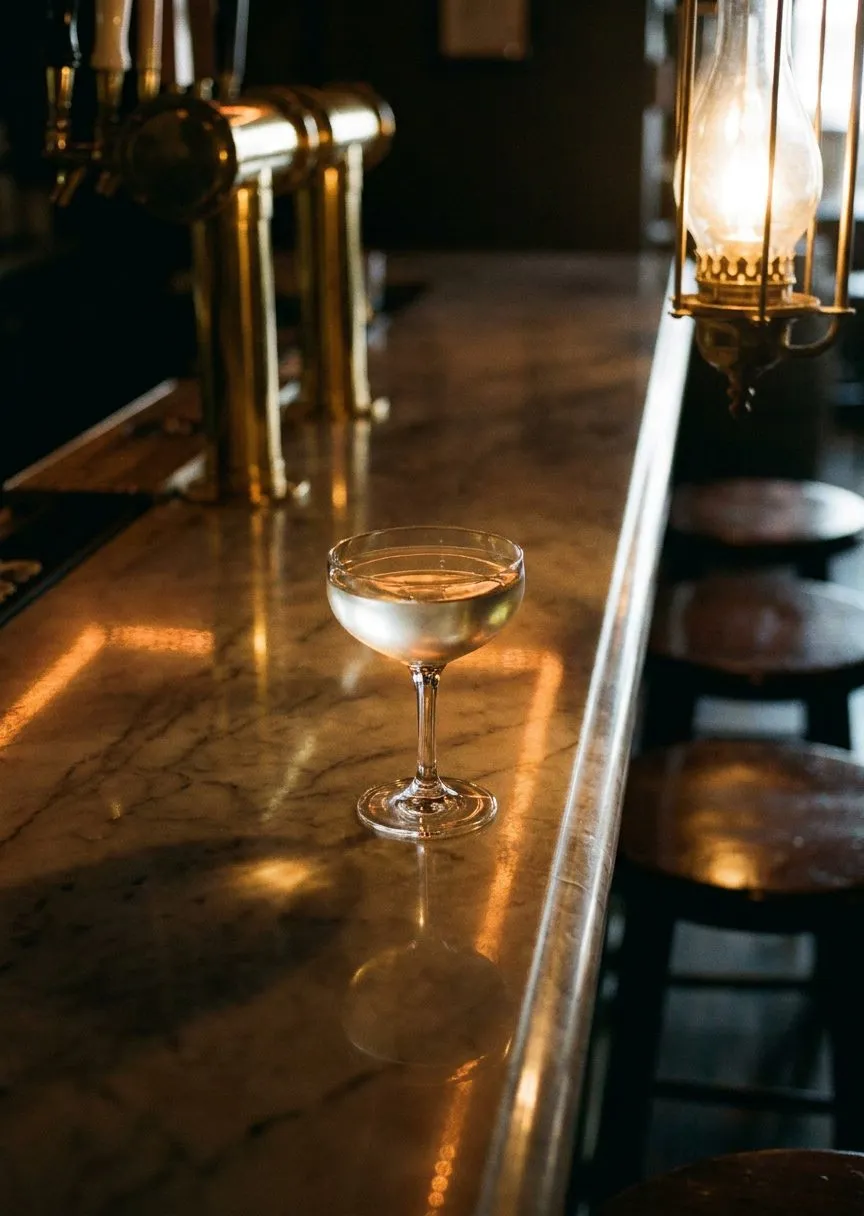
The Gibson is correct here—gin, vermouth, cocktail onions speared and glistening. It's a drink that belongs in rooms with gas fixtures and marble counters, crisp and unsweet and unfussy. The oysters arrive on ice, East and West Coast both, briny and cold against the stone. If you're hungry beyond shellfish, the menu runs to chops and Dover sole, the kind of food that doesn't apologize for being exactly what it is. The mutton chop, a nineteenth-century staple that disappeared from most menus decades ago, has found its rightful place here—a thick, double-rib cut that tastes like vindication for every restaurant that thought modernity meant abandoning substance.
But the corner stool isn't really about the food, exceptional as it is. It's about the convergence of material and light and time, the feeling of sitting in a room that has genuinely survived rather than been recreated. Restoration dining—when it's done with this level of care—offers something beyond nostalgia. It offers continuity, the rare chance to occupy the same physical space as strangers separated by a hundred years.
The gaslight test
You can tell a lot about a restoration by how it handles its showpiece details. Some places mount the historical elements like museum exhibits, roped off or spotlit into irrelevance. Gage & Tollner lets you sit under the gaslight. Lets you rest your arms on cold marble. Lets the mirror show you your own distorted reflection without explanation or placard. The room trusts you to notice, or not. Either way, the fixtures keep burning.
Late in the evening, when the bar is full and the noise rises, the gaslight above the corner stool holds its own small pool of warmth. It's the kind of detail that sounds precious in description but reads as simple fact when you're there. The flame. The marble. The mirror. A stool in Brooklyn where gaslight still means gaslight, and always has.
The neighborhood that forgot and remembered
Downtown Brooklyn spent decades trying to become something else. The high-rises went up, the chains moved in, and buildings like Gage & Tollner sat dark through the transformation, too expensive to demolish, too complicated to revive. Fulton Street became a corridor of banks and cell phone stores, the kind of place you passed through rather than lingered in. The ornate facades remained, but they felt like scenery, backdrops to a neighborhood that had turned its attention elsewhere.
The restaurant's resurrection signaled something shifting. Not gentrification exactly—that wave had already crested—but a different kind of reckoning with what the neighborhood had been and might be again. Within a few blocks, other spaces began paying attention to their bones. The Dime Savings Bank became an event venue that kept its vast banking hall intact. The Williamsburg Savings Bank Tower, long the borough's tallest building, started treating its lobby like the architectural marvel it is rather than something to panel over and forget. Gage & Tollner didn't cause this shift alone, but it proved that downtown Brooklyn could hold spaces that asked you to slow down, to sit under a gaslight with a Gibson and remember that cities are built in layers, and sometimes the oldest layers are worth keeping close to the surface.
Practical notes
Gage & Tollner is located at 372 Fulton Street, Brooklyn, a short walk from nearby subway stations. Street parking is scarce; the neighborhood is better accessed by transit. The bar is open in the evenings on weekdays; verify current hours directly as they adjust seasonally. The ground-floor dining room and bar are wheelchair accessible via the Fulton Street entrance. Reservations are recommended for dining tables but the bar operates on a walk-in basis. Bring cash for tipping; the bartenders earn it.
Tags: #GageAndTollner #PullUpAChair #HistoricBars #DowntownBrooklyn #RestorationDining #NYCBars #OysterBar #GaslightEra #BrooklynDining #CitySecrets #ClassicCocktails #FultonStreet #Late2026 #HiddenGemNYC #AuthenticRestoration
Please drink responsibly. Must be of legal drinking age.
Sources consulted: Gage & Tollner - Wikipedia · Gas lighting - Wikipedia · Brooklyn Tourism & Visitors Center · NYTimes Dining · Time Out New York Restaurants
All trademarks are the property of their respective owners.