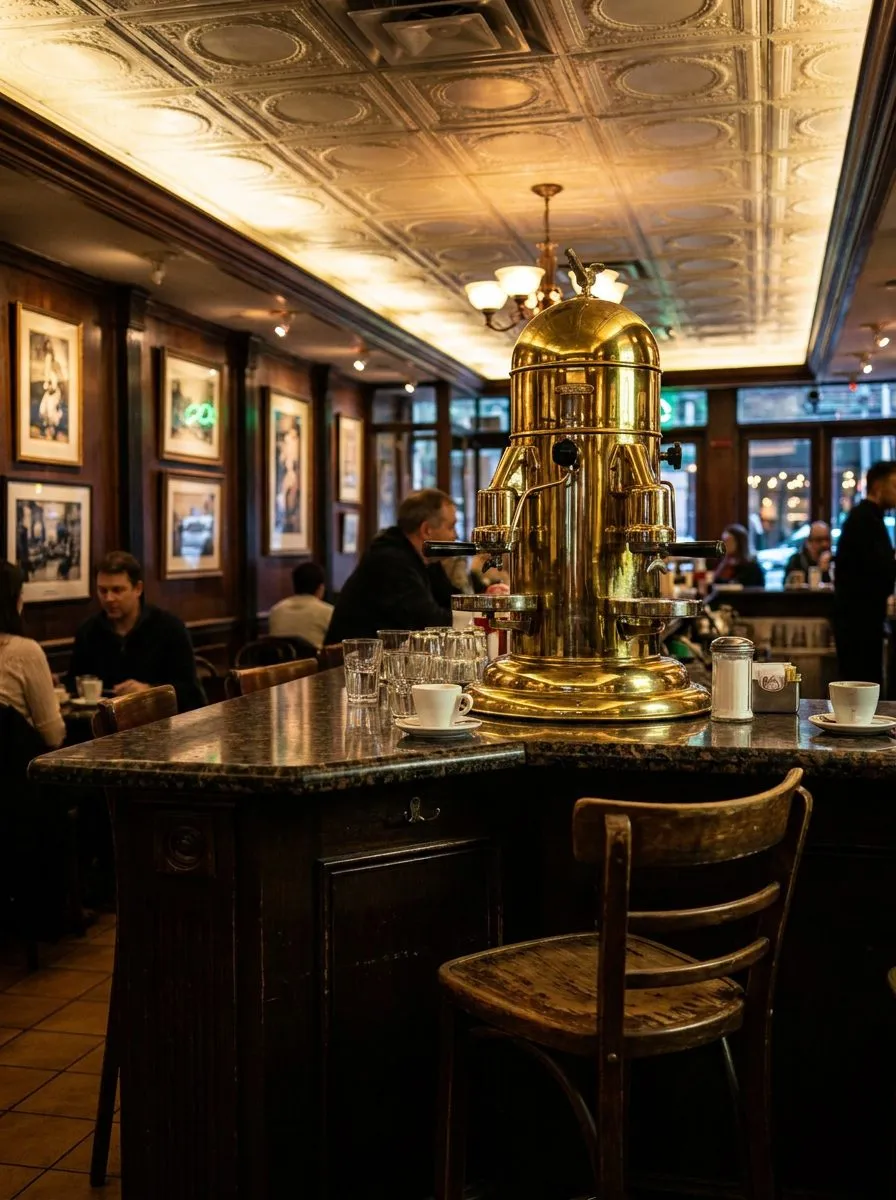
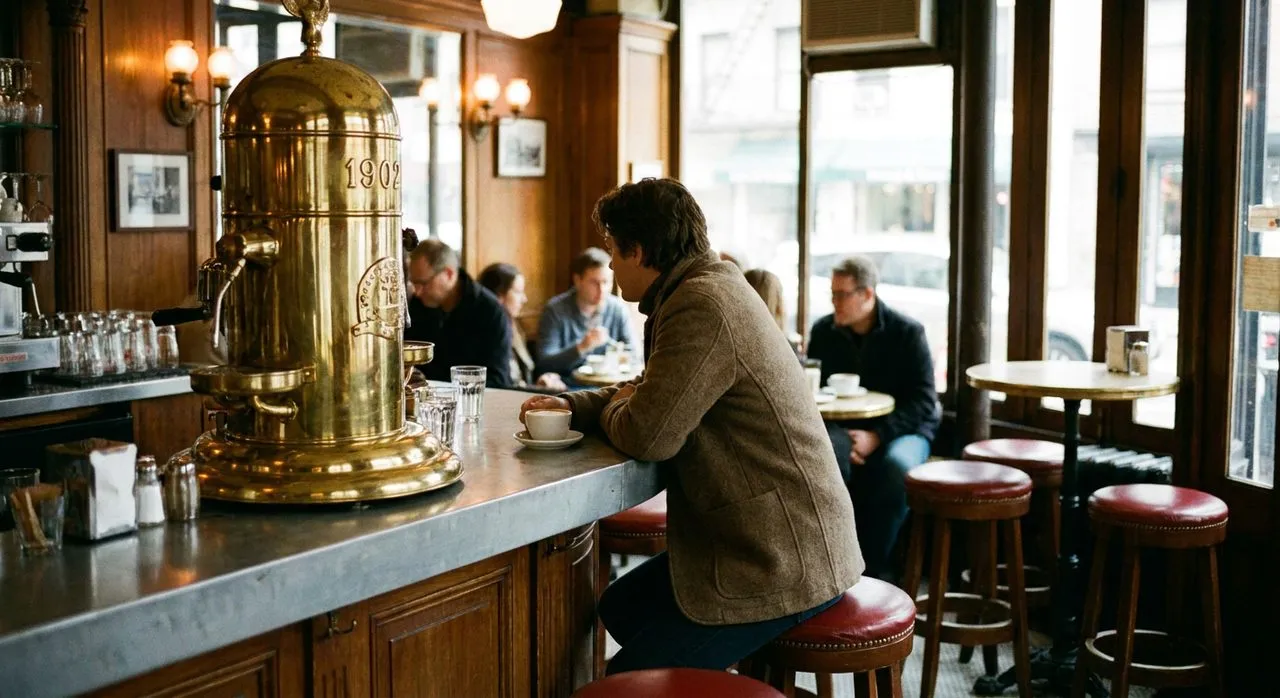
There's a corner stool at Caffè Reggio on MacDougal Street that has been there for decades, and if you time it right, it's yours. The seat faces a gleaming 1902 brass espresso machine—the first in America—and from this vantage point you can watch the bartender pull shots with the same lever-action choreography that introduced cappuccino to a country that didn't yet know what to make of it. The machine hisses and groans. Steam curls toward a darkened painting overhead. You're three feet from history, and the coffee is still excellent.
The machine that started it all
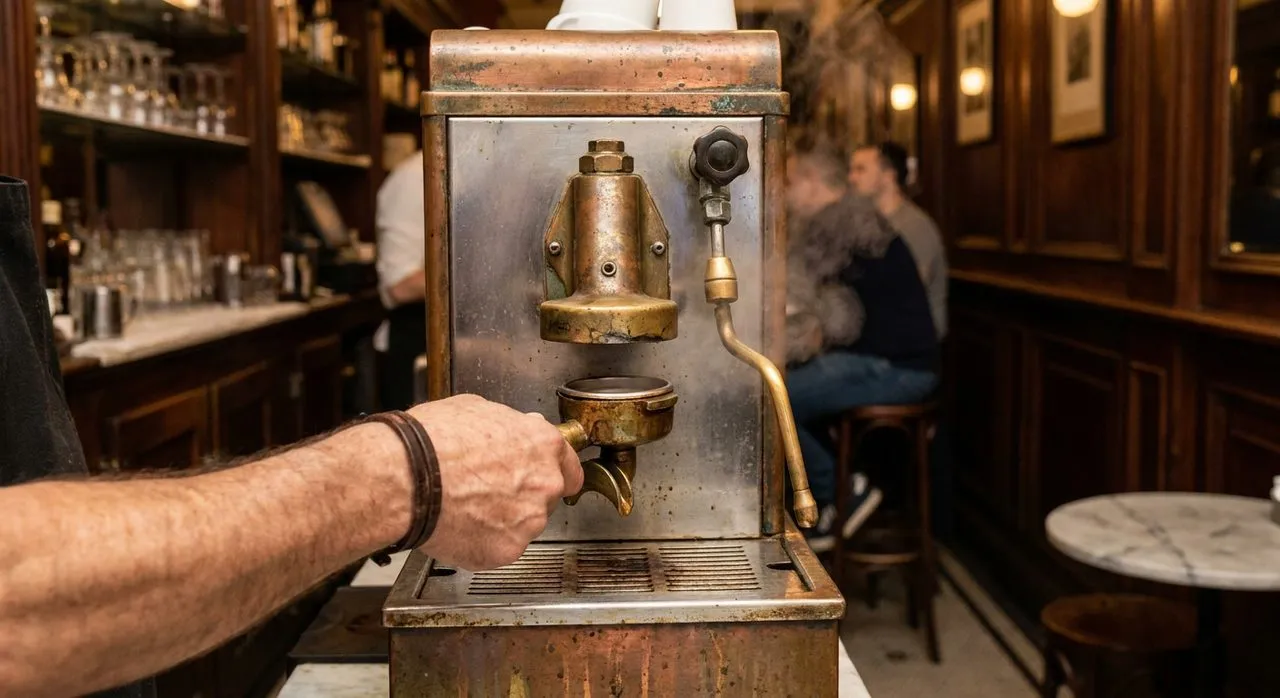
The espresso machine at Reggio is a 1902 model, all brass fittings and ornamental eagle, and it still works. Not as a museum piece or photo backdrop—it pulls every cappuccino and espresso ordered at the bar. The bartender works the lever with practiced economy, tamping grounds into the portafilter and locking it into place with a twist that's equal parts ritual and reflex. This is espresso counter culture in its purest form: no pour-over station, no oat-milk menu, just a machine older than your grandparents doing what it was built to do.
The corner stool gives you the best view. You're close enough to feel the heat radiating from the boiler, close enough to catch the scent of fresh grounds and burnt sugar. The machine's eagle crest gleams under amber bar lights, and if you sit there long enough, you start to understand why legacy cafes matter—not because they're old, but because they've refused to apologize for it.
Timing your visit
Most weekdays, the corner stool closest to the espresso machine sits empty between 2:30 and 4:00 in the afternoon. It's the sweet spot after the lunch rush has ebbed and before the evening crowd of NYU students and tourists fills the narrow space. Arrive during this window and you can claim the seat without hovering awkwardly, order at the bar, and settle in for an hour of uninterrupted people-watching.
The late-afternoon light slants through the front windows at this hour, gilding the espresso machine and throwing long shadows across the marble-top tables. It's quieter, too—the hiss of the steam wand and the low murmur of conversation replace the midday clatter. Regulars know this rhythm. They time their visits to avoid the rushes, lingering over a single espresso with the ease of people who've been doing this for decades.
The Caravaggio overhead
Above the bar hangs a large, darkened painting—a Caravaggio, or so the story goes. It's actually a 19th-century copy; the original resides in Malta. But Reggio's version has occupied the same spot since opening day in 1927, accumulating a century's worth of espresso steam and cigarette smoke (back when smoking indoors was still legal). The painting depicts a somber religious scene, all chiaroscuro drama and shadowed faces, and it lends the cramped cafe an unexpected gravitas.
From the corner stool, you can study the painting while you wait for your cappuccino. The varnish has darkened over the decades, but the composition remains arresting—a reminder that Domenico Parisi, who founded Reggio, brought more than an espresso machine from Italy. He brought an entire aesthetic, a conviction that coffee should be consumed in rooms that feel like small chapels of European refinement, even if they're wedged into a Greenwich Village basement.
What to order
Order the cappuccino. It's what the machine was designed for, and it's still the best thing on the menu—a short, strong shot topped with microfoam that hasn't been tortured into latte art. The espresso is dark and faintly bitter, the milk sweet and hot. It arrives in a heavy ceramic cup, no sleeve, no lid, no apology for the temperature.
If you want to drink like a regular, ask for a corretto. It's not on the menu, but the bartender will add a shot of Vecchia Romagna brandy to your espresso without missing a beat. Regulars order it year-round, winter and summer alike, and it transforms the coffee into something warmer and more medicinal—a drink that tastes like old Italy and feels like a secret handshake.
The regulars and the rhythm
By late 2026, Caffè Reggio has been pouring coffee for nearly a century, and the regulars treat it accordingly. They arrive between the rushes, claim their usual seats, and exchange nods with the bartender. Some bring newspapers. Others bring nothing at all, content to sit and watch the espresso machine work. There's no Wi-Fi, no outlets, no incentive to stay beyond the quality of the coffee and the pleasure of sitting in a room that hasn't changed in a hundred years.
The NYU students come in waves—mid-morning, lunchtime, late afternoon—filling the tables with laptops and textbooks before draining away again. The regulars wait them out. They know the rhythm, know when the corner stool will be free, know that the best time to visit Reggio is when it feels least like a destination and most like a habit.
Why it matters
Greenwich Village is thick with coffee shops now, each offering single-origin beans and oat milk and industrial-chic interiors. Caffè Reggio predates all of it. It's been on MacDougal Street since 1927, through the Depression and the Beats and the folk revival and every subsequent wave of neighborhood transformation. The espresso machine still works. The corner stool still faces it. The Caravaggio copy still hangs overhead, darkening imperceptibly with each passing year.
Sitting on that stool, you're not just drinking coffee—you're occupying a sliver of continuity in a city that rarely allows it. The machine hisses. The bartender pulls the lever. The cappuccino arrives in a heavy cup, exactly as it did a century ago. It's a small thing, and it's everything.
Practical notes
Caffè Reggio is on MacDougal Street in Greenwich Village. The nearest subway stops are West 4th Street (A/C/E/B/D/F/M lines) and Broadway-Lafayette (B/D/F/M/6 lines), both about a five-minute walk. Street parking is scarce; public garages are available on Bleecker and LaGuardia. The cafe is small, with limited seating and one step at the entrance; accessibility may be challenging for wheelchairs. Bring cash—credit cards are accepted, but the bartenders appreciate small bills. Hours vary seasonally; verify directly before visiting. Arrive weekday afternoons for the quietest experience and the best chance at the corner stool.
Tags: #CaffèReggio #GreenwichVillage #PullUpAChair #NYCCoffee #LegacyCafes #EspressoCounterCulture #MacDougalStreet #VillageCafe #NYUArea #EspressoMachine #CappuccinoHistory #NYCInstitutions #VintageNYC #CoffeeRituals #KarposFinds
Please drink responsibly. Must be of legal drinking age.
Sources consulted: Caffè Reggio · Espresso machine · Greenwich Village · Time Out New York: Cafés · The New York Times: New York
All trademarks are the property of their respective owners.