Most people ride the AirTrain to catch a flight. A small, stubborn minority ride it to catch the sunrise over a tidal marsh where aircraft and egrets share the same thermal currents. The AirTrain is fare-free within its airport loop only when using an eligible transfer; otherwise verify the current paid fare before stating a specific amount, but the destination here is weirder and infinitely quieter: a wooden boardwalk threading through phragmites and open water, where the only TSA checkpoint is a great blue heron standing motionless in the shallows. It is one of New York's loveliest pieces of liminal infrastructure—a transit line that deposits you, accidentally, into a national wildlife refuge.
The empty morning cars
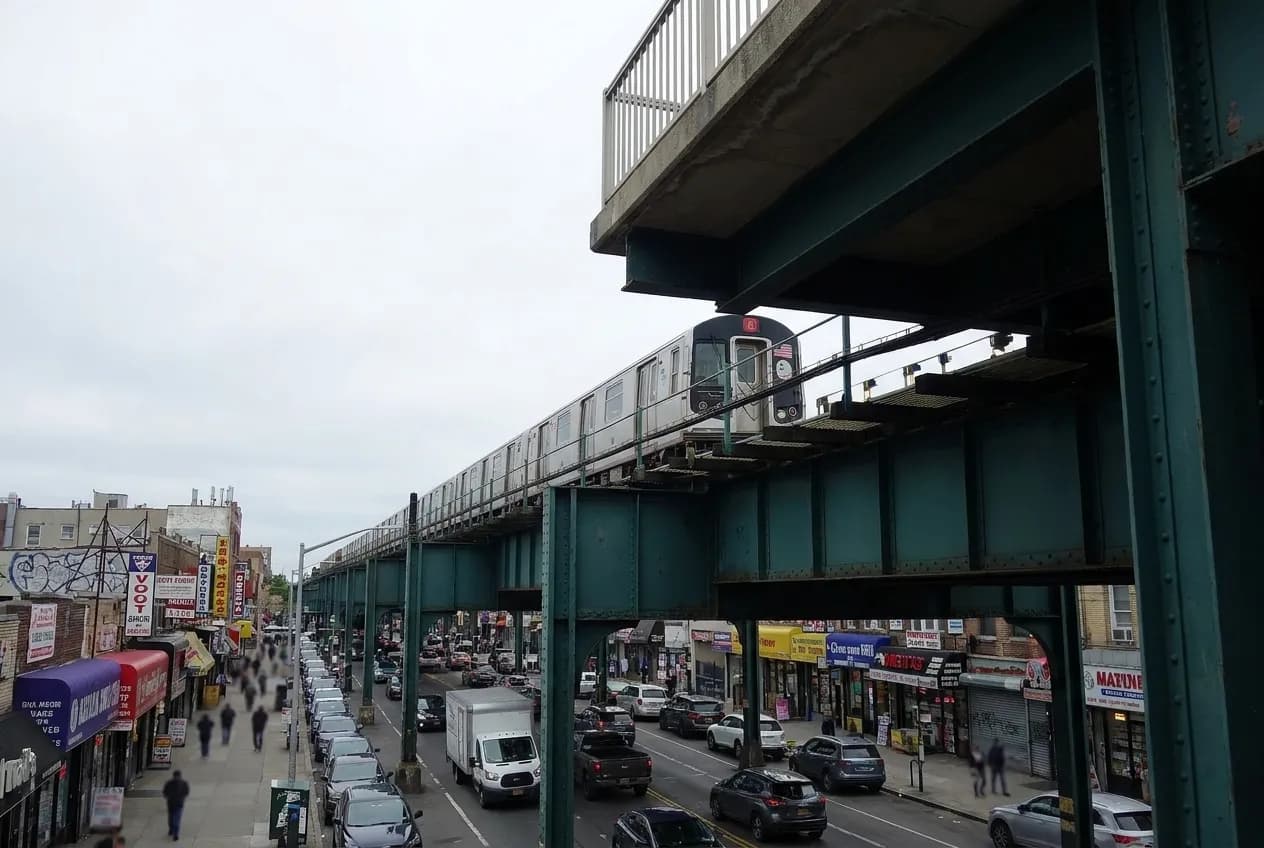
Timing matters. The 7–8am AirTrain window means empty cars and marsh fog still low over the refuge boardwalk, a combination that transforms the ride from airport shuttle to something closer to a slow-motion film sequence. You'll have your pick of seats. The train arcs north through the cargo zone, past American's maintenance hangars, then swings east along the perimeter road where runway lights blink in neat rows and nothing else moves. The automated announcements echo through empty cars, announcing terminals to no one. Through the windows, you can watch the transition from concrete to wetland happen in slow degrees—first the airport infrastructure, then fragments of green between buildings, then suddenly the full sweep of Jamaica Bay opening up to the south, pewter-colored in the early light.
By the time you reach Howard Beach—Rockaway Boulevard, the fog is beginning to lift but hasn't burned off. The platform is concrete and quiet. A handful of MTA workers wait for the A train. Nobody else gets off. You may get a curious glance from the token booth clerk as you exit toward the parkway instead of queuing for the subway—this is not the usual flow of traffic at this hour.
Finding the refuge
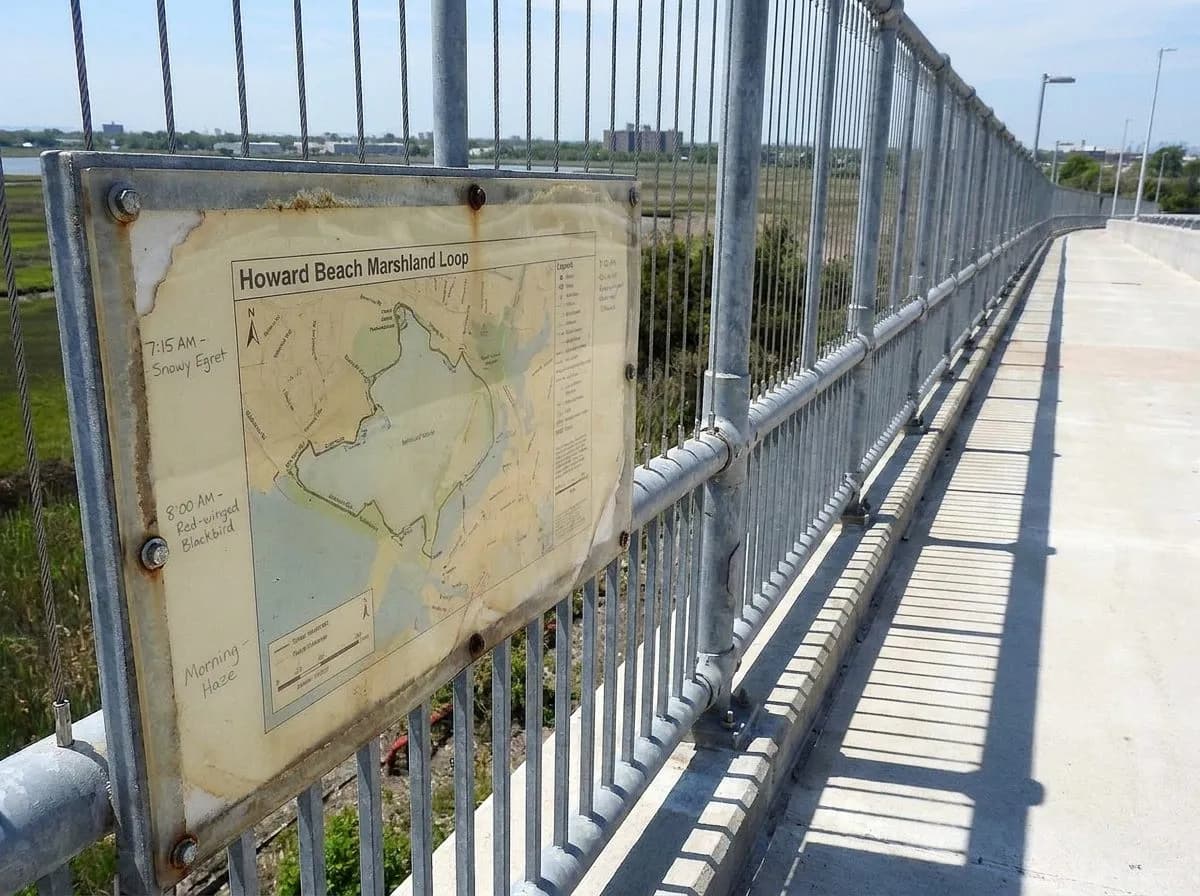
Exit Howard Beach station's north side, cross the Belt Parkway pedestrian bridge, and the refuge entrance is 0.4 miles west down Cross Bay Boulevard. The pedestrian bridge is windy and industrial, a graceless span over six lanes of morning commuter traffic, but it delivers you to the sidewalk beside salt marsh and open sky. Cross Bay runs straight and flat. To your left, the bay glitters behind a fringe of reeds. To your right, single-family homes with chain-link fences and boat trailers. The residential blocks here are quiet, working-class Queens, with fishing rods propped on porches and boats covered with blue tarps for winter. This stretch of sidewalk belongs to neither city nor nature entirely—it's a seam where both coexist without pretense.
The refuge entrance is unmarked except for a small wooden sign and a gravel parking lot. There's no visitor center here, no ticket booth. Just a trailhead and a map board showing the West Pond loop. You are still within the flight path. You are also, suddenly, alone with a lot of birds.
The boardwalk and the overlook
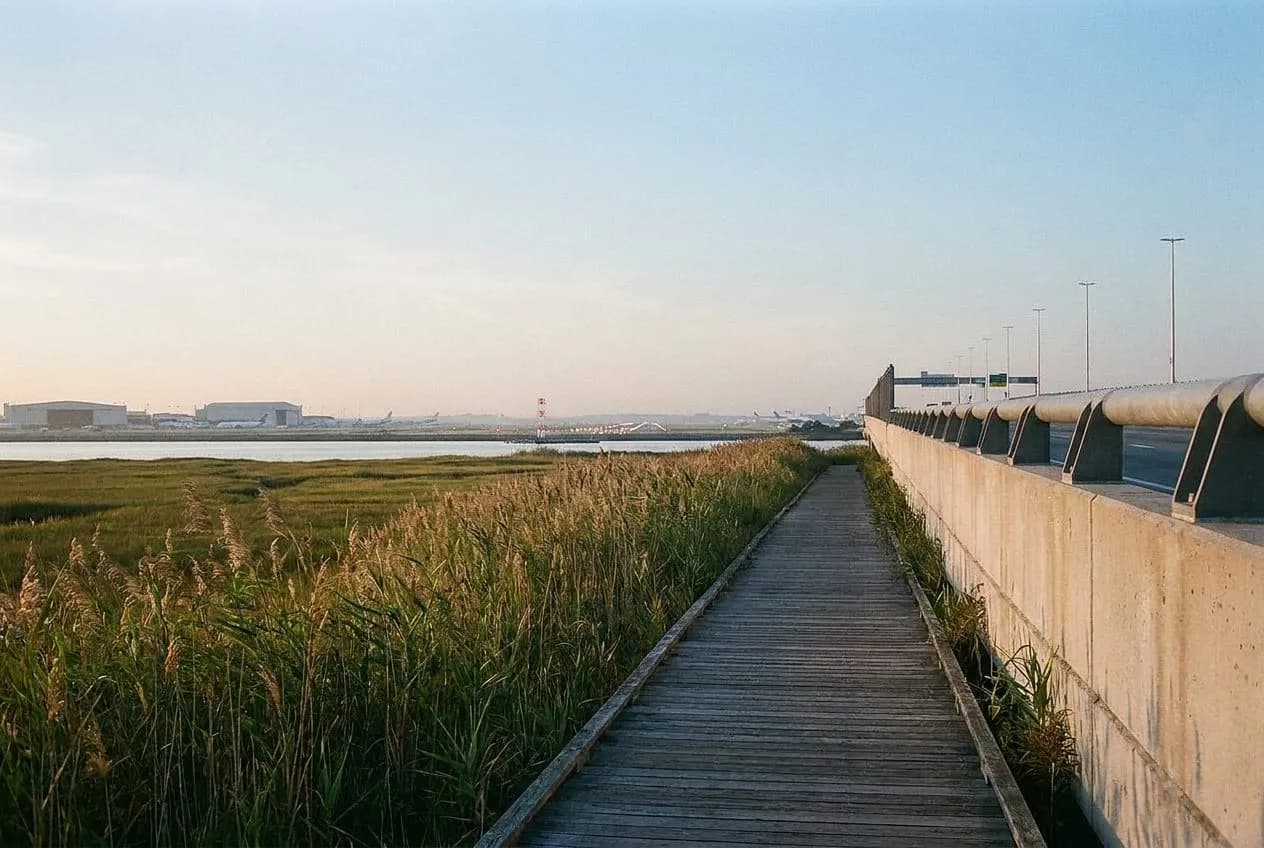
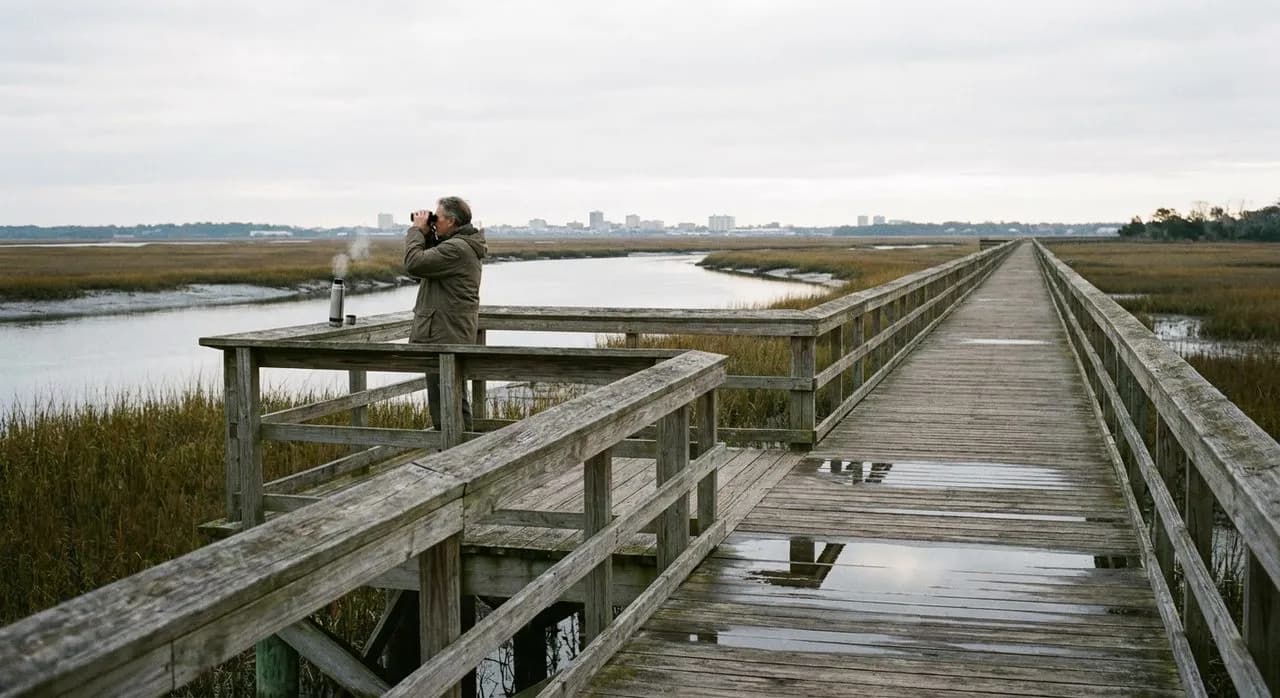
The trail is a wooden boardwalk, weathered gray, that skims above the wetland on low pilings. In winter the phragmites are blonde and brittle, chattering in the wind. The mud smells like salt and decomposition, clean and faintly sulfuric. You'll see snowy egrets, black-crowned night herons, and—if the tide is right—a northern harrier coursing low over the marsh grass. The A train runs to Howard Beach–Rockaway Boulevard, but do not specify a 12-minute interval without verifying the service schedule, and the sound folds into the landscape rather than breaking it.
At mile 0.9, the West Pond overlook bench faces the runway approach path where landing gear drops at eye level. Sit here long enough and you'll watch a 777 descend in near-silence, wheels unfolding like talons, close enough to see the brake dust on the tires. Then a heron lifts off from the pond edge, and for a moment both are airborne in the same frame, separated by a few hundred feet of altitude and several orders of magnitude in grace.
The bench is splintered and damp. Bring something to sit on. The view is worth the wet jeans.
What the marsh sounds like
Sound works differently here. The dominant note is wind—constant, shifting, moving through the reeds with a dry rustle that rises and falls in waves. Underneath that, the marsh itself: the lap of brackish water against pilings, the distant honk of Canada geese staging somewhere out of sight, the creak of the boardwalk under your feet. Then the punctuation: a jet on approach, engines spooling down to a whisper by the time it passes overhead, or the metallic clatter of the A train crossing the trestle, brief and percussive.
What's missing is human voices. On an early winter morning, you might walk the entire loop without hearing another person speak. The silence isn't total or pure—this is still Queens, still within city limits, still under a flight path—but it's conspicuous, rare, and strangely hypnotic. The soundscape is mechanical and organic in equal parts, a layered composition that shouldn't work but does. By the time you reach the north end of the pond, you've stopped noticing the planes entirely. They've become part of the marsh's rhythm, no more intrusive than the gulls.
The return loop
The full circuit is 1.8 miles, mostly flat, and takes about an hour if you don't stop to identify warblers. The northern section skirts the edge of the pond, where the water is brackish and still and reflects the sky in shades of pewter and pale blue. The boardwalk may need seasonal repair, but verify current condition and whether the National Park Service keeps it passable year-round The path curves gently back toward the trailhead, offering different vantage points on the same body of water: closer views of the mudflats at low tide, wider panoramas where the pond opens up toward the bay.
You'll emerge back at the trailhead slightly colder, slightly salted by wind, and oddly refreshed. The return walk to Howard Beach station reverses the route: Cross Bay Boulevard, the pedestrian bridge, the platform. The A train will take you back to the city proper, or you can ride the AirTrain loop again, this time as the fog lifts and the marsh turns golden under full morning light. Either way, you've completed one of the city's stranger and more beautiful commutes.
Why this works
The genius of this loop is its radical juxtaposition: urban marshland framed by runways and elevated trains, a place where nature and infrastructure don't so much coexist as braid together. It's not wilderness. It's not a park in the manicured sense. It's a working wetland inside the skeletal grid of Queens, and that in-betweenness is exactly the point.
You won't see another soul on the boardwalk before nine. You'll see a lot of herons. And if you time it right—early, cold, fog still clinging to the reeds—you'll have one of those rare New York mornings when the city feels like it belongs to you and the birds in equal measure.
Practical notes
Jamaica Bay Wildlife Refuge West Pond Trail, Cross Bay Boulevard, Queens. Nearest subway: A train to Howard Beach–Rockaway Boulevard, then 0.4-mile walk west. AirTrain from Jamaica Station also connects. Refuge trails open dawn to dusk; verify seasonal hours with the National Park Service. Boardwalk is flat and generally accessible, though some sections may be uneven. Bring binoculars, layered clothing, water, and something to sit on. No café or restrooms at the West Pond trailhead; facilities available at the main Refuge Visitor Contact Station on Cross Bay Boulevard, 1.5 miles south. Street parking available at trailhead lot. Winter 2026 conditions: muddy, windy, beautiful.
Tags: #TheLongWayHome #HowardBeach #JamaicaBayWildlifeRefuge #NYCMarshland #AirTrainNYC #QueensNature #UrbanBirding #JFKAirTrain #WinterWalksNYC #LiminalNYC #TidalFlats #HiddenNYC #NYCOutdoors #MarshlandWalks #RockawayBay
Sources consulted: Jamaica Bay Wildlife Refuge · National Park Service - Jamaica Bay · MTA AirTrain JFK · Howard Beach Station · Time Out New York
All trademarks are the property of their respective owners.