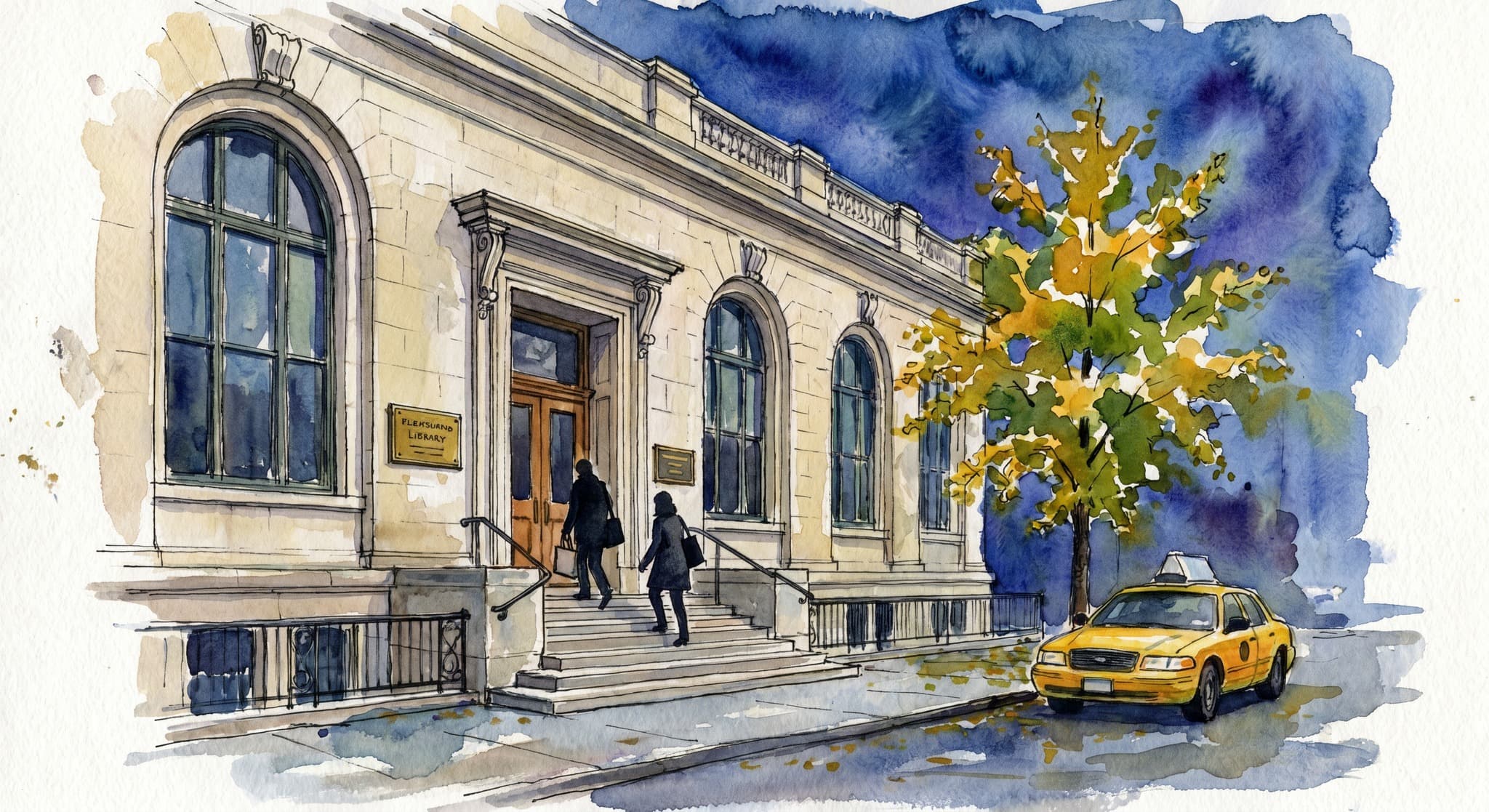
Twenty blocks north of Madison Square Garden, on the fourth floor of a Beaux-Arts limestone block on Central Park West, sits a reading room that has been quietly running on roughly the same furniture, the same light, and the same low conversational hum since the mid-twentieth century — and on the same institutional purpose since 1804. The New-York Historical Society's members' library is the city's oldest scholarly collection still in continuous use. On a Knicks home-game evening, when half of Manhattan is funneling toward 33rd and 7th, this is the room two miles north where you can read for three hours and not hear a single horn.
The Chair
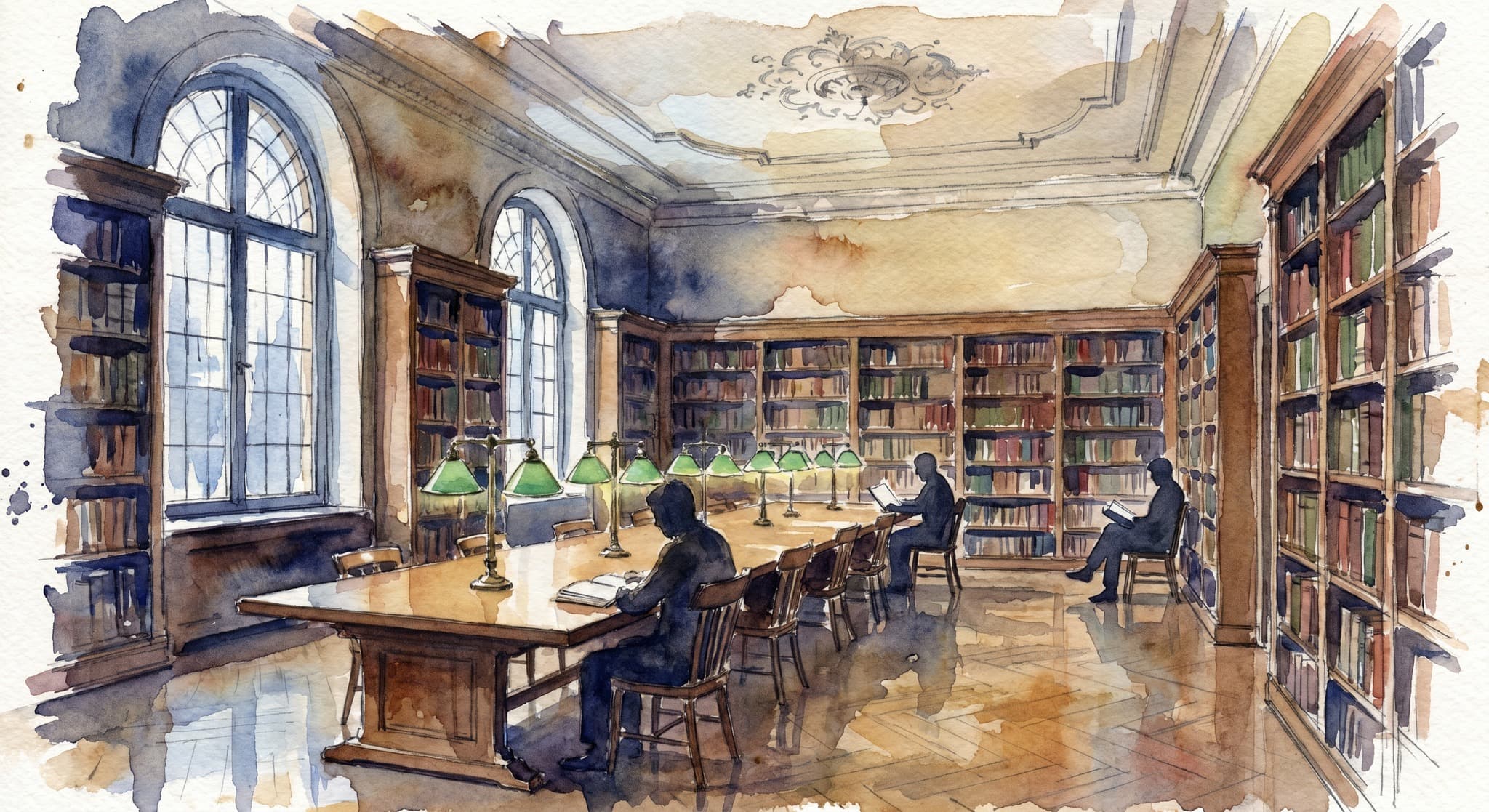
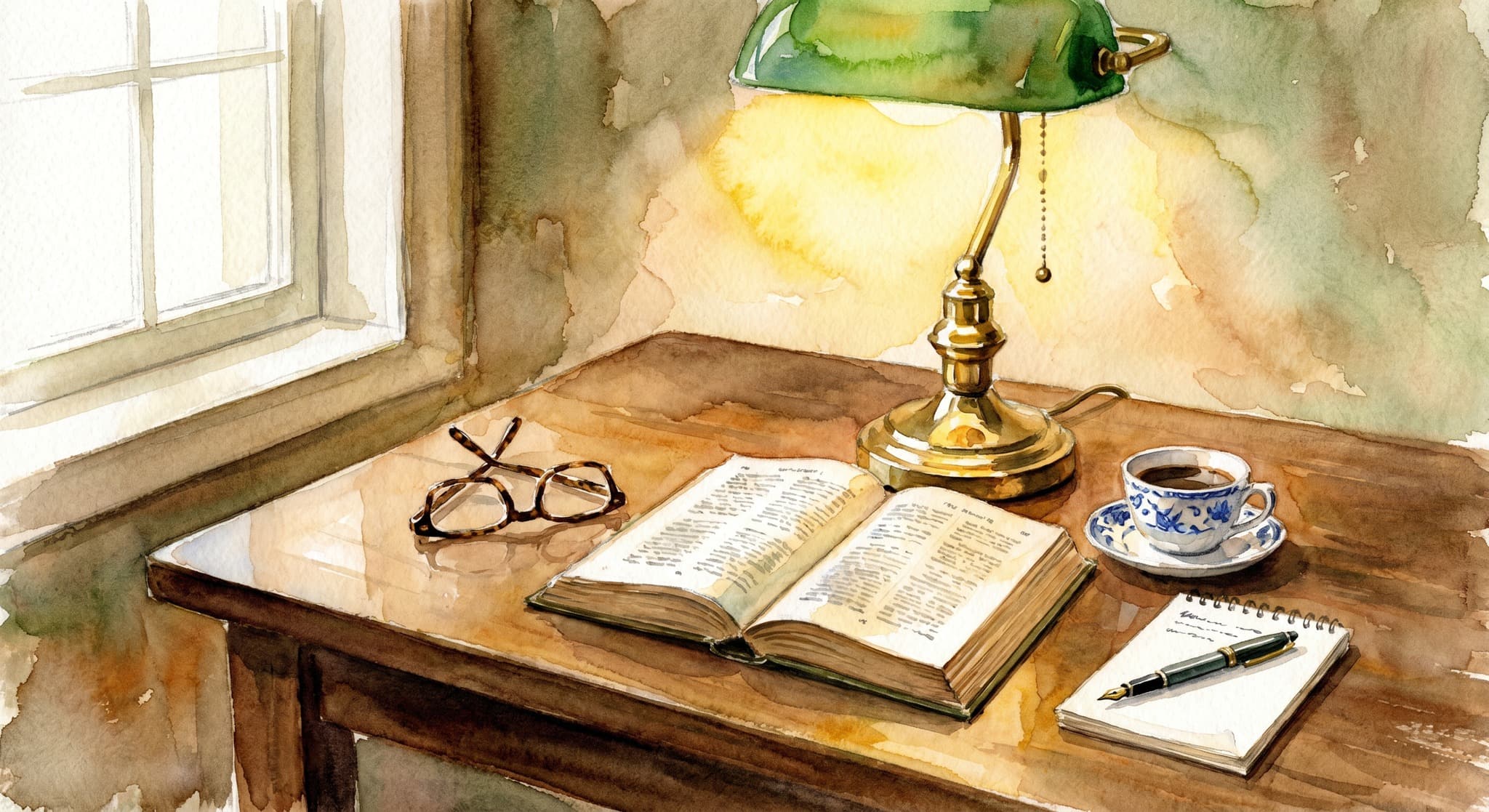
The chair to take is the second from the north end of the long oak refectory-style reading table that sits down the center of the fourth-floor Patricia D. Klingenstein Library. It is a solid-oak armchair with a slightly worn leather seat pad, original to the 1937 refurbishment. The back is tall enough to read against without slouching. The arms are wide enough to set a coffee and a folded jacket. The seat is the right height for the table, which matters more than people realize until they have sat in a reading-room chair where it isn't.
The reason this specific chair is the one to take: it sits directly under the third arched leaded-glass window from the north wall, which on a clear afternoon delivers an even, indirect, cool-temperature north light onto the open page for roughly the four-hour window between 1pm and 5pm. The green-shaded banker's lamp on the table covers the rest of the day. The combination — natural north light layered with a tungsten reading lamp — is the lighting condition most scholars and editors will tell you is the platonic ideal for sustained reading, and the Society's library has been delivering it, on this exact table, in this exact chair, for ninety years.
Who Gets In
The fourth-floor reading room is members-only on weekdays — a $145 annual individual membership unlocks the door — and open to non-member visitors with a reader's-card application on certain Friday afternoons. The application is one page and is approved on the spot if you say you are reading. The room is not gatekept by credential; it is gatekept by the fact that almost no one in this city remembers it exists.
This is the structural advantage. Two miles south, the New York Public Library's Rose Reading Room is the city's most famous quiet space, and on any given Saturday afternoon it has a 45-minute wait for a seat. The New-York Historical Society's fourth-floor library has six to eight people on a weekday afternoon. Same kind of light. Same kind of table. Same kind of silence. Less than half a percent of the Rose Room's foot traffic.
What You Read
You can read anything. The members' library will pull from its 350,000-volume collection — early American newspapers, the Audubon double-elephant folio of *The Birds of America*, the Robert L. Stuart manuscript collection — if you fill out a slip and wait twenty minutes. You can also read what you brought. The room is not enforcing what kind of book is allowed. A novel from McNally Jackson, a stack of *New Yorkers*, the report you have been avoiding at the office — all of it reads better at this table than at a coffee shop.
The thing to know is that the librarian will, if you ask softly, bring up one of the rare-book pulls just so you can sit with it for an hour. The 1804 founding-document folio is the unofficial reader's-introduction pull — five minutes of provenance from the librarian, a white-cotton-glove handoff, and then you and a 222-year-old book at your elbow for as long as you want it. Most members never ask. The librarians wish more people would.
The Hour
The room is open Tuesday through Sunday, 10am to 5:30pm, with the reading-room desk staffed by an actual research librarian (not a security volunteer) from 1pm onward. The hour to be in the chair is **2:00pm to 5:00pm on a weekday**, ideally a Wednesday or Thursday when the museum's general traffic is low and the school groups are not cycling through the lobby below. The light is best in that window. The librarian is at the desk. The room is six readers deep and not eight.
The off-hour, surprisingly, is **Knicks game night** — about 6pm on a home-game Tuesday or Friday. The museum closes at 6pm Tuesday and 8pm Friday, and the members' library closes with it, but the building's lobby and the front steps on Central Park West become, for thirty minutes after closing, one of the quietest pieces of sidewalk in Manhattan while the rest of the borough is on the subway heading south. If you have finished reading by 5:45 and you walk out at 6:00, you are doing the rarest thing in New York at that hour: leaving a place slowly.
What Else the Room Has
The room runs on a small etiquette built up over its century of continuous use. The coffee bar in the museum lobby on the first floor is fine for a takeaway cup — the lid is required, the librarian will gently mention it if you forget. The Wi-Fi works but is throttled; the room is not built for video calls and the librarian will mention it if you take one. The whisper-volume conversation is permitted but rare; most readers do not look up.
There is one quiet rule that took me three visits to learn: do not photograph the room with the flash on, and do not photograph readers from the front. The librarians will not stop you. They will remember you. The next time you ask to pull a rare book, the answer might take longer.
Why It Works as "Pull Up a Chair"
This column is about the single seat in a city where the room around it makes the seat better than the chair alone would. The reading room at the New-York Historical Society is that idea in its purest form. The chair is a 1937 oak armchair you could buy at an estate sale in New Jersey for $80. The room is a $200 million architectural-historical context that lifts that $80 chair into the second-most-comfortable place to read a book in Manhattan, behind only the Morgan Library's east room and ahead of every coffee shop, every co-working lounge, and every hotel lobby below 96th Street.
The reason it is second and not first is that the Morgan has J. Pierpont Morgan's ceiling. The reason it might actually be first, for the working reader, is that you can sit in this chair every weekday for a year on a $145 membership, and you cannot sit in the Morgan's east-room chair at all. This is a working library, and the chair is yours if you want it.
Practical notes
- Location: New-York Historical Society, 170 Central Park West at West 77th Street, Upper West Side, Manhattan. Patricia D. Klingenstein Library, 4th floor — take the lobby elevator and turn right at the landing.
- Hours: Library Tuesday–Sunday, 10am–5:30pm (Friday until 7:30pm during exhibition runs). Closed Mondays and major holidays.
- Cost: $145 individual membership unlocks weekday access. Non-member day-pass reader application accepted Fridays 1–4pm. Museum admission is separate ($24) but not required for library access.
- Getting there: B/C train to 81st Street–Museum of Natural History (two minutes walk south); 1 train to 79th Street (eight minutes walk east through Central Park).
- Best window: Weekday Wednesday or Thursday, 2pm–5pm — librarian on duty, light at its best on the long table, lowest visitor traffic.
- What to bring: Your own book if you want; a notebook; a takeaway coffee with a lid; reading glasses. Laptops are permitted but should be silenced.
- What to ask for: The 1804 founding-folio pull — five minutes of provenance from the librarian and an hour with a 222-year-old book.
- What to do after: Two-minute walk into Central Park for the cool-down at the Diana Ross Playground bench; ten-minute walk south to Sant Ambroeus on Madison for an espresso; or take the 1 train fifteen stops south to Madison Square Garden if you are turning the evening into a Knicks night anyway.
The point
A reading chair is, in the end, two things: the wood you sit in and the room you sit it inside. The Historical Society's fourth-floor library has both calibrated as carefully as any room in the city, with two centuries of institutional weight underneath and a north-window light overhead. Most New Yorkers spend their entire lives in this city without knowing the room exists. Two miles south on game night, twenty thousand people will be cheering at the Garden. Up here, the Audubon folio is on its shelf, the librarian is at her desk, the chair is empty, and the light is good until five.
#nychistoricalsociety #pullupachair #nyclibraries #uppereastside #uppwestside #readingroom #quietnyc #centralparkwest #manhattanreads #knicksnight #classicnyc #wheretoread #nycmuseums #bibliophile #scholarlibrary
Sources consulted: nyhistory.org · nymag.com · nytimes.com · eater.com · nba.com/knicks
All trademarks are the property of their respective owners.