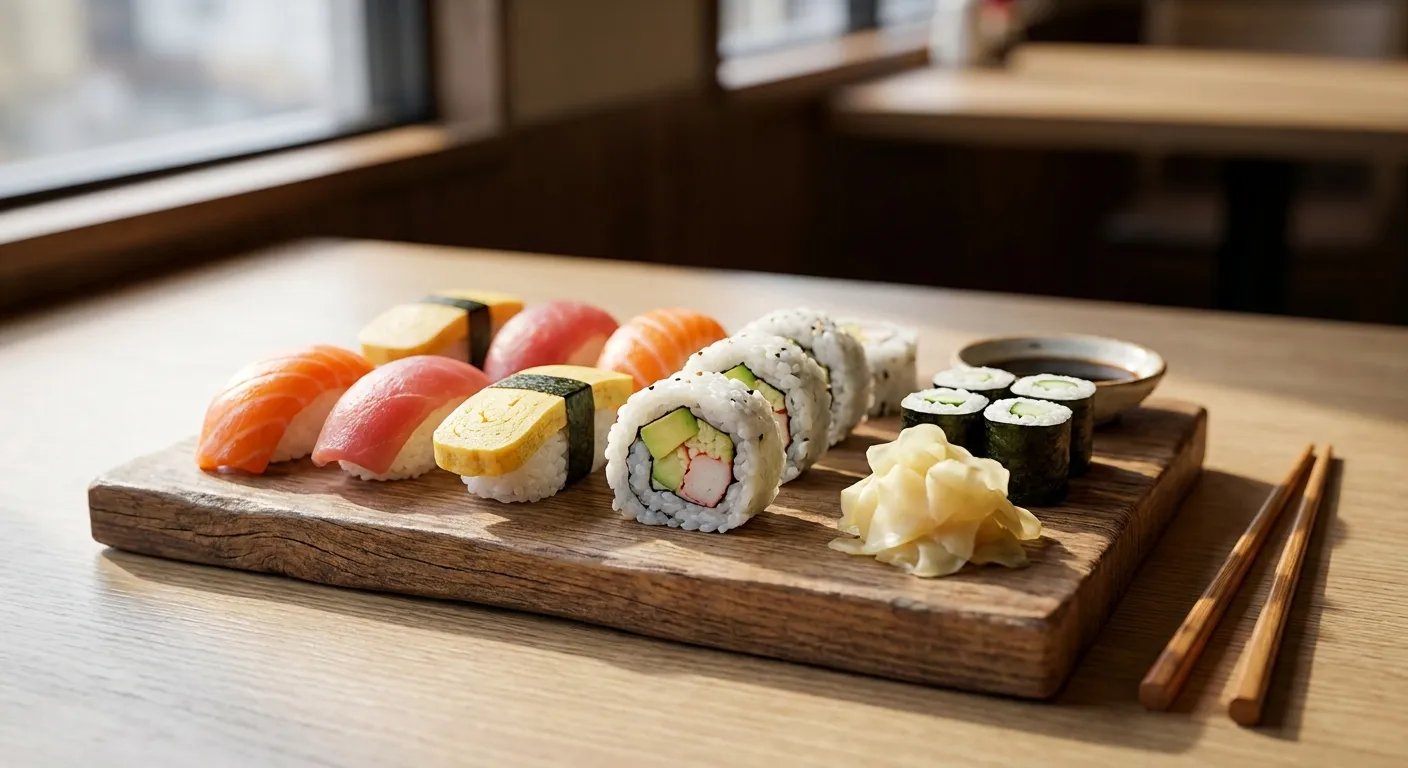
Every regular at every sushi counter in San Francisco was once a person staring at a menu full of unfamiliar words, quietly panicking, and ordering a California roll. There is no shame in this. Sushi has accumulated more gatekeeping than almost any other food, and most of it is noise. The fish doesn't care whether you know what engawa is.
This is the primer that skips the lecture. You'll learn the three words that unlock any sushi menu, the cooked and vegetarian orders that make a first visit easy, the two etiquette rules that actually matter, and the San Francisco rooms where nobody will blink while you figure it out.
Nigiri, Maki, Sashimi: Three Words That Unlock the Menu
Nigiri is a slice of fish draped over a pressed pillow of seasoned rice — the purest way to taste both. Maki is the roll: rice and fillings wrapped in nori seaweed and cut into rounds, the format most Americans meet first. Sashimi is just the fish, sliced clean, no rice at all — usually eaten with chopsticks, and better saved for when you already know you like a particular fish.
Two bonus words worth knowing. A handroll (temaki) is a maki that never got cut — a nori cone you eat immediately with your hands. And chirashi is a bowl of sushi rice with fish scattered over the top, which is quietly the best value format on most menus and requires zero chopstick dexterity.
Start Cooked: The On-Ramp Nobody Talks About
You do not have to start with raw fish. Some of the best things at a sushi bar never were raw: tamago, the sweet layered omelet, is the traditional test of a chef's fundamentals. Ebi (cooked shrimp) and unagi (grilled freshwater eel, glazed with sweet soy) are both fully cooked nigiri classics. Inari — sushi rice tucked into a sweet fried tofu pocket — is vegetarian, cheap, and beloved by actual Japanese grandmothers. Nobody serious considers these training wheels.
- First raw bite: salmon nigiri. It's rich, mild, and buttery — the gateway fish for a reason.
- Second raw bite: maguro (lean tuna). Clean and meaty, nothing fishy about it.
- Nervous? Order a cucumber or avocado roll alongside. It's a palate reset, not an admission of defeat.
- Ask the chef or server what's good today. This is the single most pro move a beginner can make.
Etiquette, Minus the Eye-Rolling
Only a few rules genuinely improve the food. Dip nigiri fish-side down, lightly — rice soaks up soy like a sponge and falls apart. Skip stirring wasabi into your soy dish at a good counter; the chef has usually already seasoned the nigiri. Pickled ginger is a palate cleanser between bites, not a topping. And yes, eating nigiri with your hands is traditional and completely correct — often easier than chopsticks.
That's it. Everything else — the ceremony, the ordering sequences, the debates about rice temperature — is enthusiast territory you can wander into later, or never. No one at a neighborhood counter is grading you.
Low-Pressure Rooms Where You Can Learn
Ebisu in the Sunset has been feeding this city for more than forty years, and that longevity shows in the confidence of the room: straightforward rolls and nigiri, quick service, and a staff that has walked thousands of first-timers through the menu. It's the platonic neighborhood sushi restaurant — good enough to trust, casual enough that nothing feels like a test.
Domo Sushi in Hayes Valley is the other easy entry point: a lively little room with bar seating only, where creative rolls run roughly twelve to twenty dollars and the baked rolls give raw-shy diners a warm, saucy place to start. The energy is closer to a favorite bar than a temple, which is exactly what a beginner wants.
Budget Reps and Special Cases
Repetition is how you build a palate, and Hokkaido Sashimi Marketplace on Geary in the Richmond makes reps cheap: part Japanese convenience store, part sushi counter, with rolls topping out around thirteen dollars and inari made to order. Grab a chirashi bowl and some onigiri and practice on your couch with zero audience.
Two special cases worth knowing. Shizen in the Mission is a vegan sushi bar and izakaya whose plant-based specialty rolls are inventive enough that omnivores fight for seats — the answer for vegetarian beginners tired of cucumber rolls. And Sasa in Japantown pairs a spacious, communal room with a chef's-choice "mystery box" option, a fun low-stakes way to let someone else decide what you eat.
When You're Ready to Level Up
Once salmon and tuna feel like old friends, graduate to a walk-in counter like Saru Sushi Bar in Noe Valley, an intimate spot where you can watch the chefs work and start ordering piece by piece. And when you're ready for the full experience, omakase — letting the chef choose everything — is secretly the most beginner-friendly format of all, because it deletes ordering anxiety entirely. Oma San Francisco Station, a small counter inside the Japantown mall, offers one of the city's more approachable entry points at around ninety-five dollars. Not cheap, but a fraction of the city's splurge counters, and an education in every course.
Sushi Beginner FAQs
Do I have to eat raw fish to enjoy sushi?
No. Tamago, cooked shrimp, grilled eel, inari, and vegetable rolls are all legitimate sushi, not consolation prizes. Plenty of people eat happily at sushi bars for years with only occasional raw bites — and Shizen in the Mission proves a whole menu can skip fish entirely.
Is it rude to eat sushi with my hands?
The opposite — nigiri and handrolls were designed as finger food, and eating them by hand is traditional in Japan. Chopsticks are for sashimi and shared plates. Use whichever keeps the rice intact; no one behind a counter in this city will care.
How much should a beginner expect to spend in SF?
A grab-and-go practice run at a market counter can stay under fifteen dollars, a satisfying sit-down dinner of rolls and a few nigiri usually lands in the thirty-to-fifty range, and approachable omakase starts around ninety-five dollars. Start cheap, calibrate your palate, then decide what's worth the splurge. Ask Karpo before you go, and it'll point you to whichever counter fits tonight's budget.