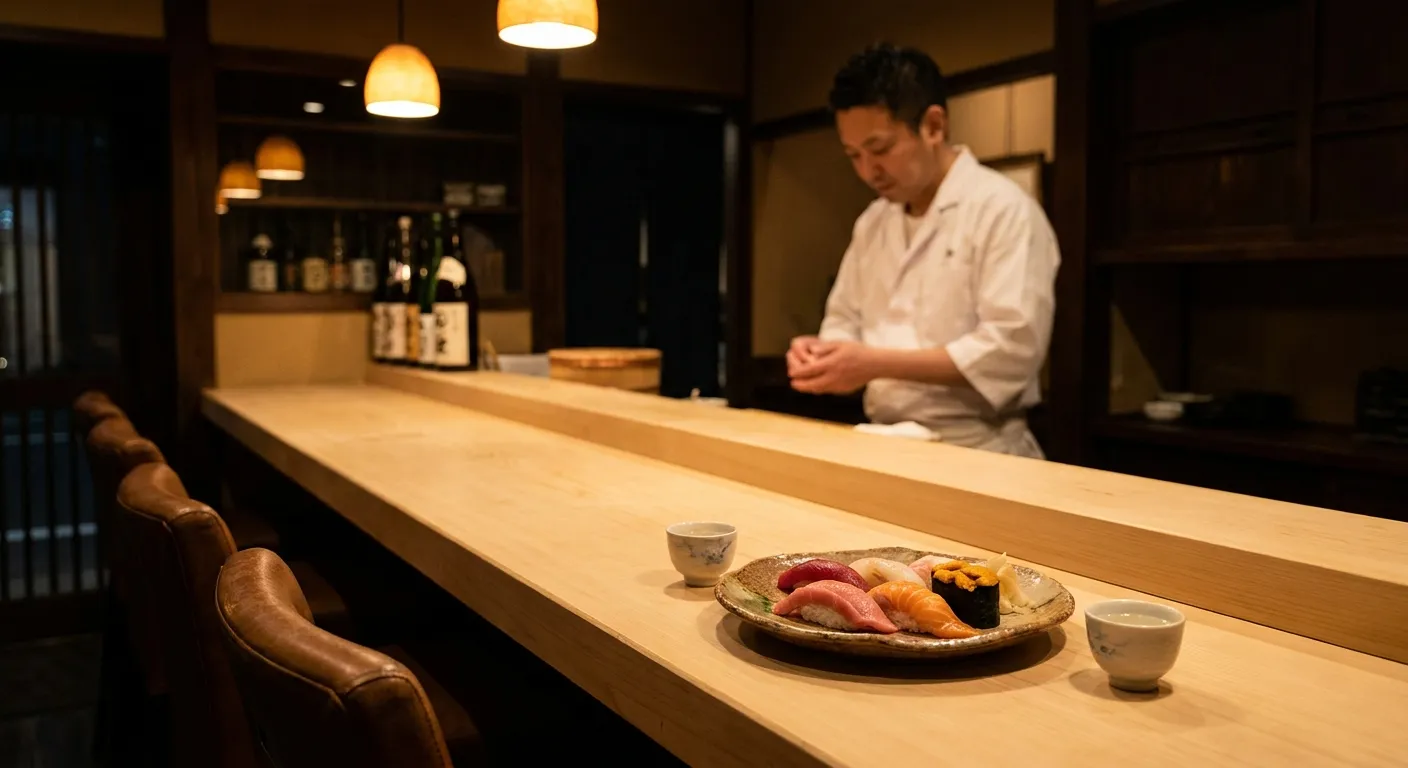
The sushi counter quietly solves every structural problem of a dinner date. You sit side by side instead of across an interrogation table. There's a built-in show, so a lull in conversation isn't a crisis, it's a chance to watch someone score a piece of fish with surgical calm. And the food arrives in a rhythm someone else controls, which means the night has pacing without either of you managing it.
San Francisco has counters at every altitude, from walk-in hand roll bars to seven-seat rooms that book out fast. The trick is matching the room to the stage of the relationship. Here's the ladder, bottom rung to top, plus the practical part nobody explains: how to actually land two seats.
Why the Counter Beats a Table
A table date is two people staring at each other for two hours. A counter date gives you a shared focal point, a chef working a meter away, and a running excuse to lean toward each other and compare notes on what you just ate. Course-by-course service also builds in natural chapters: the night escalates piece by piece instead of arriving all at once. It's theater where you're allowed to whisper.
First Dates: Saru Handroll Bar and Ebisu
For a first date you want low stakes and an easy exit that you hopefully won't use. Saru Handroll Bar on Polk Street is built for exactly this: a sleek, minimal room where temaki come across the counter one at a time, the nori still crisp, the rice still warm. It's first-come, first-served with no reservations, so there's zero pressure of a booked commitment — the date can be forty-five minutes or it can stretch all night over one more roll.
Ebisu in the Inner Sunset is the other opening move: a family-run institution that's been feeding the neighborhood for four decades, a block off Golden Gate Park, walk-in friendly from 5pm. The menu is enormous — sashimi, rolls, udon, a long appetizer list — which quietly de-risks dining with someone whose tastes you don't know yet. It's warm, unpretentious, and nobody is performing.
The Step-Up Date: Robin in Hayes Valley
When you're past the audition phase and want to show some range, Robin on Gough Street is the move. Chef Adam Tortosa has run this high-energy Hayes Valley room since 2017, sending out a contemporary omakase — think potato chips with caviar on nigiri, A5 wagyu under foie gras snow — with a playlist louder and a mood looser than the hushed temples of the genre. The sliding-scale pricing lands roughly between $110 and $220 per person depending on how deep you go, which lets you calibrate the flex. Book on Resy; it's a date that feels like an event without requiring reverence.
The Hushed Splurge: Ju-Ni and Ken
Ju-Ni in NoPa seats twelve around an L-shaped counter, four guests to a chef, which means your half of the counter gets an actual human relationship with the person feeding you. The omakase runs around fourteen courses of mostly nigiri and books through Tock at around $238 a head. It's intimate without being silent — the chefs talk, pour, and explain, and you get to enjoy it as a team of two.
Ken is the endgame: a tiny omakase counter of about seven seats, a multi-hour procession of roughly fifteen courses at around $225 per person, with the chef scoring butterfish and torching nigiri close enough to feel the heat. It's one of the tougher reservations in the city, which is precisely what makes it anniversary material — the booking itself is part of the gift.
The Full Production: Akikos
Akikos is the big-occasion counter downtown, a rebirth of a decades-old SF sushi name into a sleek room built around an open chef's stage. Chef-owner Ray Lee's dry-aged fish program, sourced locally and from Tokyo's Toyosu market, anchors a long tasting that runs around $270 at dinner. Here's the date-night hack hiding in plain sight: the omakase also runs at lunch for around $170, and a daytime omakase date — unhurried, sunlit, slightly conspiratorial while everyone else is at work — might be the most underrated romantic move in the city.
How to Actually Land Two Counter Seats
Counter real estate is scarce, but two is the magic number — pairs slot into counters far more easily than groups. A few rules of engagement:
- Book the drop. High-demand counters release dates on Tock or Resy weeks ahead; set a notification and grab seats the morning they open.
- Go weeknight. Tuesday and Wednesday counters have the same fish and half the fight.
- For walk-in rooms like Saru, arrive before the doors open. First seating is the calmest, and you'll watch the room fill behind you.
- Consider the lunch omakase. Same counter, same chef, gentler price, better light.
- Ask for the corner if the counter has one — angled seats let you actually face each other instead of sitting in parallel.
- Confirm cancellation terms before you book; most omakase reservations are prepaid and final.
Sushi Date Night FAQs
How much should I budget for a sushi date in SF?
The spread is wide. A hand roll date at a walk-in bar can stay reasonable, Robin's sliding scale runs roughly $110 to $220 per person, and the top omakase counters land around $225 to $270 a head before drinks, tax, and fees. Decide the tier before you sit down — sake escalates quickly and cheerfully.
Is an omakase counter too intense for a first date?
Usually, yes. A two-hour prepaid tasting is a lot of commitment for someone you met last week. Start at a walk-in counter like Saru or a casual room like Ebisu, where the night can flex with the chemistry, and save the omakase for when you already know you like sitting next to this person for three hours.
What's the etiquette at a sushi counter?
Arrive on time — omakase seatings run on a schedule. Eat nigiri soon after it lands, fingers are traditional and fine, and go easy on perfume or cologne in a small room built around subtle flavors. Beyond that, relax: the chefs want you to have fun, and a date that's clearly going well is the best audience they get all night. Ask Karpo to help you pick the counter, and it'll match the room to the mood.