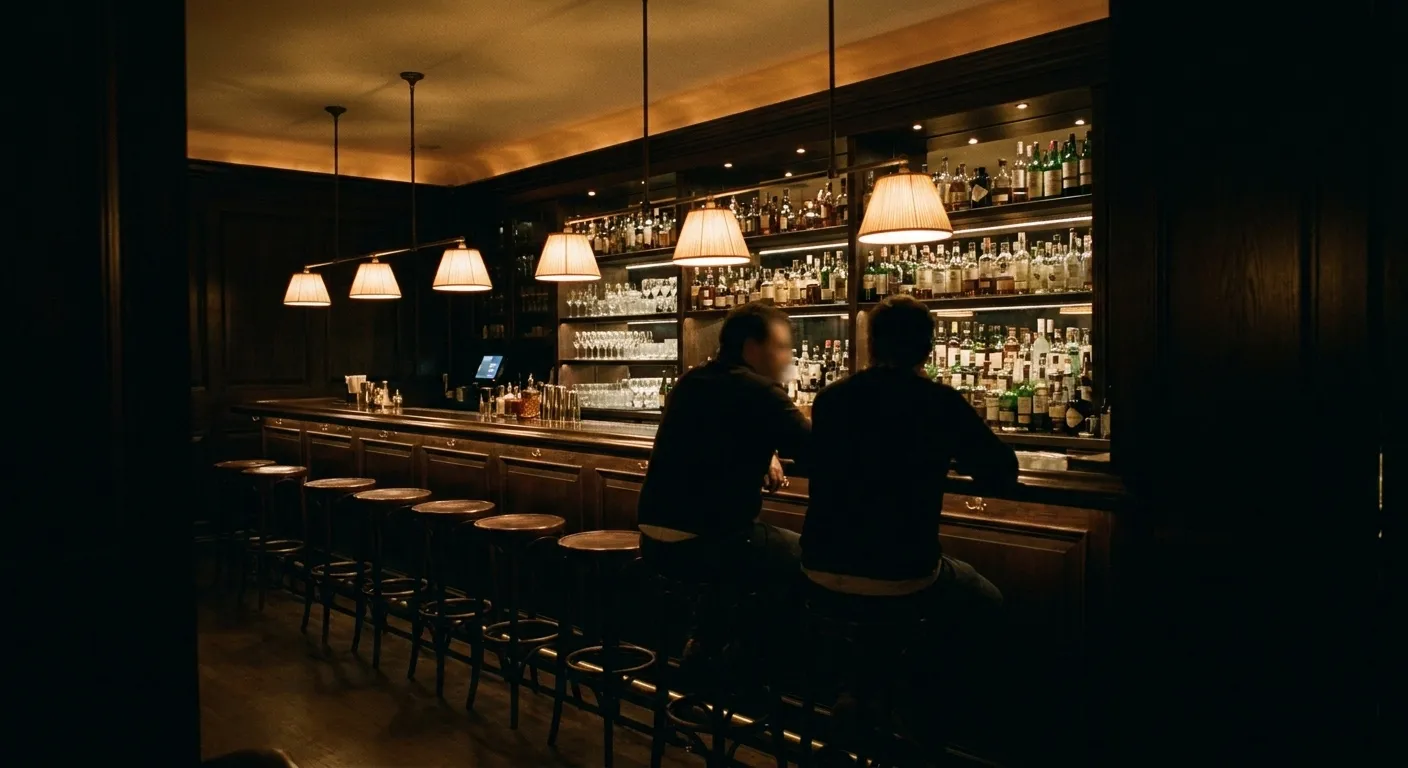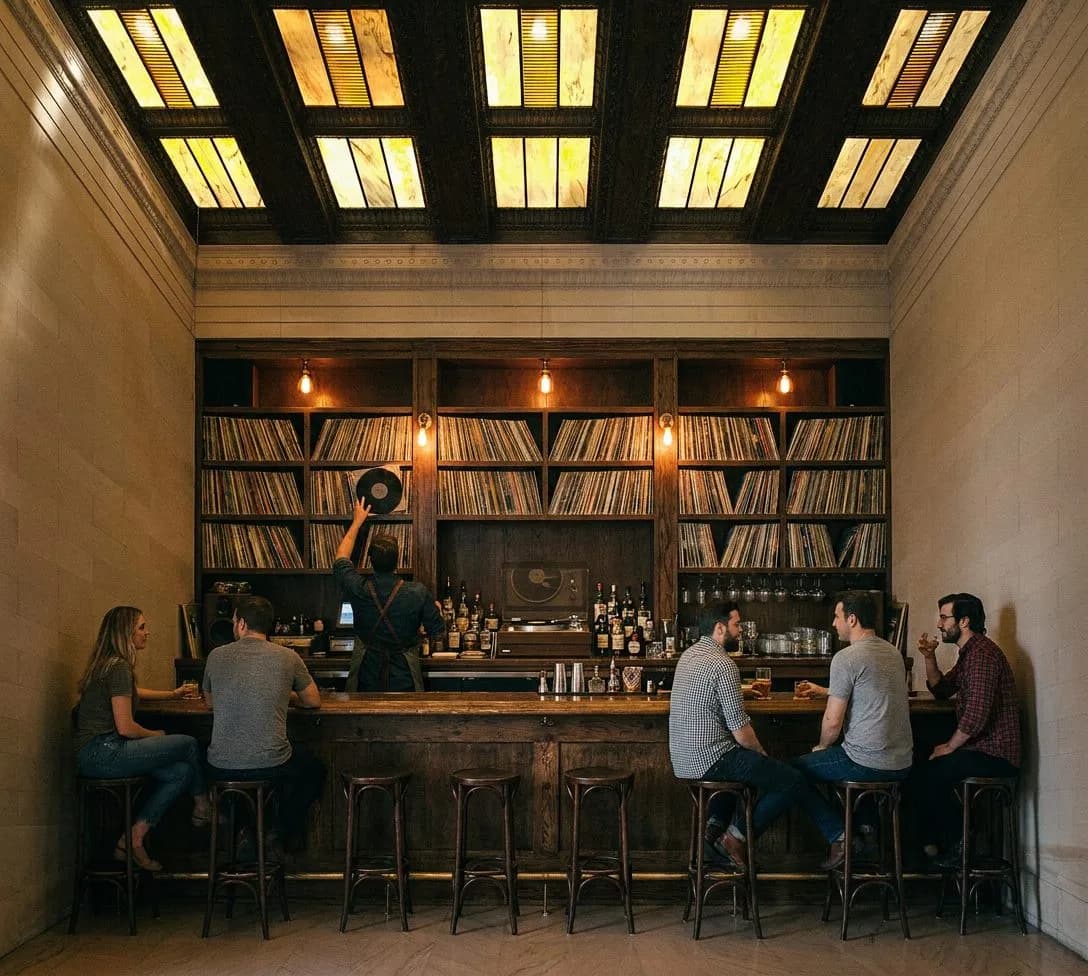
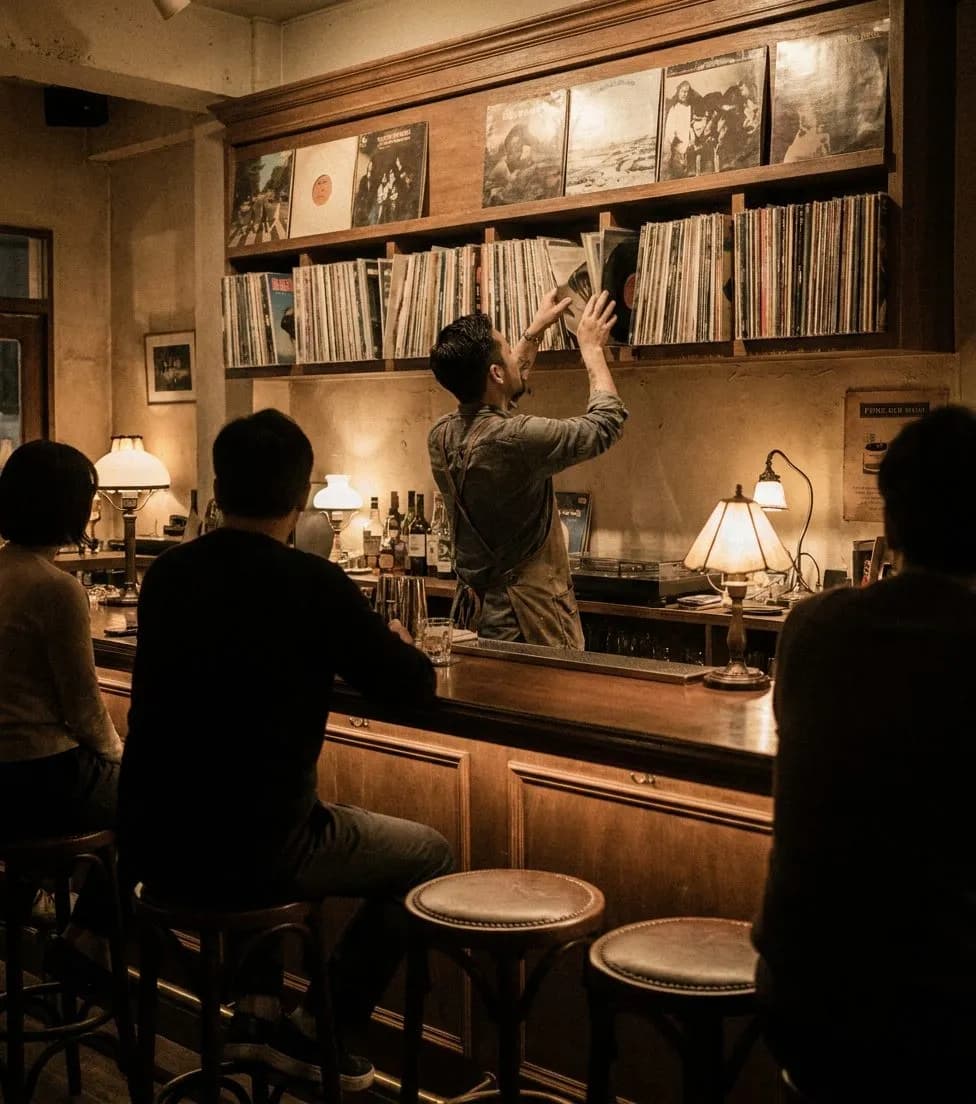
The bar stools at Slowly Shirley face a wall where vinyl records stand spine-out in shallow shelves, organized by genre but loosely so, the kind of filing system that suggests someone's apartment got promoted to commercial space. The room smells faintly of citrus oils and wood polish. Behind the bar, 750ml bottles with handwritten labels sit in the lowboy cooler—each one a morning's batch of Negroni, Martini, or Old Fashioned, ready to be poured without ceremony. The bartender moves between the turntable at one end and the glassware at the other, attending to both soundtrack and service with the same deliberate rhythm.
The geometry of vinyl and sound
Speakers anchor each end of the bar, which means the audio doesn't radiate from a single source—it converges. Stools two through four from the turntable end offer the best sound quality, a sweet spot slightly off-center where the stereo separation makes sense and you can hear both the cymbal shimmer and the bassline without one drowning the other. Regulars know. They'll wait for those seats on a busy night, nursing a drink at a table until the geometry opens up.
The records themselves do more than play. Stacked on open shelving that climbs nearly to the ceiling, they absorb some of the room's sharpness—fewer hard surfaces bouncing sound back, less of the tinny echo that plagues so many cocktail bars with exposed brick and concrete floors. The effect is subtle but measurable. Conversations stay intelligible even when the room fills.
Batched for the rush
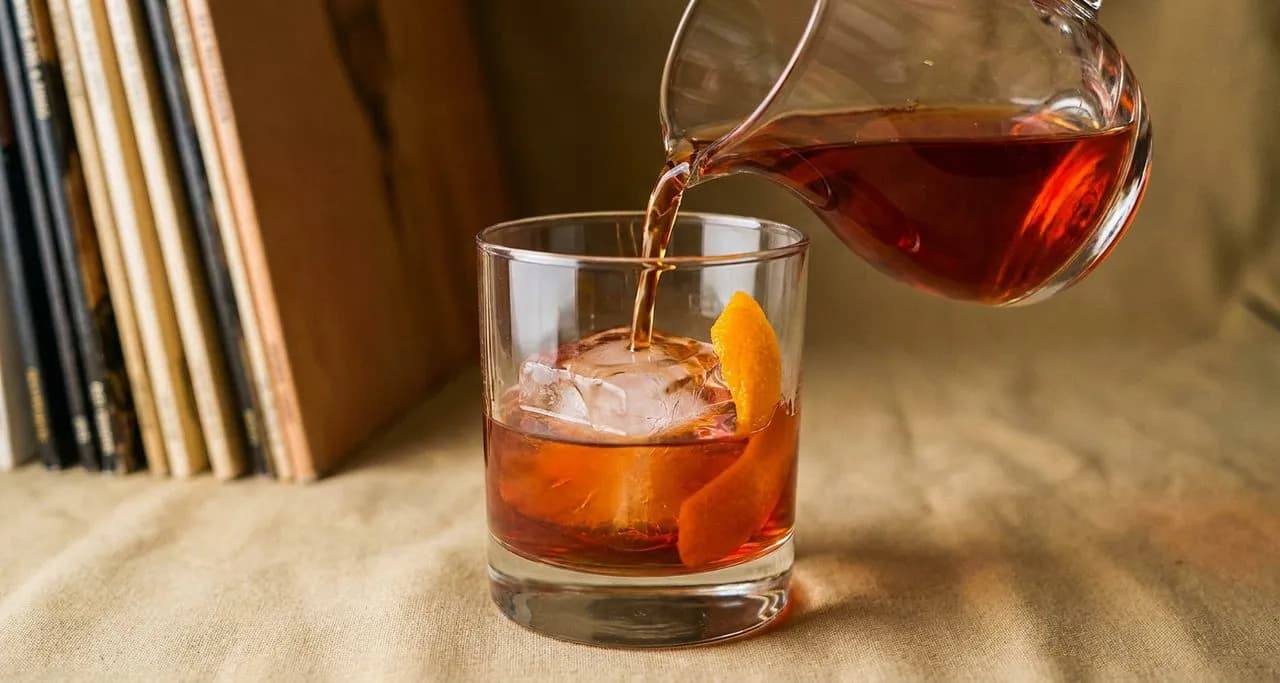
The Negroni here is batched each morning in those 750ml bottles, then stored refrigerated until service. When you order one, the bartender pulls a bottle from the cooler, pours directly over a single large cube, and hands it across without additional stirring. The drink arrives cold, diluted to spec by the prep work done hours earlier. Service is faster during the evening rush because there's no measuring, no building, no theatrical stir-and-strain.
It's a pragmatic choice that also happens to taste correct. The batch rests, the botanicals marry, and what you get is consistent from the first round at six to the last call past midnight. Some purists balk at pre-batched cocktails, but those purists aren't the ones working a packed Friday bar alone while also curating a four-hour soundtrack.
The bartender as selector
The bartender changes records approximately every thirty-five to forty minutes, timing the flips to natural lulls in conversation—the brief quiet that falls after a round is delivered, before the next wave of orders begins. It's not random. They read the room. Early evening might get a CTI jazz record or Brazilian tropicália. Past ten, when the crowd loosens, perhaps a Detroit techno twelve-inch or a Krautrock deep cut.
Regulars know not to request specific albums, though you can suggest genres and sometimes that suggestion lands. The unspoken protocol is to trust the selector. This isn't a jukebox bar. The turntable sits in plain view, a reminder that someone is thinking about what you're hearing, that the music is chosen rather than algorithmically generated. That care registers even if you don't consciously notice it.
The room's acoustic signature
Walk into Slowly Shirley on a quiet Tuesday and the space reads differently than it does on a weekend night. Without bodies to absorb sound, the room has more reverb—you hear the ceiling, the floor, the glass. Add thirty people and the records on the walls start doing their work, softening the reflections, shaping the acoustics in ways that typical decor doesn't. Vinyl is dense. A wall lined with a thousand LPs is a wall with texture, mass, and irregular surfaces that scatter sound rather than bounce it cleanly back.
It's an accidental design win. The shelves were likely installed because the owner ran out of storage space and because exposed collections signal a certain kind of cultural fluency in Bushwick. But the result is a room that sounds better the more records it holds, a feedback loop of accumulation and acoustic improvement.
Why the stools matter
Bar seating here isn't just real estate—it's the best vantage for watching the bartender move between turntable and taps, for reading the spines of records you half-remember from a college roommate's shelf, for catching the moment when the needle lifts and thirty seconds of silence prompt a dozen people to glance up before the next side drops. Tables are fine if you're with a group, but the stools put you in conversation with the room's logistics, its rhythms, the small choreography of pouring and cueing and timing that makes the night feel considered rather than haphazard.
Spring of 2026 finds Manhattan’s Lower East Side still negotiating its identity—part nightlife corridor, part polished destination. Slowly Shirley lands somewhere in the middle. It's casual enough that you can walk in without a plan, but attentive enough that regulars treat it as a kind of members' club without the membership. Any city guide to Brooklyn's eastward sprawl should account for bars like this, where the infrastructure is simple but the curation is specific.
The ritual of the record flip
There's a brief pocket of anticipation each time an album ends—the runout groove's repetitive click, the bartender stepping away mid-pour to lift the tonearm, the careful sleeve extraction and flip or replacement. Forty minutes is long enough that you forget the music is analog, then short enough that the flip never feels interruptive. You start to notice how the bartender uses the silence: to reset, to scan the room, to decide whether the mood wants more of the same or a left turn into something else entirely.
It's theater without performance, structure without rigidity. And it anchors the evening in something slower than the scroll, the swipe, the algorithmic shuffle. You stay longer than you planned, not because the drinks are groundbreaking—they're good but not precious—but because the room has a rhythm and you've synced to it without realizing.
Practical notes
Slowly Shirley is in Manhattan’s Lower East Side; verify the current address and hours directly. The closest subway access is via Manhattan subway lines; verify the nearest stop directly. The bar is ground-level with a small step at the entrance; reach out ahead if you need accessibility specifics. Seating is first-come; no reservations. Bring cash as a backup, though cards are accepted. Expect a quieter crowd Tuesday through Thursday if you want easier access to those prime stools near the turntable.
Tags: #PullUpAChair #SlowlyShirley #BushwickBars #VinylBar #BatchedCocktails #NegroniSeason #BarStools #BrooklynNightlife #RecordCollection #CocktailCulture #NYCBars #BushwickGuide #AnalogNights #Spring2026 #CityGuide
Please drink responsibly. Must be of legal drinking age.
Sources consulted: Negroni · Bushwick, Brooklyn · Visit Brooklyn · MTA Subway Guide · Cocktails
All trademarks are the property of their respective owners.