Ten years ago, ordering spicy fried chicken in New York meant knowing somebody who knew a place. Now there is a chain version on almost every commercial strip in the five boroughs, standardised, reliable, and calibrated for the widest possible audience. That is not a complaint exactly — the floor has risen. But the ceiling has not moved, and the places that hold it up are not the ones with the queue outside.
The versions worth crossing the city for keep short hours and sell out, which is exactly what a listings page will not tell you. Ask Karpo what is open and still frying near you tonight.
What the chains changed
The chain model optimised three things: consistency, speed and a heat ladder that tops out somewhere most customers can handle. All three are achievements. The cost is that the product converged. A spicy chicken sandwich from any of the major operators is recognisably the same object — similar brine, similar crust thickness, similar sweet-hot sauce, similar pickle.
The result is that the word 'spicy' in New York now mostly signals a flavour profile rather than a level of heat. If you want chicken that is actually hot, or that is hot in a way that is not cayenne-and-sugar, you have to go looking somewhere else.
The Southern and soul food kitchens
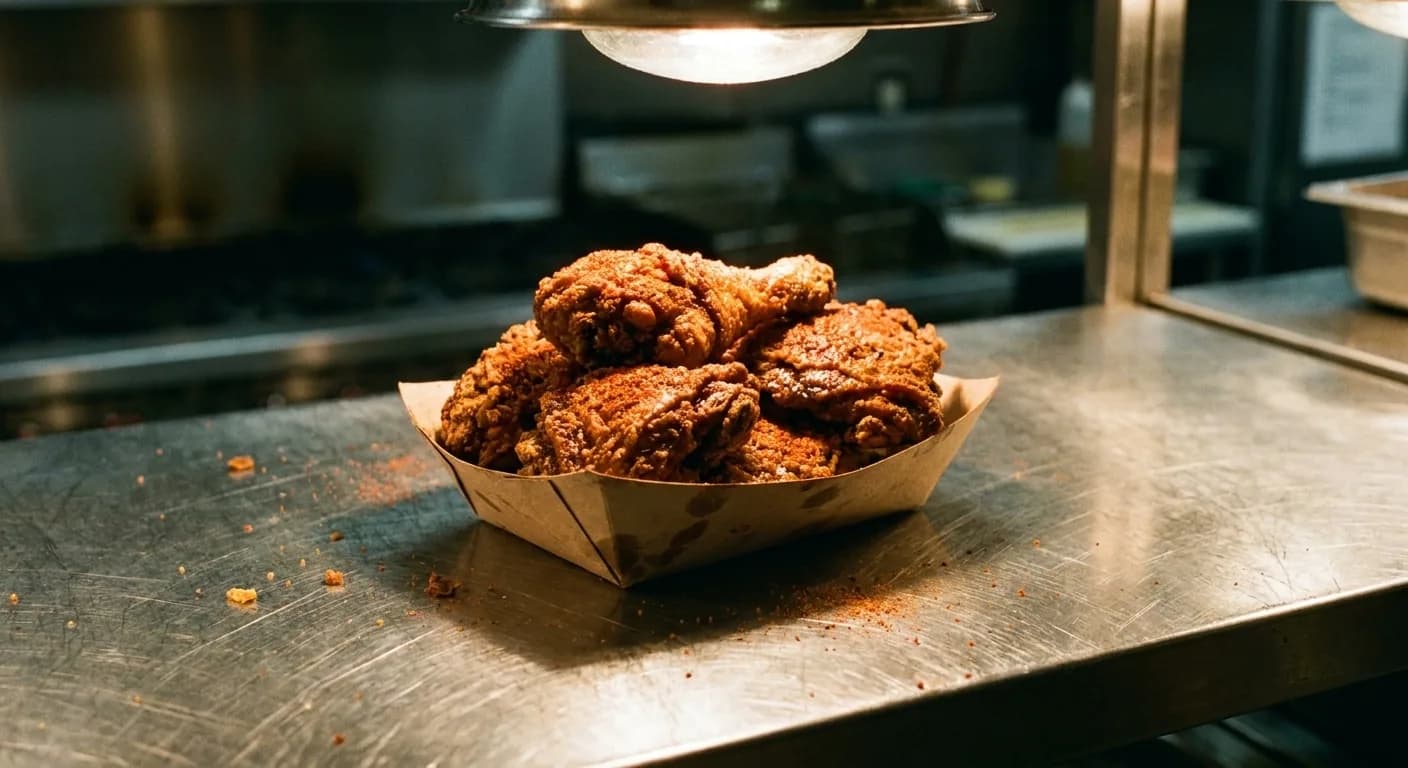
The oldest continuous tradition of fried chicken in this city is in Harlem, Bed-Stuy, Crown Heights and Jamaica, in kitchens that predate the trend by decades. The heat in these places comes from a house seasoning worked into the flour rather than a paste applied after, which produces a completely different result: heat distributed through the crust instead of sitting on top of it, and a flavour that is peppery and savoury rather than sweet.
These are also, as a category, the places most likely to keep short hours, sell out, and close on days that seem arbitrary from the outside. That is the trade. A chain will be open at nine on a Tuesday. A kitchen that has been frying the same recipe since the nineteen-seventies may not be, and checking before you travel is not optional.
Korean fried chicken, and where it actually lives
New York's Korean fried chicken is world-class and it is not primarily in Manhattan's Koreatown, which is the assumption most guides make. The depth is in Queens — Flushing and Murray Hill above all — where the restaurants serve a local Korean community rather than a tourist one, and where the menus are longer and the frying more varied.
The technique is the double fry: a thin, brittle, almost glassy crust that stays crisp under sauce, which is the entire point. Heat comes from a gochujang-based glaze applied after cooking, so it reads sweeter and rounder than a dry-spiced Southern bird. It is also the most sociable version of fried chicken in the city — designed to be shared over a long table with beer, not eaten standing up.
The halal and South Asian layer
The least documented spicy fried chicken in New York runs through the halal carts and the Bangladeshi, Pakistani and Afghan restaurants of Jackson Heights, Kensington, Parkchester and the Bronx. The seasoning here is a different vocabulary entirely — chilli with cumin, coriander, turmeric and black pepper — and the heat arrives with aromatics rather than on its own.
There is also a genuine pipeline in this city from cart to storefront: a successful cart opens a small restaurant, the restaurant opens a second location, and the recipe stays intact. Some of the best spicy fried chicken in New York is currently sold from operations that did not exist as sit-down restaurants three years ago, which is precisely why they are absent from most published guides.
How to choose on a given night
Decide which of the four traditions you want before you decide where to go, because they are not substitutes for one another. Sweet and shareable points to Queens. Peppery, savoury and traditional points to Harlem or central Brooklyn. Aromatic and complex points to Jackson Heights or the Bronx. Fast, consistent and near you points to the chain, and there is no shame in that on a Wednesday.
The one thing that applies across all of them: fried chicken has a half-life measured in minutes. In a city where a delivery order can spend forty minutes in a bag, the difference between eating it at the counter and eating it at home is larger than the difference between most of these restaurants. If the choice is between the fourth-best version eaten at the counter and the best version eaten forty minutes later out of a paper bag on the subway, take the counter every time.
Practical notes
Korean fried chicken depth in New York is in Queens — Flushing and Murray Hill — more than in Manhattan's Koreatown. Southern and soul food kitchens in Harlem, Bed-Stuy, Crown Heights and Jamaica season the flour rather than saucing after frying, and frequently keep short hours or sell out. Call before travelling. Fried chicken degrades within minutes; eat it where it was cooked.
Tags: #FriedChicken #NYC #SpicyFood #Restaurants #Queens #Harlem #KoreanFriedChicken #Flushing #JacksonHeights #NYCEats #WhereToEat #Brooklyn #FoodGuide
All trademarks are the property of their respective owners.
Ask Karpo first
The best versions keep irregular hours and sell out, and no listings page tracks that. Ask Karpo which fried chicken near you is open tonight and which tradition it belongs to.