 Fast Food Near Me in the East Village: Crif Dogs Deep-Fries Its Franks
Free Things to Do
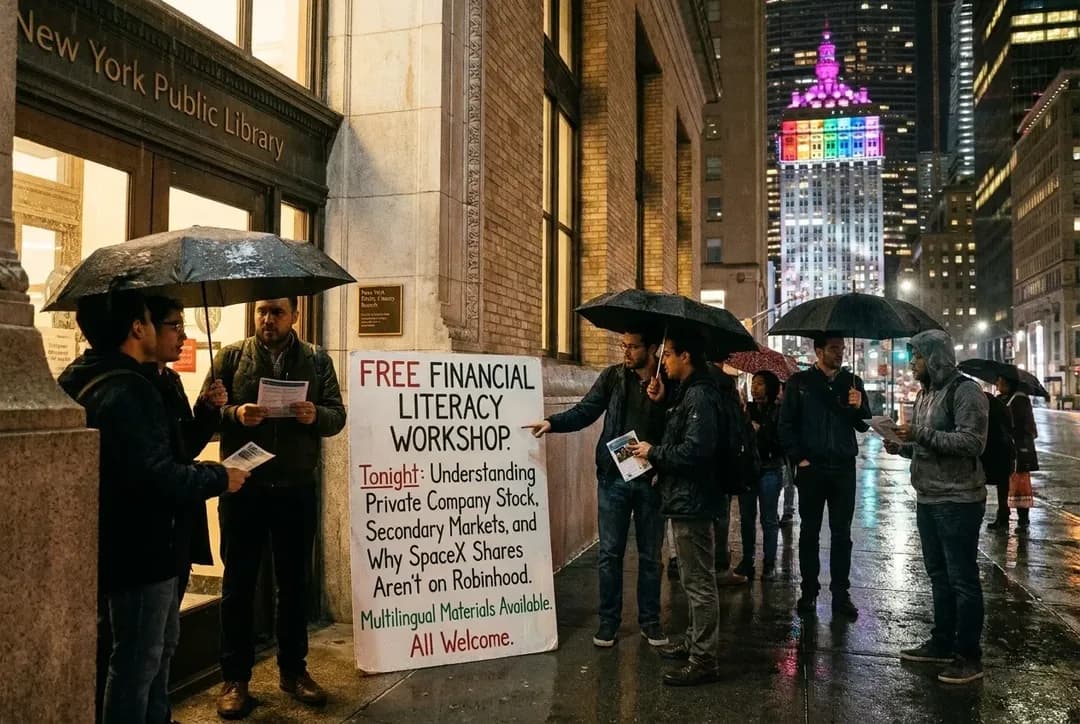
SpaceX Stock Curiosity: Free NYC Library Investment Literacy Workshops for Beginners
Public library workshops demystify private-company equity, secondary markets, and why you can't buy SpaceX stock on retail apps. Weekend and evening sessions welcome curious beginners navigating finance terminology solo or with friends.
The fascination with SpaceX stock has sent thousands of New Yorkers to search engines, only to discover that Elon Musk's aerospace venture isn't listed on any public exchange—no ticker on Robinhood, no option on Fidelity, no simple "buy" button. For curious investors and students intimidated by finance jargon, New York City's public library system offers a grounded alternative: free financial-literacy workshops that unpack private-company shares, secondary markets, and the mechanics behind closed equity. These sessions cater to beginners exploring investing solo or with a friend, typically scheduled on weekends and evenings to accommodate work schedules, and require nothing more than a library-calendar check and, in some cases, advance registration. Rather than promising instant wealth or access to exclusive deals, the workshops focus on literacy—teaching participants how to distinguish between public and private markets, evaluate risk in speculative assets, and recognize when a headline-grabbing company remains out of reach for retail buyers.
Text Karpo your borough, your current investment experience level, preferred language, and whether you want beginner or intermediate sessions—we'll send a schedule of free workshops in the next two weeks, explain what SpaceX stock access actually requires, and list one online SEC tutorial as a backup.
Why SpaceX Shares Stay Off Retail Platforms
SpaceX operates as a private corporation, meaning its equity is not traded on the New York Stock Exchange or Nasdaq. Ownership remains concentrated among venture-capital firms, institutional investors, employee stock-option holders, and a small circle of accredited individuals who meet Securities and Exchange Commission wealth or income thresholds. Retail brokerage apps like Robinhood and Webull list only publicly traded securities—stocks that have completed an initial public offering and filed continuous disclosure reports with regulators. Without that IPO, SpaceX shares circulate exclusively in private secondary markets, where minimum investment sizes often start at tens of thousands of dollars and transactions require broker-dealer intermediaries who vet buyer qualifications.
Library workshops walk through this structural divide step by step, using real-world examples to illustrate why a company valued in the hundreds of billions can still be invisible to everyday investors. Instructors explain accredited-investor rules, the role of venture exchanges like Forge Global or EquityZen, and the liquidity constraints that make private shares harder to sell than public stock. Participants learn to spot misleading online ads promising "easy SpaceX access" and understand the legal frameworks that keep certain assets gated. For someone intimidated by acronyms like SEC, IPO, or LP, these sessions translate regulatory language into plain English, building confidence to ask follow-up questions without embarrassment.
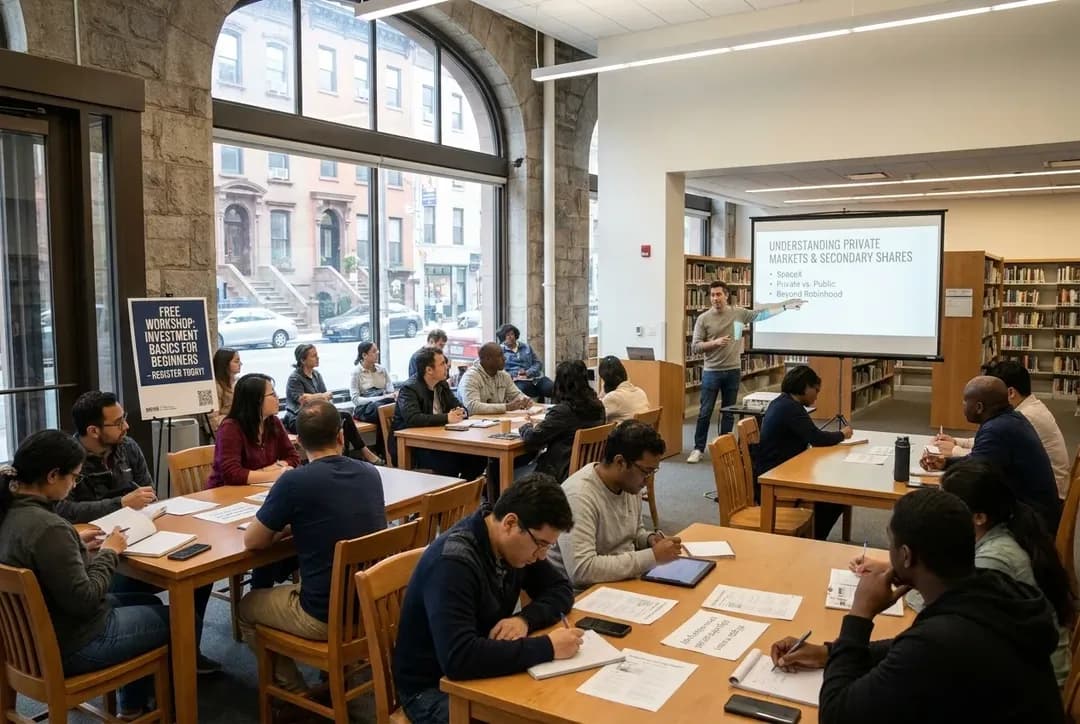
Finding Workshop Schedules Across Borough Library Systems
New York City's three major library systems—New York Public Library (Manhattan, the Bronx, Staten Island), Brooklyn Public Library, and Queens Public Library—each maintain online event calendars listing financial-literacy programming. Workshop titles vary: some are labeled "Investing 101," others "Understanding the Stock Market," and a few explicitly mention private equity or startup finance. Because each system operates independently, a searcher must check all three calendars to capture the full roster of offerings. Registration requirements differ by branch and session size; popular evening slots in Midtown or Downtown Brooklyn may fill quickly and require an RSVP through the library's event portal, while smaller neighborhood branches sometimes accept walk-ins if seats remain.
Verification steps matter. Confirm the workshop date, start time, and whether the session is in-person, hybrid, or virtual via Zoom. Note any prerequisites—some intermediate courses assume familiarity with basic terms like dividend or market cap—and check if materials will be provided in languages beyond English; several branches offer Spanish, Mandarin, or Russian interpretation upon request. If the online calendar shows "registration closed," call the branch directly; librarians occasionally hold standby lists or can recommend alternate dates. MTA subway and bus maps help plan routes to unfamiliar branches, and the system's real-time service-alert feature flags weekend track work that might extend travel time.
What Beginners Actually Learn in a Two-Hour Session
A typical introductory workshop opens with definitions: stock versus bond, public versus private, primary versus secondary market. Instructors—often volunteer financial planners, librarians with finance backgrounds, or nonprofit educators—use slides, handouts, and interactive polls to gauge the room's baseline knowledge. The SpaceX example surfaces naturally when discussing why certain high-profile companies remain private: instructors explain that founders and early investors may prefer to avoid quarterly earnings pressure, maintain control over strategic decisions, or delay the compliance costs of public reporting. Participants see a sample cap table, learn how venture rounds dilute ownership, and hear cautionary tales about retail investors who paid inflated prices on unregulated platforms only to discover their shares were non-transferable or tied to complex legal structures.
The second hour shifts to practical decision-making. Should a beginner with five hundred dollars to invest chase private deals, or build a diversified portfolio of low-cost index funds? How do secondary-market brokers earn fees, and what red flags signal a scam? Instructors distribute checklists for evaluating any investment opportunity—questions about liquidity, valuation transparency, regulatory oversight, and exit timelines. Role-playing exercises let participants practice saying no to high-pressure pitches. By the end, attendees leave with a folder of resources: glossaries, links to SEC investor-education pages, contact information for nonprofit credit-counseling services, and a reading list that includes library-available books on behavioral finance and market history. No one walks out ready to buy SpaceX stock, but everyone gains the vocabulary to understand why that purchase remains out of reach—and whether it ever made sense in the first place.
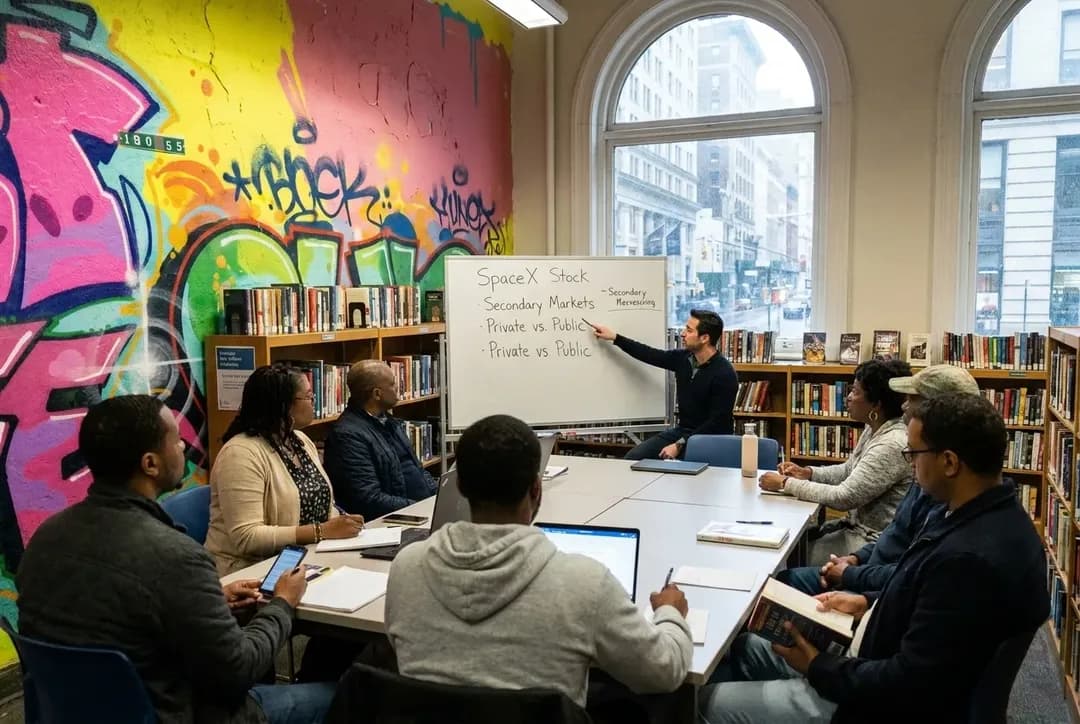
Who Benefits Most and Who Might Feel Underwhelmed
These workshops shine for true beginners: the college student who opened a brokerage account on a dare, the recent immigrant unfamiliar with U.S. capital markets, the retiree who wants to understand a grandchild's startup job-offer equity package, or the solo explorer who feels embarrassed asking "dumb questions" in front of finance professionals. The easy difficulty level—requiring only a calendar check and perhaps a registration email—removes barriers that deter people from paid seminars or intimidating Wall Street events. Going solo works well because the classroom environment encourages anonymity; bringing a friend can ease first-timer nerves and provide a post-session debrief partner over coffee.
Conversely, someone with an active brokerage account, experience reading 10-K filings, or a finance degree may find the pace too slow and the content redundant. Intermediate investors hunting specific strategies—options trading, tax-loss harvesting, or venture-fund LP structures—should seek advanced workshops or professional advisors rather than general-literacy sessions. The workshops also won't unlock actual access to SpaceX shares; they teach why access is restricted, not how to circumvent restrictions. Anyone hoping for insider tips, hot stock picks, or a shortcut to wealth will leave disappointed. The value lies in literacy, not alpha.
Logistics, Language Access, and Follow-Up Resources
Most library financial-literacy workshops are free and open to all ages, though some branches request that attendees be sixteen or older for sessions covering investment accounts and legal contracts. Participants need not hold a library card to attend, but registration systems may ask for a card number; visiting the circulation desk before the workshop to obtain a free card solves that hurdle in minutes. Materials—handouts, worksheets, glossaries—are typically provided in print and digital formats. For non-English speakers, call ahead to confirm interpretation availability; while not guaranteed at every session, larger branches with diverse populations often arrange translators for scheduled workshops if notified a week in advance.
After the workshop, many libraries offer follow-up office hours where participants can book fifteen-minute one-on-one consultations with the instructor to ask personalized questions. Some systems partner with nonprofit organizations like the Financial Clinic or Neighborhood Trust, which provide free coaching on budgeting, debt management, and goal-setting. Online learners can access recorded webinars through library digital portals, and several branches maintain curated resource guides—web pages listing vetted articles, videos, and tools for continued self-study. The MTA's subway and bus network makes reaching any borough library feasible; real-time service alerts and elevator-status updates help travelers with mobility needs plan accessible routes. No single workshop will transform a beginner into a sophisticated investor, but the combination of clear explanations, judgment-free environments, and zero cost creates a repeatable learning loop—attend one session, digest the concepts, return for the next level, and gradually build the confidence to navigate financial decisions without fear or jargon-induced paralysis.
Tags: #financialliteracy #investingworkshops #NYClibraries #freeeducation #privateequitybasics #beginnerinvestors #stockmarketeducation #publiclibraryevents #weekendworkshops #investmentfundamentals
Sources consulted: Source 1: nycgovparks.org · Source 2: new.mta.info · Source 3: nypl.org · Source 4: a816-health.nyc.gov
All trademarks are the property of their respective owners.
Ask Karpo first
Ask Karpo to turn this NYC idea into a current plan for your date, budget, companion, transit preference, and energy level. Karpo can narrow the route and flag what to verify before you go.
Ask Karpo for more information.
Keep reading
- Fast Food Near Me in the East Village: Crif Dogs Deep-Fries Its Franks
 Things To Do Near Me in NYC: Riding the Roosevelt Island Tram
 Things To Do Near Me in Washington Heights: The Cloisters' Medieval Galleries