 Chinatown New in Town Weekend Planner: Errands and Temples
Weekend Plans
Singapore Scenic Pedestrian Bridge Route for 2 Honest Notes
Use a Singapore scenic pedestrian bridge route at the Helix for two honest travel notes, separating visible details from personal responses and sourced facts.
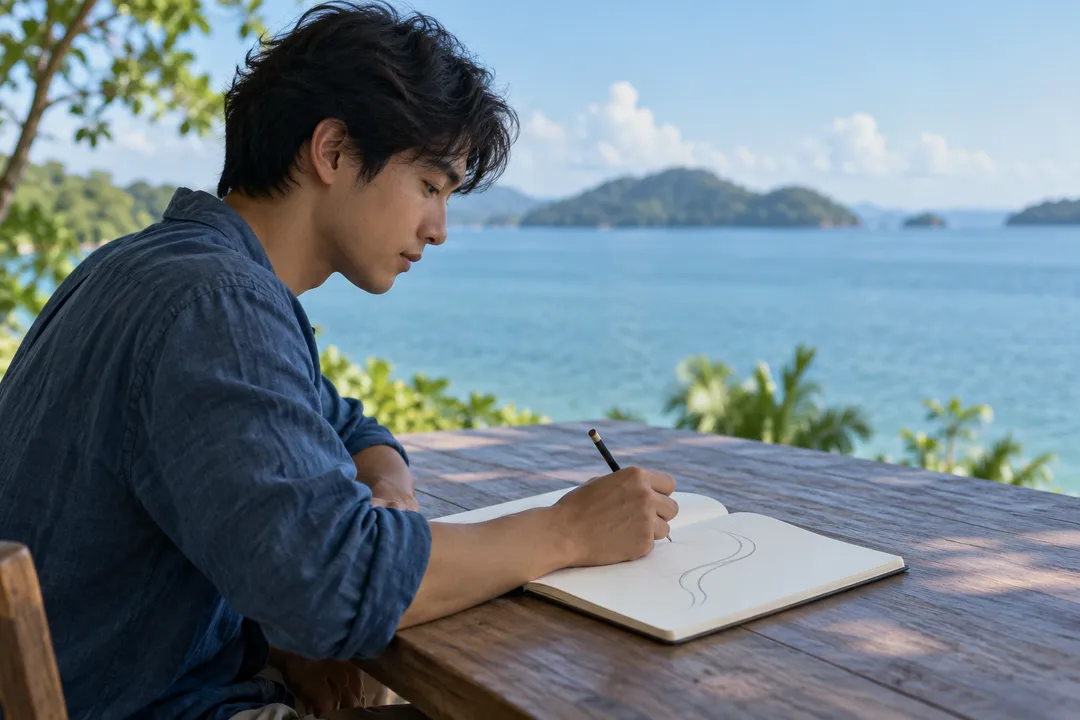
A Singapore scenic pedestrian bridge route around the Helix can end with two useful notes: what you saw, and what the scene made you imagine. Keeping those notes separate turns a familiar sightseeing stop into a travel-writing exercise that does not confuse impressions with facts. URA identifies the Helix as a pedestrian bridge linking Marina Bay and Marina Centre, while the National Heritage Board describes its viewing pods. Use those official accounts for context, then make your own observations. The photographs here are AI-generated activity illustrations, not documentary images of the Helix or examples of its actual construction.
Pack a question instead of a script
Choose a question you can explore without knowing the answer in advance. You could ask how the view changes when a frame sits between you and the skyline, or which element your attention returns to after looking away. Avoid beginning with a finished caption about an extraordinary feat of engineering. That script encourages you to find evidence for a claim you have already decided to make. A question leaves room for a smaller, more interesting discovery, including the possibility that a detail of water or light matters more to you than the famous structure.
Bring a notebook you can close quickly, or use whatever ordinary note-taking method you prefer. The exercise does not require drawing ability. A few words identifying a shape or direction are enough to preserve an observation. Do not write while moving across a pedestrian route. Gather a mental impression, then make the note from a suitable place where stopping is allowed and does not obstruct others. If no suitable place is available, keep the task in memory until after leaving the crossing. The notebook serves the walk, rather than creating a reason to occupy space.
Establish the place with a small fact file
Write the name Helix Bridge and keep the official source beside it in your preparation notes. URA's Marina Bay overview identifies the pedestrian connection separately from the Bayfront vehicular bridge. That distinction is useful when reading a map or describing the scene later. Do not merge the two structures into one because both appear in a photograph. This exercise is not a guide to identifying every building visible from the crossing. Name only what you can support, and leave an unfamiliar tower as an unfamiliar tower until you have a reliable identification.
The National Heritage Board's Jubilee Walk entry describes four viewing pods extending over the water. That is a sourced feature you can look for without inventing a reason for every design choice. Keep any explanation of the feature's purpose attached to its source rather than presenting it as something you inferred by looking. Your own notebook can record where you noticed a change of view, but it should not claim that the pod is empty, available or suitable for your group before you arrive. A description of a feature is not a reservation of space.
First note: describe only what the eye can support
Give the observation note a simple test: could another person standing in the same place recognise what you mean? A bright reflection interrupted by a dark edge is a visible relationship. Calling the scene peaceful is an interpretation that another person might not share. Neither kind of writing is inherently better, but they do different jobs. Begin with a few concrete relationships: near and far, curved and straight, bright and shaded. You do not have to list every object. Choose the arrangement that made you stop looking elsewhere.
Be careful with claims that sound factual because they use a precise number or technical word. You may count visible elements within your frame, but that does not establish how many the whole bridge contains. A photograph can hide or overlap parts. Likewise, a curved member can be described as curved without naming its structural function. If technical identification matters to your writing, use a source that actually identifies it. The observation exercise remains worthwhile when the language is modest. Precision is often a matter of limiting a claim to what you actually know.
Second note: give the imagination its own space
On the next line, write what the pattern reminds you of. It might suggest handwriting, a coiled spring or a rhythm in music. Phrase it as your association, rather than a statement about what the designer intended. That distinction protects the freedom of imaginative writing. You can respond to a structure without pretending to know its maker's thoughts. A companion may see something entirely different, and comparing those responses can be the most memorable part of the outing. There is no need to make one interpretation win.
Imagine that one visitor sees a ribbon while another remembers a science lesson. Their notes can sit beside each other without being reconciled. The scene has prompted two personal connections. If either person wants to explain the design's inspiration, that becomes a separate sourced statement, rather than proof that their response is more valid. Keep the page divided into observation and association so the reader can tell which is which. This small discipline is especially useful when the notes later become a social caption, where confidence of tone can make an unsupported claim travel quickly.
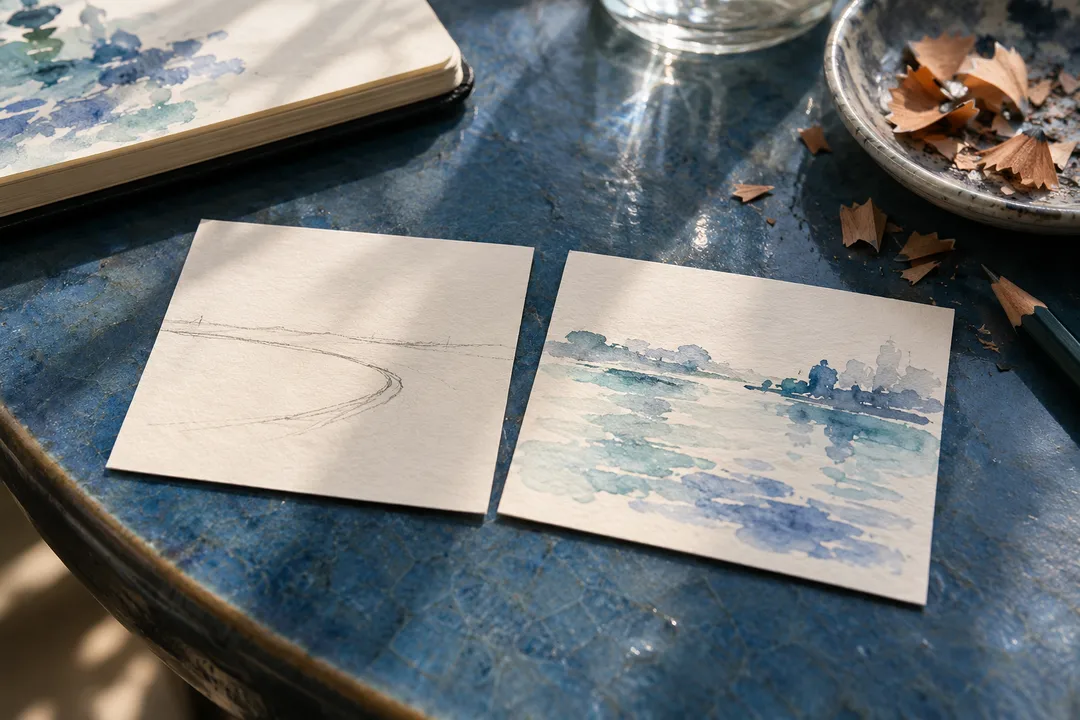
Generated still life of abstract note cards, illustrating two kinds of writing. The cards are not records of an actual Helix Bridge visit.
Edit a caption after leaving the crossing
Choose one line from each note and read them together. The observation establishes the scene, while the association explains why you cared about it. Remove any statement that quietly changed from personal response into universal fact. Words such as always, quietest or everyone can add a claim you never investigated. You can preserve a particular experience by locating it in your own visit, without prescribing the same experience for future readers. Do not add a crowd prediction, a light-show time or an access claim merely because it makes the caption feel more useful.
If a photograph accompanies the caption, distinguish what it actually shows from material you read beforehand. A detail image should not be described as a complete view. A generated illustration should be labelled as generated beside the image, and should not be offered as evidence of a real engineering feature. That is why this article uses activity scenes rather than invented views of the Helix. The writing exercise needs curiosity and a notebook, not a synthetic photograph that invites a reader to trust a construction detail that was never recorded.
Leave room for an ordinary waterfront walk
The neighbourhood extension can be simple: follow the waterfront portion you selected before the visit, with the notebook closed for a while. Do not assume that the pedestrian link commits you to walking the entire bay promenade. Pick the departure arrangement separately and keep any business visit out of the plan unless you have sourced it for yourself. This page does not give measured walking times, a station route or an accessibility certification. A reliable small itinerary is more useful than a confident list of connections whose approaches you have not examined.
Practical Notes: keep moving routes clear, secure loose paper and follow local barriers. Use official mapping for the approach and departure rather than treating an illustrative image as a route guide. You may ask Karpo APP a question about a waterfront outing, but the notebook exercise is an independent activity, not a promised app feature or automatic fact-checking service. Finish with two honest notes that you can recognise as your own: one grounded in a visible detail, and one explicitly personal. Together they preserve more of a place than a borrowed caption ever could.
Ask Karpo for more information.
Keep reading
- Chinatown New in Town Weekend Planner: Errands and Temples
 Kampong Glam New in Town Weekend Planner: Mosque to Murtabak
 Holland Village New in Town Weekend Planner: Meet People