 Chinatown New in Town Weekend Planner: Errands and Temples
Weekend Plans

Singapore Scenic Pedestrian Bridge Route: Hear Three Layers
Hear three sound layers on a Singapore scenic pedestrian bridge route by the river, using a small listening notebook and a crossing with room for attention.
A Singapore scenic pedestrian bridge route can begin with listening rather than taking a photograph. Choose a small part of the Singapore River and make one public pedestrian crossing the centre of a sound notebook. The exercise below separates what you hear nearby, across the water and behind you. It is a proposed activity, not a report of a guided event. The accompanying AI-generated photographs illustrate listening and note-taking, not a particular Singapore bridge or its surroundings.
Give the ear a small assignment
Imagine arriving by the river with an hour you could easily fill by scrolling through other people's photographs. Instead, put the device away and make the first decision with your ears. You are looking for three layers of sound, not three impressive attractions. One might be close enough to have a visible cause, another might seem to travel across the water, and a third might arrive from the street behind. These are listening categories, not promises about what will be audible.
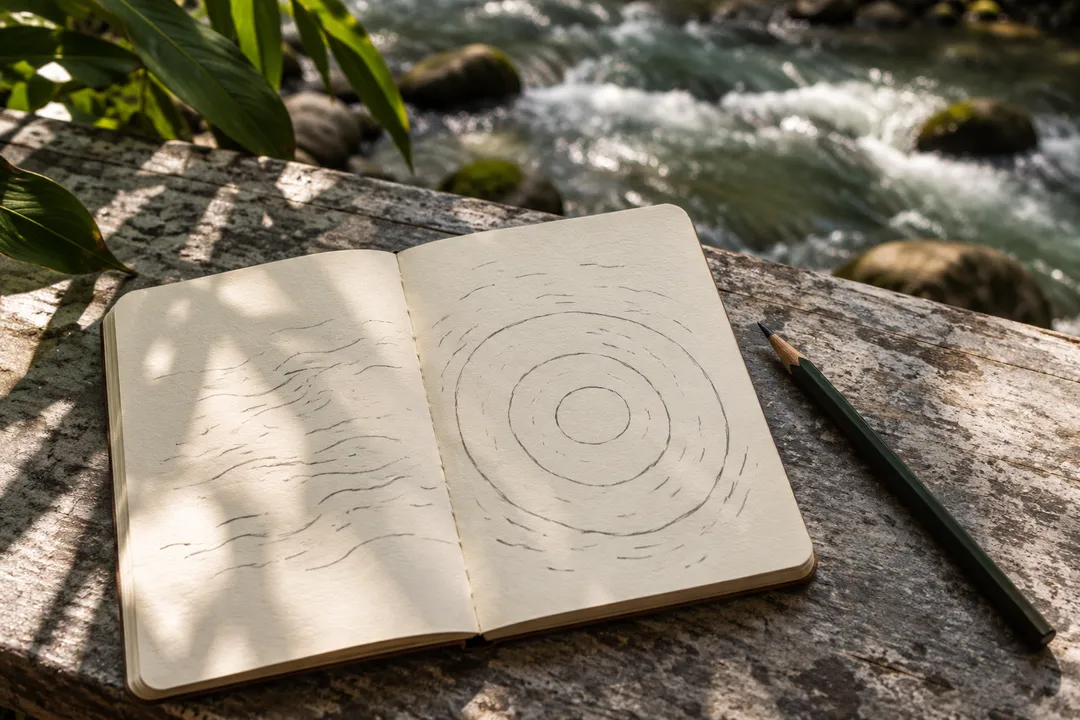
Take a pocket notebook and a pencil that can be used while you are safely stationary. Draw three loose circles on the page before setting off. The innermost circle means nearby, the middle one means somewhere beyond your immediate space, and the outer one means direction or distance uncertain. You do not need a microphone, an audio application or a musical vocabulary. The circles keep a short impression from turning into a list of guesses about the city's infrastructure.
Select a crossing that does not require a performance
The Singapore River is an appropriate setting because its bridges offer a physical change of bank. The National Heritage Board documents Cavenagh, Anderson and Elgin bridges as a historic river group. For this exercise, however, a bridge's age is less useful than whether the pedestrian route you encounter allows an ordinary crossing. Choose from a map, obey any barriers, and leave the listening task for a suitable place on land whenever stopping would obstruct other people.
A scenic label does not entitle anyone to silence. If you hear conversation, traffic or maintenance activity, these belong to that moment's soundscape. Do not wait for strangers to move or ask a passerby to stop talking for a recording. Equally, do not choose a narrower or more exposed position to make the exercise feel special. The notebook is successful when it captures your experience honestly, even if the most obvious observation is that one layer overwhelmed everything else.
Listen once before naming anything
Begin on the starting bank. Stand or sit somewhere permitted and outside the path of people moving through. Let your gaze settle without closing your eyes. Pick one sound and describe its texture before assigning a cause: rattling, continuous, hollow, sharp, uneven. A sound can be clear while its origin remains uncertain. Write a question mark when you cannot see the cause. Calling every distant low sound a boat engine would turn a useful observation into an unsupported claim.
Now add direction using your own body as the reference. Behind your left shoulder is more honest than north if you have not established your orientation. A short phrase such as repeated taps from behind can be enough. Resist making an entire sentence while people are passing. You can complete the note after moving away from the route. This first entry is a baseline for comparison, not a measurement, and it does not establish a typical noise level for the neighbourhood.
AI-generated close-up illustration of a listening notebook activity. This is not an on-site photograph or a measured sound map of the Singapore River.
Let the crossing interrupt the exercise
During the crossing, your main task is walking. Keep the notebook closed, stay aware of other users and let the sounds remain unrecorded until you reach the other bank. You are not collecting continuous data. That deliberate gap distinguishes the activity from field recording and gives you something to remember. If a sound catches your attention, hold a simple impression in mind without turning around abruptly or stopping in the route to identify it.
On the far side, find another permitted stopping place and reopen the circles. Write one thing that seemed different and one thing that remained present. Perhaps a sound was masked, perhaps your attention moved, or perhaps nothing changed enough to describe. All three outcomes count. Avoid saying the bridge amplified or filtered a sound unless you have evidence for that physical explanation. Your notebook records two listening positions and an intervening walk, not an acoustic experiment with controlled conditions.
A useful page contains a disagreement
When two people do the activity together, let each finish a note before comparing. One person may notice a short metallic rhythm while the other remembers a broad wash of movement. Neither needs to win. Place both descriptions beside the same circle and leave the difference visible. Asking what made you attend to that sound can be a more interesting exchange than agreeing on its cause. Personal attention is part of the outing rather than an error to eliminate.
For a solo version, make the disagreement internal. Read your first description again and ask whether its adjective described the sound or your mood. Busy can mean several overlapping sounds, but it can also mean you felt hurried. Replace it with the detail you actually remember, or keep the original word with a note about the uncertainty. This small edit gives the page a purpose beyond collecting attractive language and does not require you to become an expert listener.
Keep other people's words out of the page
Do not transcribe an overheard conversation. Capture a rhythm or an impression of overlapping voices without reproducing private content or identifying individuals. A listening notebook can be detailed without being intrusive. If you later share a photograph of the page, remove any identifying information that slipped into it. The exercise concerns your relationship with a public space, not collecting material about people who happened to be nearby while you were concentrating.
A short extension along the same riverbank can add a final contrast, but it is optional. Choose a nearby public path on your map rather than adding another named crossing to complete a collection. If rain, discomfort or the need to travel on makes the extension unattractive, finish with the two entries already made. A small complete observation is more useful than a longer walk undertaken only because a plan looked unfinished on a screen.
Practical Notes for a sound notebook
Pack lightly: pencil, paper, drinking water appropriate to your needs and whatever you normally carry outdoors. Keep your hearing available to the surroundings. This is a listening activity, so headphones would remove part of its purpose. Do not treat the suggested pauses as rest facilities supplied by a particular bridge. You choose a safe permitted stopping place when you arrive, and you can abandon the activity entirely if the space does not suit it.
In Karpo APP, a useful question is: help me turn one Singapore River crossing into a short listening exercise with a simple finish. Describe whether you are alone or with a friend, and how much of your outing you want to spend outdoors. Treat any suggested sequence as something to decide on yourself. Your own notebook holds the observations. End by circling the sound you would recognise again, then leave the page unfinished enough for another day's different river.
Ask Karpo for more information.
Keep reading
- Chinatown New in Town Weekend Planner: Errands and Temples
 Kampong Glam New in Town Weekend Planner: Mosque to Murtabak
 Holland Village New in Town Weekend Planner: Meet People