 Chinatown New in Town Weekend Planner: Errands and Temples
Weekend Plans

Singapore Scenic Pedestrian Bridge Route for a Real Catchup
Choose a Singapore scenic pedestrian bridge route by Robertson Quay for a catchup, with Alkaff Bridge as a reference and space to listen between crossings.
A Singapore scenic pedestrian bridge route can give two friends a reason to meet without making sightseeing compete with conversation. Around Robertson Quay, use Alkaff Bridge as a shared visual reference, then choose a bankside stretch where you can walk together and a place to finish talking. The bridge supplies a change of perspective, not a checklist of landmarks. This suggested outing is for a catchup that keeps slipping behind messages and busy calendars. AI-generated activity photographs accompany the text. They depict imaginary participants in generic riverside settings, not Alkaff Bridge, Robertson Quay or verified seating there.
Decide what the invitation means
An invitation to walk can mean exercise, a tour, a serious conversation or an easy hour in company. Two people may accept the same words while expecting different afternoons. Put the emphasis in the invitation: you would like to catch up, with a bridge crossing as a small shared activity. If your friend is hoping for a brisk workout, that sentence gives them a chance to say so. It also avoids the disappointment of arriving with things to talk about and finding that the other person has planned a sequence of attractions to photograph.
Choose an ending that belongs to the conversation. You could finish after each person has had time to tell one story, or at an agreed departure point dictated by the time available. Do not promise a certain emotional result. A pleasant route cannot guarantee openness, resolve an argument or make a difficult subject easy. Its contribution is simpler: you have set aside time and reduced the number of other decisions. The person who organised the walk should still be willing to change the activity if their friend would rather sit or go home.
Let a bridge interrupt the routine
The National Heritage Board's Singapore River Walk material identifies Alkaff Bridge and connects it with Robertson Quay's river setting. Use that reference to place the outing on an official map. This article does not reproduce a full heritage trail or turn every crossing along the river into a stop. The surrounding neighbourhood gives a context for walking, but your invitation does not need a historical lecture. Choose one short observation to share, such as a colour you noticed, then let the conversation return to the people taking the walk.
A crossing changes what is in front of you and can provide a natural pause in a sentence. It need not become a dramatic symbol of friendship or a moment for a posed photograph. Pay attention to where you are moving, and resume any absorbing story after leaving the through route. The useful quality of a bridge here is that it divides the outing into recognisable parts. There is a before, a crossing and an after. That simple sequence can make an otherwise vague suggestion to meet feel concrete enough to put on a calendar.
Give the first story room to arrive
Start with a question that leaves the other person some choice. Ask what has been taking up their attention, rather than demanding a complete update on work, family and every unfinished plan. A friend may begin with an apparently small story because it is easier to tell while settling into the walk. Resist immediately matching it with your own similar experience. Let their account reach its end before deciding whether they want a question, an opinion or simply a listener. Those are conversational choices, not services a route or app can provide.
Silence does not mean the walk has failed. Someone may be looking at the water, arranging their thoughts or enjoying a break from talking. You do not have to fill every gap with facts about the quay. If the silence feels uncertain, offer a small observation rather than a new interrogation. A shared outing can contain attention to the place and attention to each other. The aim is to leave room for both, without making every pause carry the pressure of a question about how the friendship is going.
Use a pause for the difficult sentence
Some subjects deserve more attention than walking permits. If a friend begins something important while you are approaching a crossing, ask whether they would like to continue in a suitable place away from moving pedestrians. Do not stop abruptly in front of people or steer the conversation towards a railing for atmosphere. A busy public space may also be a poor place for private details. Give the speaker the option of saving the subject for another setting. Choosing privacy is not a refusal to listen.
Suppose one person wants advice about a job change and the other assumes they are only being asked to hear the story. A useful question is whether ideas would help, or whether the friend would prefer you to listen first. That single distinction can prevent an afternoon from becoming an unsolicited coaching session. It is also more helpful than selecting a supposedly perfect scenic location for a serious talk. The quality of attention comes from what the people do, not from a promise that the surroundings will produce the right conversation.
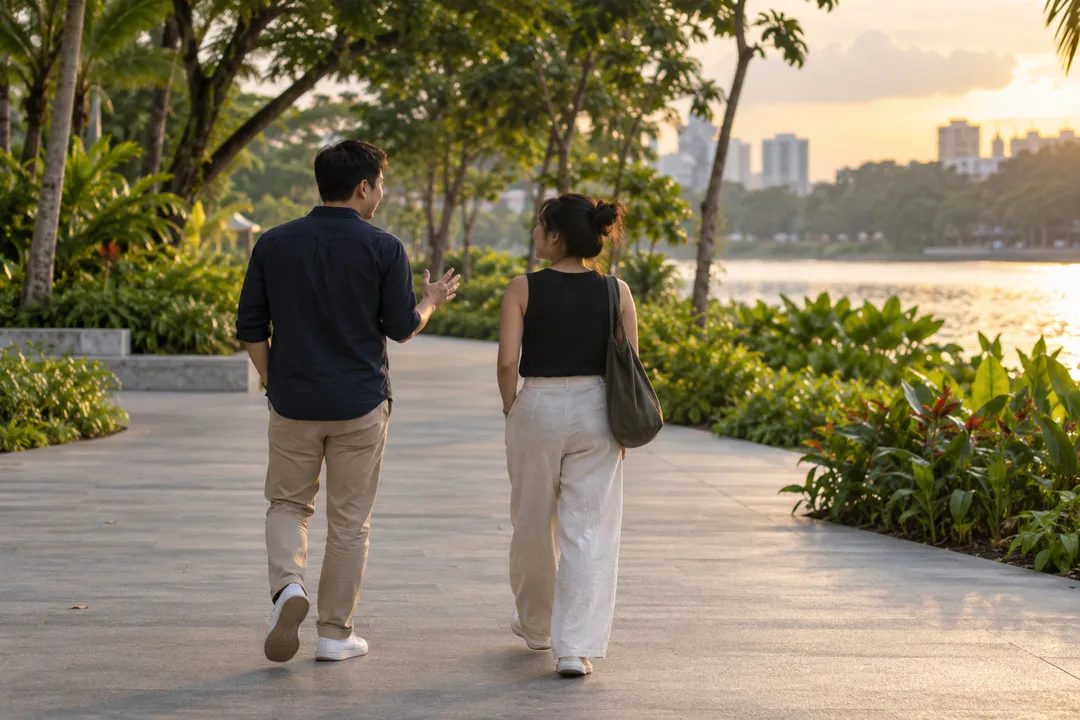
AI-generated illustration of two imaginary friends on a generic riverside path. It is not evidence of the layout or conditions at Robertson Quay.
Share the route work fairly
The organiser should not have to navigate continuously while also being the listener. Choose the arrival and departure paths in advance, then describe the basic arrangement to your friend. Use an official river map to identify Alkaff Bridge, but source transport details separately if they are needed. This page does not provide a station-to-bridge route or certify a continuous accessible path. If either person needs a specific surface, gradient or resting arrangement, include that requirement in the planning before making the outing depend on it.
Keep phones available for navigation and genuine interruptions without leaving them as a third participant in every pause. You might agree to finish a message before beginning the walk or explain that you are expecting a necessary call. A rule demanding total disconnection can exclude a parent, carer or someone with a practical responsibility. State the need plainly and allow an interruption to be handled without embarrassment. The aim is attention that both people can realistically give, rather than a display of being perfectly present.
End without making another obligation
Before separating, mention one thing you enjoyed hearing. If you offered to send a link or introduce someone, keep the promise small and specific. Avoid turning a good conversation into an extensive action list for the person who shared a problem. A future walk can remain an invitation, with a different length or setting if that would suit better. The surrounding neighbourhood extension is optional: follow only the bankside portion you selected, and decide on any business visit separately rather than assuming a table or purchase will be available.
Practical Notes: respect barriers, keep through routes clear and move any sustained discussion away from the crossing. Bring what you need for your own comfort without relying on an unnamed facility. You can ask Karpo APP for ideas for a low-key catchup in the area, while making the actual arrangements with your friend. This page does not claim the app schedules both people, monitors their mood or finds live quiet spots. Its result is an invitation you can send: a meeting, one river crossing, room for a story and an ending that respects both calendars.
Ask Karpo for more information.
Keep reading
- Chinatown New in Town Weekend Planner: Errands and Temples
 Kampong Glam New in Town Weekend Planner: Mosque to Murtabak
 Holland Village New in Town Weekend Planner: Meet People