 Chinatown New in Town Weekend Planner: Errands and Temples
Weekend Plans

Singapore Scenic Pedestrian Bridge Route Without a Camera
Try a Singapore scenic pedestrian bridge route without taking pictures, using the riverbanks to practise visual recall and make a personal memory afterwards.
A camera-free Singapore scenic pedestrian bridge route gives you a different souvenir: something remembered before it is recorded. Use a small crossing by the Singapore River to look deliberately, walk without taking photographs, and reconstruct a few details afterwards. The point is choosing attention, not proving that photographs spoil travel. This is an optional memory exercise rather than an organised event. Both AI-generated illustrations depict generic activities and should not be read as photographs of Singapore's bridges.
Decide what the camera is sitting out
Put the camera away for the crossing and its two banks, rather than declaring a whole holiday free of pictures. A bounded agreement is easier to keep and easier to explain to a companion. Your device can remain available for navigation or an urgent message. Using it for those purposes does not invalidate the activity. What you are suspending is the impulse to turn each interesting thing into a picture before deciding what made it interesting.
Choose three kinds of detail you might recall: a line, a colour relationship and a movement. These are prompts rather than objects to hunt down. A line might belong to a railing or the meeting of two surfaces. A colour relationship might be between water and an adjacent wall. Movement might come from a person, a shifting reflection or your own changing viewpoint. None needs to be especially beautiful, and the activity still works when one category produces nothing memorable.
A friend can make a different selection. Do not compare choices at the start or turn the walk into a competition over who notices more. You can agree only on the photography boundary and a finishing point. If one person would rather keep taking pictures, that is a legitimate preference. Split the activities without scolding them, or choose a different outing together. A useful memory exercise is voluntary, and nobody owes the group a particular way of experiencing a city.
Build the memory before the crossing
The National Heritage Board's account of the Singapore River Bridges brings Cavenagh, Anderson and Elgin together as a historic group. Use that account if you want an identifiable river context, but select the actual pedestrian route from your map and the signs in front of you. This exercise does not require completing the group. One ordinary crossing is enough to separate a first look from a later attempt at remembering it.
From a permitted place on the starting bank, look for the relationship among the objects rather than inventorying them. Which line divides your view? What occupies the space behind it? Is the detail large in the scene or merely the thing you happen to notice? Looking this way gives you something to describe later without requiring an image. Remain aware of the path around you, and move on if your stopping place interferes with other people's passage.
Now choose a very short private description. Pale strip against darker water is more portable than a long paragraph you will struggle to remember. You are not trying to discover the correct colour name or the precise material of a distant surface. Avoid supplying those facts unless you know them. The phrase should preserve what you saw from that position. It can remain approximate because this is a record of attention, not a condition survey or a reference photograph.
Allow the middle to go uncollected
Cross normally, without repeatedly turning back to rehearse the description. Your surroundings will change while you walk, and you do not need to preserve all of them. Let the gap remain a gap. This is the part many picture-taking habits find difficult: an interesting moment can be allowed to pass without being captured or immediately explained. There is no requirement to look over the edge, slow other pedestrians or find an elevated viewpoint to make the crossing worthwhile.
Beyond the crossing, move to somewhere appropriate before testing recall. Keep your eyes open and ask what returns first. It may be the detail you selected, a different detail or the feeling of looking. Begin with that answer rather than reconstructing what you think a successful exercise should contain. If the image is indistinct, say so. A blank space on a page is an honest result and is more revealing than a confidently invented description of a railing you barely registered.
AI-generated indoor memory-sketch activity, showing abstract marks made after a walk. It does not document a real view, a bridge design or a Singapore location.
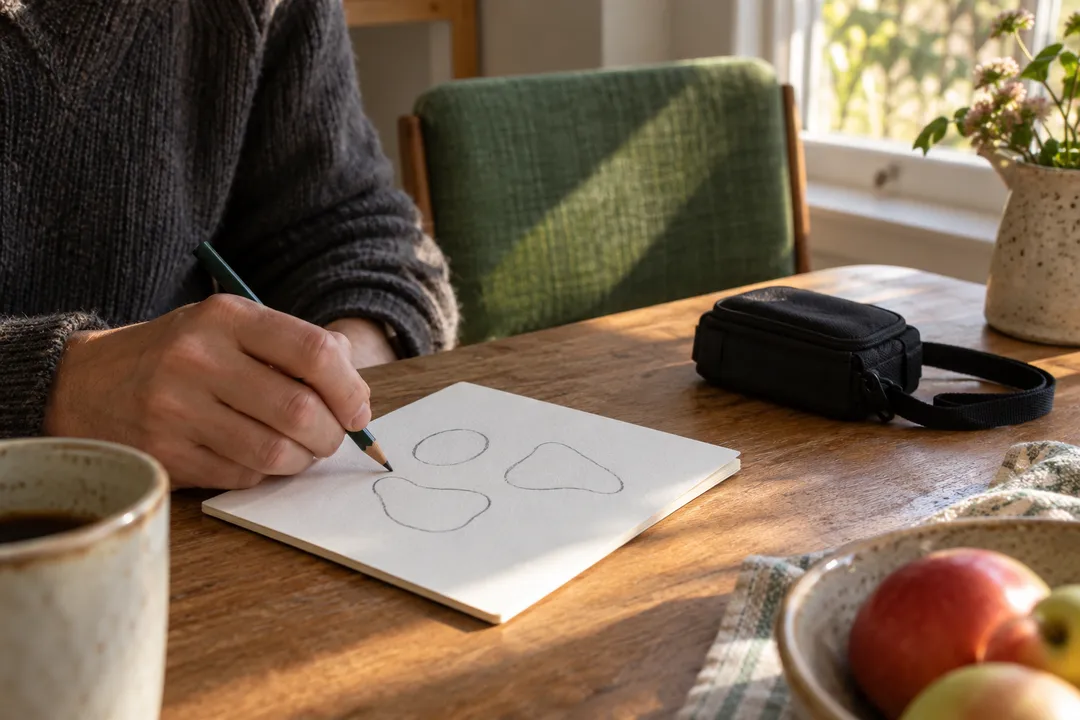
You can make the record later at home, on paper or in a private note. Draw a rough line, add the colour relationship in words and describe one movement. Mark details you are unsure about. Do not use a stock image to repair the memory or copy another traveller's photograph into your account as if it were your own view. Your recollection has value precisely because it shows the small selection your attention made during that particular crossing.
A companion remembers a different frame
When you compare recollections, begin with what each person recalls independently. One may remember a curve, while the other recalls the space visible through it. Ask where the person was looking and what drew their attention. Do not declare one description wrong simply because it differs from yours. If a factual distinction matters, keep it separate from the memory exchange and use a reliable reference later. A conversation about seeing is different from adjudicating architectural details.
Keep consent in mind if a person becomes part of the remembered scene. Describe an anonymous action without turning a stranger into a character with an invented motive or biography. Someone carrying a bag is an observed detail. Calling them a commuter late for work supplies a story you do not know. A camera-free exercise does not remove the obligation to distinguish observation, interpretation and imagination when you share an account with someone else.
For the neighbourhood continuation, stay with the bank you have reached and choose an ordinary onward public path on your map. Avoid adding another bridge just to obtain a better memory. A final glance at the river can provide closure without becoming a second assignment. You can also finish immediately. The point is to have one thing you deliberately attended to, rather than a route full of extra stops included to make a small activity appear substantial.
Practical Notes and the optional photograph afterwards
If you decide to take a photograph after the agreed activity ends, keep it separate from the recall record. Label the sketch as remembered and the photograph as later. You may discover that the image contains details you never noticed. That difference can be interesting without proving that one medium is superior. Avoid revising your earlier page until it appears photographically accurate. Its omissions belong to the exercise and may be the part you most want to retain.
Karpo APP can be the place to ask for help wording your own camera-free walking brief: one Singapore River crossing, a clear finish and a small recall prompt. State which parts of the outing should remain flexible. You make the final decisions from the route information available to you and the conditions in front of you. Take your ordinary outdoor essentials, leave hands free while walking, and end with a memory you can describe in your own words rather than a challenge score.
Ask Karpo for more information.
Keep reading
- Chinatown New in Town Weekend Planner: Errands and Temples
 Kampong Glam New in Town Weekend Planner: Mosque to Murtabak
 Holland Village New in Town Weekend Planner: Meet People