 Chinatown New in Town Weekend Planner: Errands and Temples
Weekend Plans
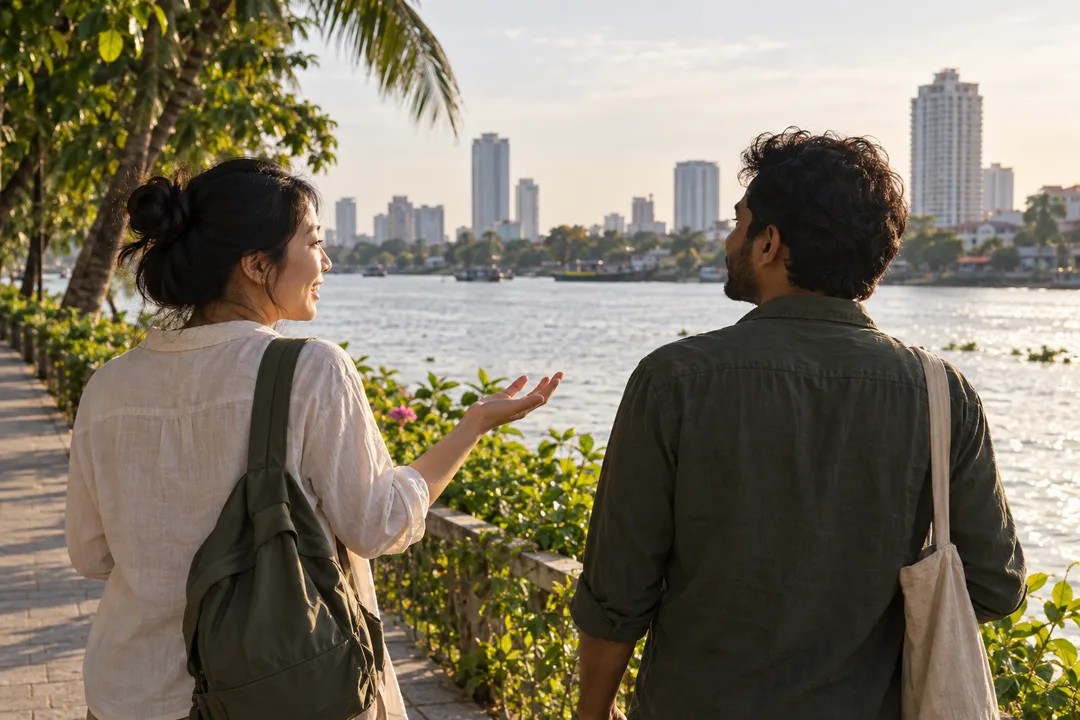
Singapore Scenic Pedestrian Bridge Route in Two Languages
Host a Singapore scenic pedestrian bridge route in two languages by the river, with shared place names, short explanations and room for your guest to respond.
Hosting a Singapore scenic pedestrian bridge route in two languages works better when the guest can shape the outing. Around the Singapore River, use a crossing as a shared reference, then take turns describing one visible detail in the language each person prefers. This is a suggested hosting exercise, not a language course or a guided-tour service. The AI-generated images show generic conversation and planning activities rather than the Singapore River or a specific bridge.
The invitation comes before the explanation
A familiar hosting problem begins with good intentions. You have prepared an introduction, but your visiting friend wants to ask about something else. Instead of delivering every fact you collected, start the invitation with a choice: would you enjoy a little history, a chance to practise conversation, or simply company beside the river? Make these different offers. Someone who accepts a walk has not automatically agreed to a lesson, and someone practising English may still want difficult questions answered in another language.
Establish how switching languages will work. A guest might welcome an unfamiliar word but dislike having every sentence corrected. Ask whether corrections should wait until the end, happen only when meaning is unclear, or be left out entirely. For mixed groups, do not assume that the most confident speaker should interpret everything. Each person needs a way to interrupt, request a simpler version and decline an explanation without having to perform gratitude for a host's effort.
Prepare a tiny shared vocabulary
Choose a river crossing together on a map before the outing. Keep the written place name available in the form used on that map, even if you also write a translation or a pronunciation reminder. This reduces the chance of two people discussing different bridges under similar descriptions. A name used as a meeting reference should remain stable. Your poetic translation can sit alongside it, but it should not replace the practical label somebody will later need to recognise.
For a historical reference, the National Heritage Board groups Cavenagh, Anderson and Elgin bridges as the Singapore River Bridges. That establishes a place-based starting point for conversation. It does not make all three crossings one continuous pedestrian itinerary, nor does it oblige you to visit the complete group. Choose one appropriate public walking route and let the rest remain background. A small shared vocabulary is easier to use than an ambitious list of landmarks nobody asked to memorise.
Translate the question rather than every sentence
Try a prompt that can be answered from the surroundings: which detail would you show a friend who has never been here? Let the guest point out a shape, a relationship between the banks or a small thing you overlooked. When an unfamiliar word arises, describe it with simpler words first. You can look up a translation once stationary. Keep the exchange focused on expressing a thought rather than demonstrating that either person knows the correct technical term.
A useful translation preserves what someone is trying to say, including uncertainty. If your guest says a structure reminds them of a place at home, do not turn that association into a statement about the bridge's origin. Repeat the distinction in the other language: this is a personal resemblance, while the historical account would need its own evidence. That habit protects the conversation from accumulating plausible but invented facts as each person tries to help the other understand.
AI-generated illustration of a two-language planning activity with blank speech bubbles. No real route, translation or bridge information is depicted.
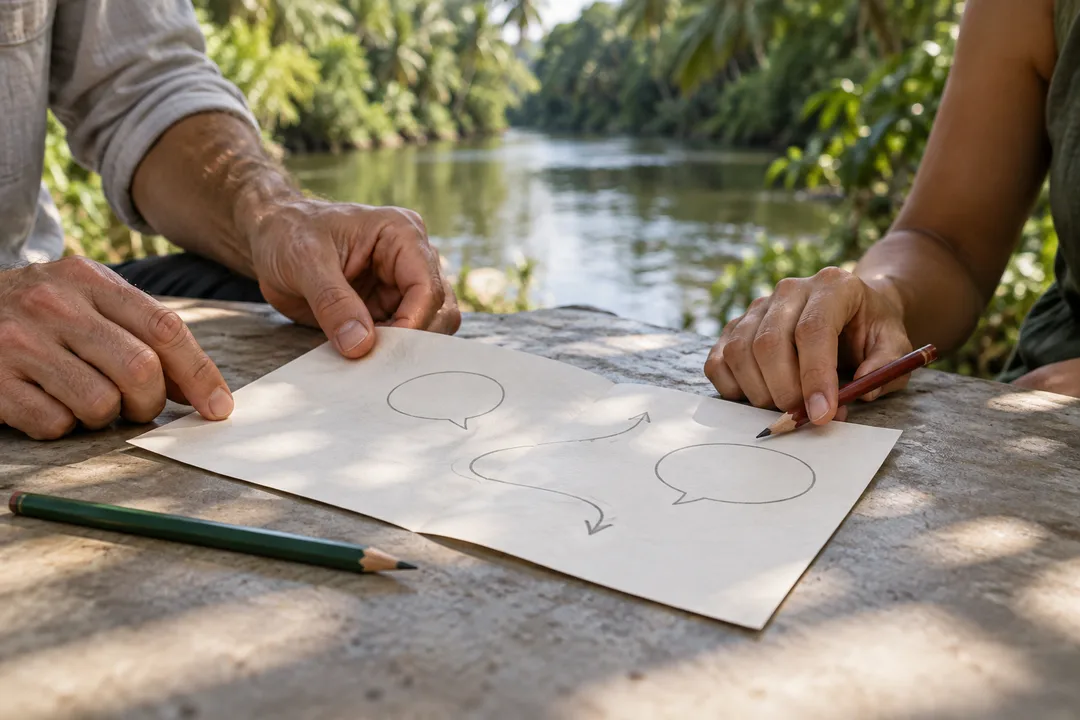
Give each bank a different speaking role
On the starting bank, let the host offer a short description and then stop. The guest can repeat the part they found interesting, ask a question or change the subject. Cross with attention on walking rather than continuing a detailed translation. Once both people are settled somewhere suitable beyond the crossing, reverse the roles. The visitor describes what now stands out, and the host listens without filling in every pause. That role reversal is the actual activity.
If a sentence becomes difficult, reduce its size rather than increasing your volume. Separate the object from the opinion: a curved line is visible, and the feeling it creates is personal. Offer one phrase at a time and leave room for a response. Avoid asking a companion to pronounce an unfamiliar place name while other people are waiting to pass. Language practice should never make somebody feel conspicuous in a public space or turn an ordinary route into a stage.
Two versions can remain unequal
A bilingual outing does not need a word-for-word account. One language may carry a longer memory, while the other carries a quick practical question. That difference is acceptable if both people understand the decisions affecting the walk. Prioritise the meeting reference, crossing choice, finish and any change of plan. Those deserve clear shared meaning. A description of water or architecture can remain partial without reducing anyone's ability to decide where they want to go.
For a group with several language preferences, summarise the next choice briefly before moving. Say what is being proposed, identify who still needs time, and wait for a response. Do not translate a private conversation for the whole group without asking. Equally, do not leave one person standing through a long exchange they cannot follow simply because the speakers are enjoying it. Hosting is a distribution of attention, and the walk gives you repeated chances to rebalance it.
Keep your own memories separate from public history
A resident can offer a personal river memory without becoming an unofficial historian. Introduce it as your experience: this is where I first noticed a particular view, or this part reminds me of an earlier walk. You do not need to invent an opening date, a former use or a story about the people passing. If a guest wants deeper history, share the official heritage account afterwards rather than filling an immediate conversational gap with something that merely sounds right.
Your surrounding neighbourhood walk can remain modest. Choose an onward public path on the same bank and continue the conversation without setting another vocabulary target. If the guest has spent the crossing concentrating hard, a quiet stretch together may be more welcome than another explanation. Ask whether they want to continue or finish. This is a social invitation with language choices, not a test that requires everyone to complete a prescribed number of descriptions before leaving.
Practical Notes for a generous host
Write a short invitation in both preferred languages before sending it. Include the same meeting reference and intended finish in each version. If you are uncertain about your translation, use simple wording you can explain instead of a polished phrase whose meaning you cannot defend. On the day, keep a written bridge name available and carry the ordinary items you need outdoors. No specific shade, seating, toilet or step-free approach is promised by this exercise.
You can ask Karpo APP to help phrase a gentle invitation for a Singapore River walk in the languages your group uses. Explain that you want optional conversation practice, short descriptions and an easy way for a guest to decline corrections. Read the wording yourself before sharing it. The useful ending is a question about the experience: which part felt easy to talk about? Let that answer guide a future invitation rather than grading how much vocabulary the walk produced.
Ask Karpo for more information.
Keep reading
- Chinatown New in Town Weekend Planner: Errands and Temples
 Kampong Glam New in Town Weekend Planner: Mosque to Murtabak
 Holland Village New in Town Weekend Planner: Meet People