 Marina Bay Food Market Grazing Route After a Conference Day
Neighborhood Guides
Historic Singapore River Scenic Canal Bridge Route Walk
Stroll the historic Singapore River scenic canal bridge route across nineteenth-century iron suspension crossings, civic quays, and colonial riverside trails.
Stepping onto the historic bridges spanning the lower Singapore River immerses pedestrians in two centuries of urban maritime trade and civic engineering. As the commercial cradle where early lighters and merchant vessels unloaded precious spices, rubber, and silk, this historic river corridor features Singapore's most celebrated collection of colonial-era crossings. Walking between the imposing neo-classical facades of the Civic District and the conserved shophouse rows of Boat Quay provides an unparalleled architectural journey. Each bridge tells a distinct chapter of nineteenth and early twentieth-century industrial craftsmanship that remains fully accessible to walkers today.

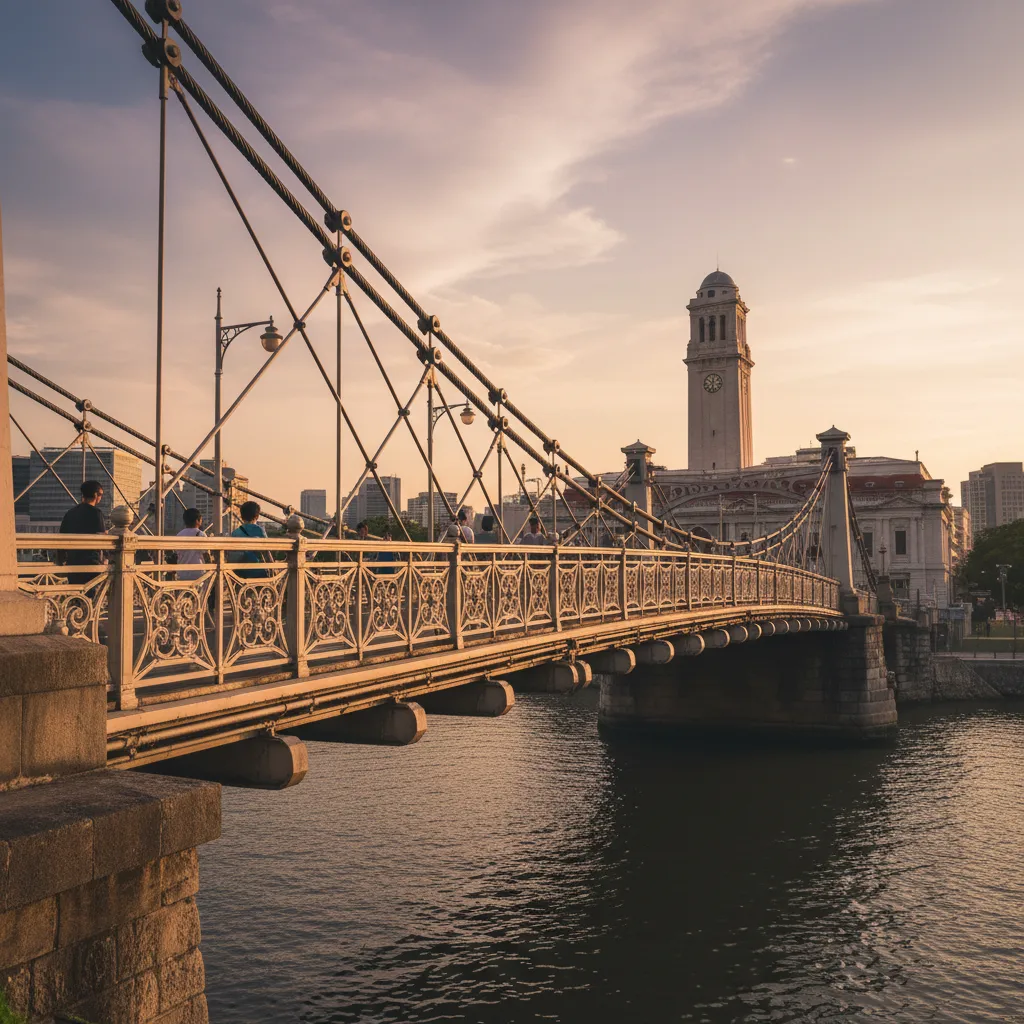
Cavenagh Bridge stands as the crowning jewel of this downtown crossing circuit, holding the distinction of being Singapore's oldest surviving suspension bridge in its original structural form. Opened in eighteen sixty-nine to commemorate the Straits Settlements becoming a Crown colony, the bridge was fabricated in Glasgow by P and W MacLellan before being shipped in modular pieces to Singapore for assembly. Pedestrians crossing its timber-planked deck can still inspect the famous cast-iron police notices erected in nineteen ten, which strictly prohibit cattle, horses, bullocks, and heavy carriages from entering the span.
Cast-iron struts and diagonal suspension rods give Cavenagh Bridge a remarkably light, web-like appearance against the towering financial towers of Raffles Place. Walking along the wooden boardwalk flanking the span allows pedestrians to examine the intricate rivets and Glasgow foundry stamps stamped into the iron beams. Positioned directly opposite the Asian Civilisations Museum and Empress Place, this pedestrianized bridge forms a natural gathering space where historical walking tours pause to discuss the river's foundational role in modern Singapore.
Traversing Anderson and Elgin Historic Crossings
Positioned immediately downstream where the river widens toward Marina Bay, Anderson Bridge presents a dramatic contrast of heavy rusticated granite abutments and intricate steel bowstring truss arches. Completed in nineteen ten to relieve heavy vehicular pressure from Cavenagh Bridge, this handsome structure features ornamental bronze lanterns and decorative heraldic shields along its sweeping arches. Today, pedestrian walkways flanking both sides of the roadway allow strollers to absorb dramatic vistas stretching from the Fullerton Hotel across to the Esplanade waterfront.
Venturing further upstream past the gentle sweep of Boat Quay, Elgin Bridge marks the historic site of the very first river crossing constructed in Singapore shortly after British arrival in eighteen nineteen. The current reinforced concrete structure, completed in nineteen twenty-nine, features elegant cast-iron lamp pillars sculpted by Italian artist Cavaliere Rudolfo Nolli and four iconic bronze lions guarding the bridgeheads. Walking across Elgin Bridge at twilight reveals glowing turquoise illumination beneath the road arches that dances across the swirling wake of passing sightseeing boats.
Coleman Bridge and Read Bridge continue the historical progression as the river curves gently toward Clarke Quay. Rebuilt in nineteen ninety to mirror its original eighteen eighty-six Victorian ironwork design, Coleman Bridge delights pedestrians with ornate fluted lamp standards, ornamental bracket details, and shaded resting bays built into the bridge piers. Read Bridge, historically known to locals as Malacca Bridge or Kam Kampong, serves as a bustling pedestrian-only plaza where cool river breezes draw street musicians, evening walkers, and office workers unwinding after business hours.
Pavement Details and Riverbank Walking Etiquette
Flawless stone flagstones and smooth granite borders pave the entire historic bridge trail, providing comfortable and continuous footing across both northern and southern riverbanks. Generous underpasses beneath Anderson, Elgin, and Coleman Bridges allow pedestrians to continue along the water edge without crossing busy city traffic streets above. Clear tactile paving runs along key crossings, while wide ramps ensure effortless accessibility for visitors using wheelchairs, luggage, or baby strollers.
Pedestrian etiquette along this busy civic promenade emphasizes courtesy and shared awareness, particularly during the high-traffic lunchtime and post-work hours. Walkers and runners generally keep to the left along narrower sections beneath bridge abutments, allowing ample space for photographers setting up tripods along the scenic balustrades. Prominently placed heritage markers and bronze statues—including the celebrated depiction of river merchants and coolies—enrich the path with insightful historical context without impeding foot traffic flow.
Shaded resting benches fashioned from polished granite and recycled timber are set back from the primary flow of pedestrians along both embankments. Waste bins with integrated recycling compartments and sheltered colonnades along Empress Lawn provide convenient amenities for walkers taking extended architectural walking tours. Watercraft passing below adhere to strict five-knot speed limits, ensuring that wash along the stone quay walls remains calm and pleasant for strollers.
Light Quality and Architectural Vistas Along the Quays
Golden hour along the lower Singapore River delivers an extraordinary visual spectacle as low-angled sunlight reflects off glass skyscraper towers onto weathered granite river walls. The contrast between Victorian ironwork silhouettes and gleaming contemporary corporate headquarters creates an inspiring dialogue between Singapore's colonial past and its dynamic present. As the sun dips lower, the pale stone columns of Empress Place glow with a rich amber warmth that makes an early evening walk unforgettable.
Nightfall introduces a sophisticated urban lighting scheme designed specifically to accentuate the structural geometry of each bridge span. Soft floodlights illuminate Cavenagh Bridge's intricate tension rods, while Anderson Bridge's steel arches glow against the deep tropical night. Strolling along the water edge allows pedestrians to enjoy the cooling river breeze while watching colorful light reflections ripple across the black water, creating a serene urban sanctuary amidst the bustling financial district.
Twilight walkers along Boat Quay can pause at the bridge approaches to watch the interplay of historic shophouse lanterns reflecting alongside soaring office skyscrapers. The river acts as a mirror that doubles the city's luminous energy, while the wide pedestrian plazas at either end of Cavenagh Bridge offer tranquil pockets to absorb the evening breeze before continuing along the waterfront path toward the bay.
Accessing the River Route via Karpo APP
Reaching the Singapore River bridge circuit is exceptionally convenient through multiple central MRT stations serving the downtown core. Raffles Place MRT Station on the North-South and East-West Lines sits directly adjacent to Cavenagh Bridge via a brief stroll past the Fullerton Hotel, while Clarke Quay MRT Station on the North East Line opens directly onto the promenade near Read Bridge. Additional access is available from City Hall MRT Station through the shaded parkland of the Civic District.
Consulting the Karpo APP provides urban strollers with real-time crowd insights, optimal walking loops, and detailed architectural walking guides that unlock the rich history behind every iron bolt and granite pier. The app assists in mapping customized walking itineraries, locating scenic photography vantage points, and identifying quiet riverside benches away from crowded dining strips. This historic bridge promenade stands as an essential Singapore experience that effortlessly bridges heritage and modern urban design.
Ask Karpo for more information.
Keep reading
- Marina Bay Food Market Grazing Route After a Conference Day
 River Valley Food Market Grazing Route With Young Kids
 Serangoon Food Market Grazing Route for a Homecoming Weekend