 Sentosa Christmas Light Up Walk Planner for Young Families
Free Things to Do
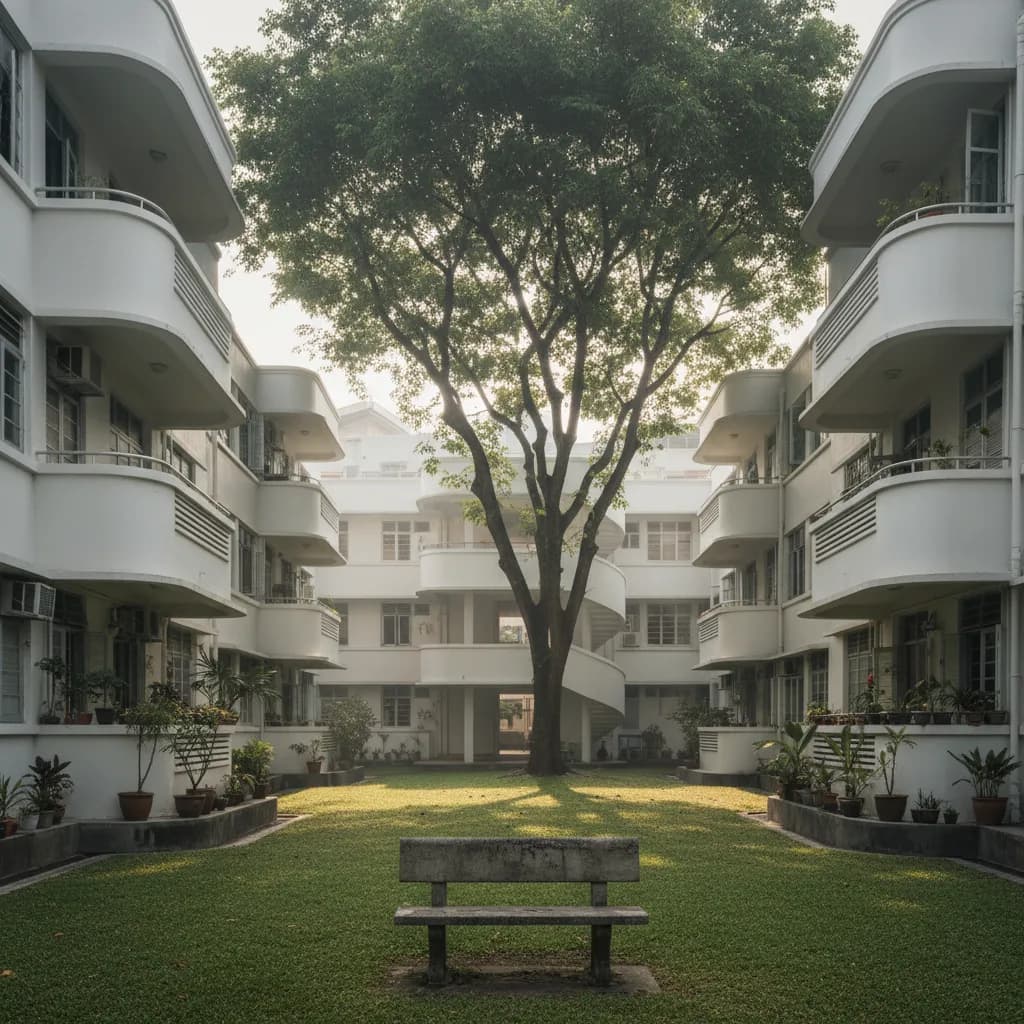
Tiong Bahru Public Reading Garden: Free Courtyard Shade
Tiong Bahru Park on Henderson Road is free and open to all, and the estate's courtyards add shady reading benches. Go early, before the heat builds.
Tiong Bahru is Singapore's oldest public housing estate, and its best free reading spots sit between its own buildings. The Singapore Improvement Trust began work here in 1927, and the first block of the curved, white Art Deco flats opened in December 1936. Between the blocks, the planners left grassed courtyards for light and air. Across Henderson Road, the 3.3-hectare Tiong Bahru Park, managed by NParks, adds lawns and tall trees. Both cost nothing and suit a book far better than a crowded cafe.
Reading in the Courtyards of the Pre-War Flats
The estate's pre-war blocks were designed so that residents enjoyed plenty of light and ventilation, with balconies, light wells and a grassed playground for children. Locals called the curved buildings fei ji lou, or aeroplane flats, for their streamlined shapes. Wander along Moh Guan Terrace, Eng Hoon Street or Guan Chuan Street, and you will find small green pockets with trees and benches tucked behind the walkways.
These courtyards are residential spaces first. Sit quietly, keep phone calls short and do not block stairways or ground-floor doors. Readers who respect that will find them some of the most peaceful spots in central Singapore. The thick walls and narrow streets keep traffic noise low, and the breeze that the planners designed for still flows between the blocks on a humid morning.
The area was given conservation status by the Urban Redevelopment Authority in December 2003, and it is often described as the only complete pre-war public housing estate left in Southeast Asia. A short history of Singapore housing or a novel set in the 1930s feels especially fitting on a bench here.
If you would rather not sit in a courtyard at all, the estate's long covered five-foot ways and shaded walkways make good standing reads while you wait out a shower. Many residents keep rows of potted plants and bougainvillea along these passages, and the greenery makes even a short pause feel like being in a garden. Keep to one side so neighbours and delivery riders can pass.

The Horse Shoe Block and Its Hidden Shelter
Block 78, at the junction of Moh Guan Terrace and Guan Chuan Street, is known as the Horse Shoe Block for its curved outline. Built between 1939 and 1940, it is the largest block in the estate and straddles both streets. The Guan Chuan Street section included a purpose-built air raid shelter, the first ever included in a public housing project in Singapore.
The block makes an ideal landmark for meeting a friend before a reading morning. Pause at the corner to look up at the sweep of the facade, then follow the walkways inward to find a shaded bench. It is a reminder that this calm estate was built on the edge of war, a detail that adds weight to whatever you are reading.
Tiong Bahru Park for a Longer Session
When you need more space, cross to Tiong Bahru Park at 1 Henderson Road. It lies between Henderson Road, Bukit Merah and Lower Delta Road, first opened around 1967, absorbed a nursery site in 1977 and was redeveloped in 2000. The lawns are generous, and mature trees cast enough shade to make reading outdoors bearable even when the air is heavy.
This park suits a long afternoon with a thick book and a picnic mat. The trade-off is noise from the children's adventure playground, which can be lively after school and at weekends. Our honest advice: set up on the far side of the lawns, away from the play area, or come on a weekday morning when the park belongs mostly to joggers and older residents taking a slow walk.
Who will you share it with? Retirees from the surrounding Bukit Merah blocks often take slow laps of the paths, parents bring toddlers for the playground, and office workers from nearby Henderson Road cut through at lunch. A wide-brimmed hat, a mat and a book you can dip in and out of make sense here, because you will probably move once or twice as the shade shifts across the lawn.
Choosing Between the Estate and the Park
The courtyards are best for short, quiet reads, especially if you are already in Tiong Bahru for breakfast or a stroll. They offer reliable shade and a strong sense of place, but limited seating. The park is better for long sessions, groups of friends or anyone who wants to lie on the grass. It also has more open sky, which means more sun at midday.
Weather often decides for you. On a scorching afternoon, the narrow courtyards between the flats stay cooler than the open lawns. After a heavy shower, the park can be soggy, while estate benches under covered walkways dry quickly. The Karpo APP can help you compare these spots by distance and shade so you choose before setting out in the heat.
A Slow Morning Route Through the Estate
Start at Tiong Bahru MRT station on the East West Line and walk down Tiong Bahru Road toward the estate. Begin with breakfast at Tiong Bahru Market on Seng Poh Road, where the hawker stalls are a local institution. Then wander east into the conservation blocks and settle in a courtyard off Eng Hoon Street or Moh Guan Terrace for your first chapter.
Continue to the Horse Shoe Block at Guan Chuan Street, then loop back past the indie shops along Yong Siak Street. When the sun is lower, cross Tiong Bahru Road and Henderson Road for a final hour in Tiong Bahru Park. The whole route is flat and walkable, though the heat makes it wise to take it slowly and carry water.
Practical Notes for Outdoor Reading in Tiong Bahru
Both the estate courtyards and Tiong Bahru Park are free and open to the public. Singapore's heat and sudden showers are the main challenges, so read early in the day or in the late afternoon, and carry an umbrella that doubles as sun protection. Insect repellent is useful on the park lawns, especially near shrubs and after rain.
Hawker centres and coffee shops in the estate make easy refreshment stops, but bring a refillable bottle. Keep your voice low in the courtyards, where residents live just a few metres away, and take any food packaging with you. If the weather turns, covered walkways along the blocks offer shelter while you wait for the rain to pass.
Ask Karpo for more information.
Keep reading
- Sentosa Christmas Light Up Walk Planner for Young Families
 Tanjong Pagar Christmas Light Up Walk Planner for Teams
 Bugis Christmas Light Up Walk Planner for Interfaith Friends