 Marina Bay Food Market Grazing Route After a Conference Day
Neighborhood Guides

Katong Post Work Route Planner: Tiles, Terraces and Sea
Katong and Joo Chiat pair Peranakan tiled shophouses, pastel terraces and a sea breeze at East Coast Park. Plan an unhurried evening loop after work here.
Katong is where Singapore's east coast slows down. Twenty minutes from the CBD on the Thomson-East Coast line, the old seaside suburb still has the tiled shophouses, carved doors and temple lanes that the Peranakan and Eurasian families built here a century ago. A Katong post work route planner is about turning that short ride into a real change of pace: a heritage walk, a long dinner, and a sea breeze to finish.
Why Katong Works After Work
Most after-work plans in Singapore stay in the city centre, where the evening crowd follows you from the office lift to the restaurant queue. Katong offers the opposite. The streets are residential, the buildings are low, and once the school runs are over the neighbourhood feels almost sleepy until dinner time brings families out onto the five-foot ways.
The area also rewards people who like to wander without a fixed list. Every few doors there is a detail worth stopping for, from a mosaic of hand-painted tiles to a shuttered pintu pagar half-door, and the walk between them is flat and shaded. It suits people who want to move their legs after a day at a desk but have no interest in a hike.
Getting There and Getting Your Bearings
Since the eastern stretch of the Thomson-East Coast line opened in 2024, Katong has become much easier to reach. Katong Park, Tanjong Katong and Marine Parade stations all sit within a short walk of East Coast Road, which is the spine of the old district. Paya Lebar, on the East-West and Circle lines, is the better choice for the northern end around Joo Chiat.
Think of the area as a long rectangle. East Coast Road runs east to west along the bottom, Joo Chiat Road runs north towards Geylang Serai, and the lanes in between hold most of the conserved terraces. East Coast Park lies to the south, across the expressway, reached by underpasses.
East Coast Road: The Old High Street
Begin on East Coast Road, which once ran close to the shoreline before land reclamation pushed the sea south. The shophouses here are among the most decorated in Singapore, with fluted pilasters, plaster garlands and coloured tiles set into the facades. Walk slowly and look up, because the upper storeys tell more of the story than the shopfronts.
This is also the heart of Katong's food reputation. The neighbourhood gave its name to a style of laksa, rich with coconut and served with cut noodles you can eat with a spoon, and the debate over who serves the best bowl has run for decades. Treat it as a reason to come hungry rather than as a mission to settle the argument tonight.
Koon Seng Road and the Joo Chiat Terraces
From East Coast Road, head north up Joo Chiat Road and turn into Koon Seng Road. This is the stretch you have probably seen in photographs: a run of pastel terrace houses with tiled fronts, timber shutters and small front gardens. These are private homes, so admire them from the pavement, keep your voice down and avoid stepping onto porches for a better angle.
Around the corner, Joo Chiat Road itself is a mix of conserved shophouses, Malay and Peranakan bakeries, and newer cafes. As you walk north, the street gradually shifts in character towards Geylang Serai, the historic heart of Singapore's Malay community, where the large public market and food centre anchor the neighbourhood.
Temples and Churches Along the Way
Katong has always been a mixed district, and its places of worship sit close together. On Ceylon Road, the Sri Senpaga Vinayagar Temple has a striking gopuram tower and a history that reaches back to the nineteenth century. Along East Coast Road, the Church of the Holy Family has served the area's Catholic and Eurasian families for generations. Visit respectfully, and save interior visits for times when services are not in progress.
A Seaside Finish at East Coast Park
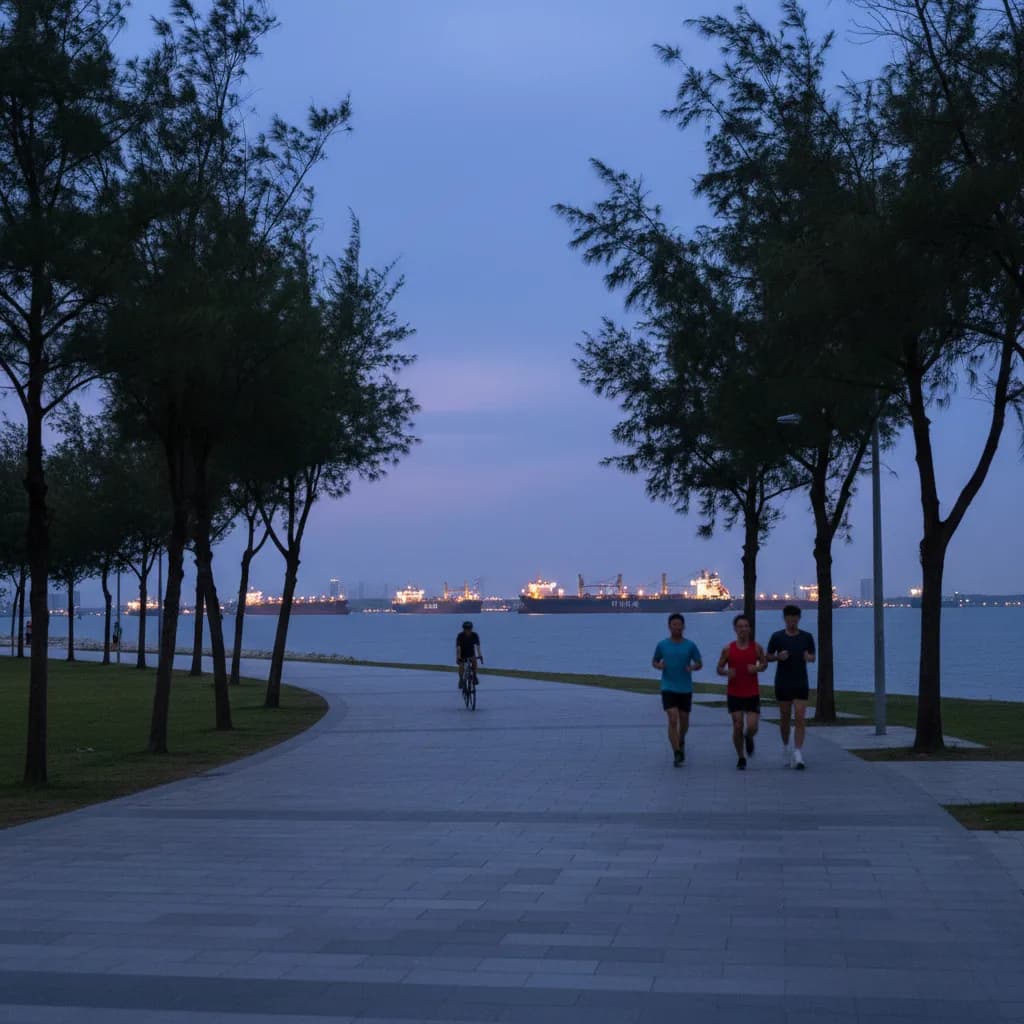
When the light starts to fade, walk south through one of the underpasses to East Coast Park. The long seafront path is one of the city's favourite places to exercise after work, with joggers, cyclists and families sharing it in the evening cool. Look out across the water and you will see dozens of ships anchored in the strait, their lights coming on as the sky darkens.
The park is long, so pick a short stretch rather than trying to cover it. Twenty minutes along the path in either direction gives you the breeze and the view without turning a gentle evening into a workout, and the hawker centres near the park make an easy, relaxed dinner stop.
Sample Routes by Time Available
With forty-five minutes, come out at Katong Park or Tanjong Katong, walk a short section of East Coast Road for the shophouse facades, turn up Joo Chiat Road to Koon Seng Road, then return the same way for dinner. This is the version for a weeknight when you want heritage and a good bowl of noodles without a late night.
With ninety minutes, do the full loop. Start at Paya Lebar, walk south along Joo Chiat Road past Geylang Serai, detour through Koon Seng Road, continue to East Coast Road for dinner, then cross to East Coast Park and walk the seafront for half an hour before taking the train home from Marine Parade.
If you are meeting a friend, name a junction rather than a restaurant you have only seen online. The corner of Joo Chiat Road and Koon Seng Road is easy to find and lets you both begin the walk together.
Where Karpo Comes In
Karpo helps you choose where to stop and in what order. In the Karpo APP, describe the evening you have in mind, for example: leaving the office in Raffles Place at six, want to see the Peranakan terraces before dark, then laksa for two and a short seaside walk, heading home on the Thomson-East Coast line. Karpo suggests stops and an order that keeps the walking easy and ends near a station.
Karpo does not monitor queues or crowds as they happen, does not hold tables for you and does not give live train times. If a first choice looks too busy when you arrive, ask Karpo for something nearby on a quieter lane and carry on with the walk.
Practical Notes
Afternoon thunderstorms are common, especially during the monsoon months, and the covered five-foot ways along East Coast Road are the best shelter. Bring water, wear comfortable shoes, and dress modestly if you plan to step inside a temple or church. Above all, remember that the terraces are homes, so the best photographs are taken quietly and from a respectful distance.
Ask Karpo for more information.
Keep reading
- Marina Bay Food Market Grazing Route After a Conference Day
 River Valley Food Market Grazing Route With Young Kids
 Serangoon Food Market Grazing Route for a Homecoming Weekend