 Marina Bay Food Market Grazing Route After a Conference Day
Neighborhood Guides

Bugis Post Work Route Planner: Temples, Arts and Books
Bugis links Waterloo Street's side-by-side temples, the Bras Basah museum belt and Fort Canning's slopes. Plan a relaxed walk out of the office from here.
Bugis is where the city's evening crowd and its oldest civic quarter meet. Step out of the station and you can be among temple incense on Waterloo Street within three minutes, then wander into a district of convent courtyards, museum lawns, art schools and secondhand bookstalls. A Bugis post work route planner is about choosing a gentle line through all of that, so the walk feels like a reset rather than a second commute.
How the District Fits Together
Picture a shallow triangle. Bugis station, on the East-West and Downtown lines, sits at the northeast corner. Waterloo Street and Queen Street run southwest from it as pedestrian-friendly avenues. Bras Basah Road crosses them at the bottom, and beyond it the land rises into Fort Canning Park. Bras Basah and Bencoolen stations, on the Circle and Downtown lines, make useful exits at the far end.
The area grew up around mission schools, churches and temples, and many of those buildings survive as schools, galleries and arts spaces. That is why the streets feel calmer here than in the shopping malls a block away. Students, office workers and older residents share the same pavements, and after work the mood is easy and unhurried.
Waterloo Street: Two Temples Side by Side
Start where the neighbourhood is most alive. On Waterloo Street, the Kwan Im Thong Hood Cho Temple draws a steady flow of worshippers, especially in the early evening when people stop on their way home to light incense and ask for guidance. Right next to it, the Sri Krishnan Temple has its own bright gopuram, and it is common to see people offering prayers at both. It is one of the clearest pictures of the city's everyday religious mix.
Give the space room. Walk slowly along the pedestrian stretch, look at the flower and fortune stalls that gather nearby, and keep photographs wide rather than pointing a lens at someone praying. The scent of incense and jasmine is half of the experience.
The Arts Belt and the Bookstalls
Further down Waterloo Street, the old school buildings have been converted into studios, rehearsal rooms and small galleries. Stamford Arts Centre, in a former school, is one of the clearest examples, and the street often hums with dance or theatre groups arriving for evening rehearsals.
Around the corner, the Bras Basah Complex has long been the city's unofficial home for books, with secondhand shops, stationery stalls and art supply counters stacked floor to ceiling. It is not glamorous, and that is the point. If you are the kind of person who decompresses by browsing, plan an extra twenty minutes here and let yourself get lost in the shelves.
Convent Courtyards and Church Lawns
Cross towards Victoria Street and you reach CHIJMES, the former Convent of the Holy Infant Jesus, whose Gothic chapel and cloistered courtyards now host restaurants and events. Walk through the arcades for the architecture, then pause by the chapel, which is still one of the most photographed buildings in the city centre.
Nearby, the Cathedral of the Good Shepherd, the city's oldest Catholic church, sits within a quiet walled compound that makes a welcome pause. Its lawn is a reminder of how green this part of the centre still is, even with towers on every side.
Museum Lawns Towards Fort Canning
Follow Bras Basah Road west and the buildings grow grander. The National Museum of Singapore, with its white dome, is the oldest museum in the country, and its forecourt is a pleasant place to sit as the light softens. On Armenian Street, the Peranakan Museum occupies a restored school building, and its facade alone is worth the detour.
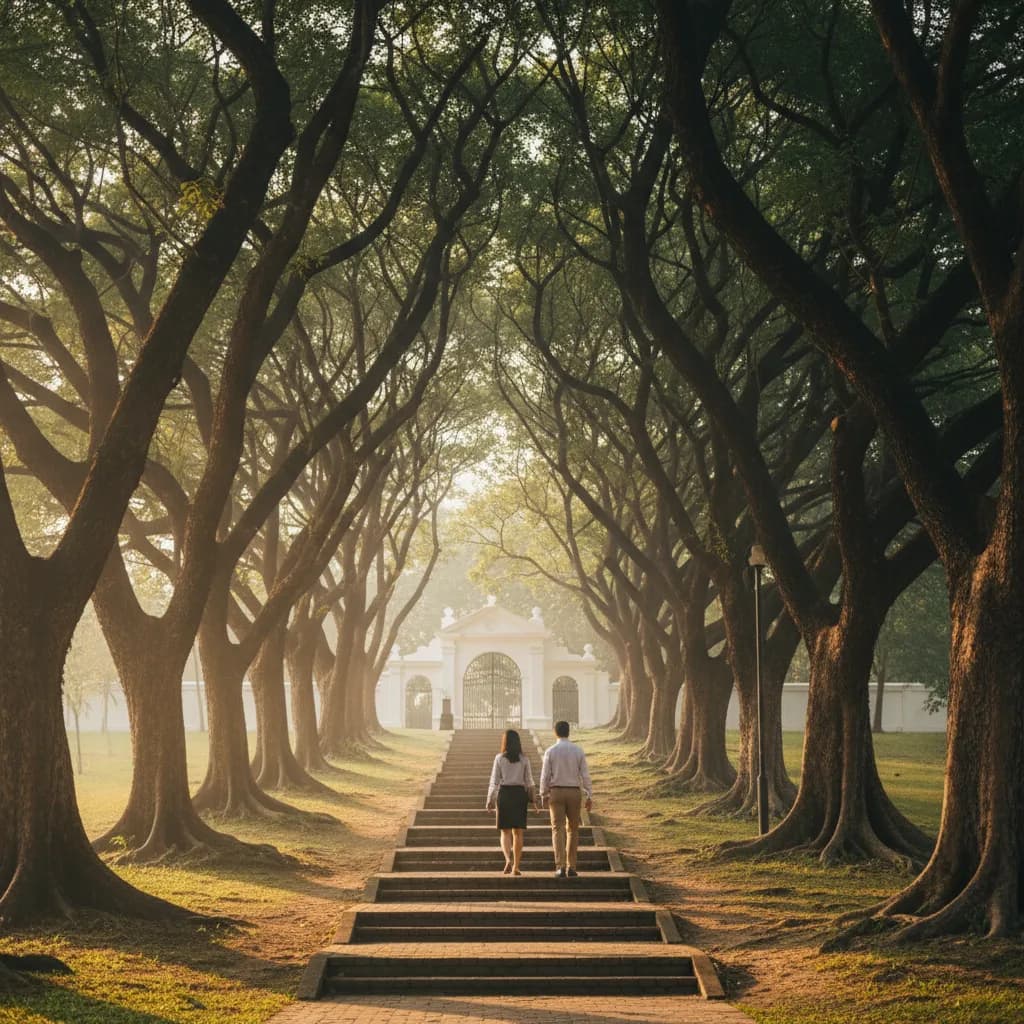
Behind the museum, the ground rises into Fort Canning Park. This hill was once the seat of ancient Malay kings, later a colonial fort and now a quiet park of rain trees, old walls and lawns. Climb the steps slowly, find the Fort Gate and the spice garden, and enjoy the cooler air under the canopy before heading down to Fort Canning or Dhoby Ghaut station.
Choosing the Right Evening
Weeknights are the sweet spot. On Mondays to Thursdays, the temple forecourt is busy but never crushed, the arts buildings have rehearsals spilling light onto the street, and the museum lawns are close to empty once the school groups have gone home. Weekends draw far bigger crowds to the shopping streets around Bugis station, so if you come then, start from Bras Basah and walk the route in reverse, saving the temples for last. Festival weeks such as Chinese New Year and Vesak bring extra worshippers and colour, which is lovely to see but needs more time and patience.
Sample Routes by Time Available
With thirty-five minutes, keep it simple. Leave Bugis station, walk Waterloo Street past the two temples, look into a couple of the old school buildings on the arts stretch, then cut across to Bras Basah station. That is enough to clear your head before the ride home.
With eighty minutes, take the full line. Start at the temples, continue down Waterloo Street to the bookstalls, cross to CHIJMES and the cathedral lawn, walk past the National Museum, then climb Fort Canning Park for the last of the light. End with dinner that Karpo has suggested near Dhoby Ghaut, where three train lines make getting home simple.
Meeting a friend? Choose a landmark rather than a mall entrance. The temple forecourt on Waterloo Street or the National Museum's front steps are easy to find and leave you both ready to walk.
Where Karpo Comes In
Karpo helps you decide where to stop and in what order. In the Karpo APP, describe your evening, for example: done at six near Bugis, want a quiet walk through the museum area and up Fort Canning, then a casual dinner for two, heading home on the North-South line. Karpo suggests places and an order that ends close to the station you need.
Karpo does not track crowds or queues as they happen, does not hold tables and does not give live train times. Check each venue's own website for anything you need to know in advance, and if your first pick is busy, ask Karpo for something nearby on a calmer street.
Practical Notes
The covered walkways between Bugis and Bras Basah are a good escape from late afternoon storms. Dress modestly if you plan to enter a temple, church or cathedral grounds, and keep conversations soft near worshippers. Fort Canning's steps can be slippery after rain, so take the gentler paths if the ground is wet, and carry water on humid evenings.
Ask Karpo for more information.
Keep reading
- Marina Bay Food Market Grazing Route After a Conference Day
 River Valley Food Market Grazing Route With Young Kids
 Serangoon Food Market Grazing Route for a Homecoming Weekend