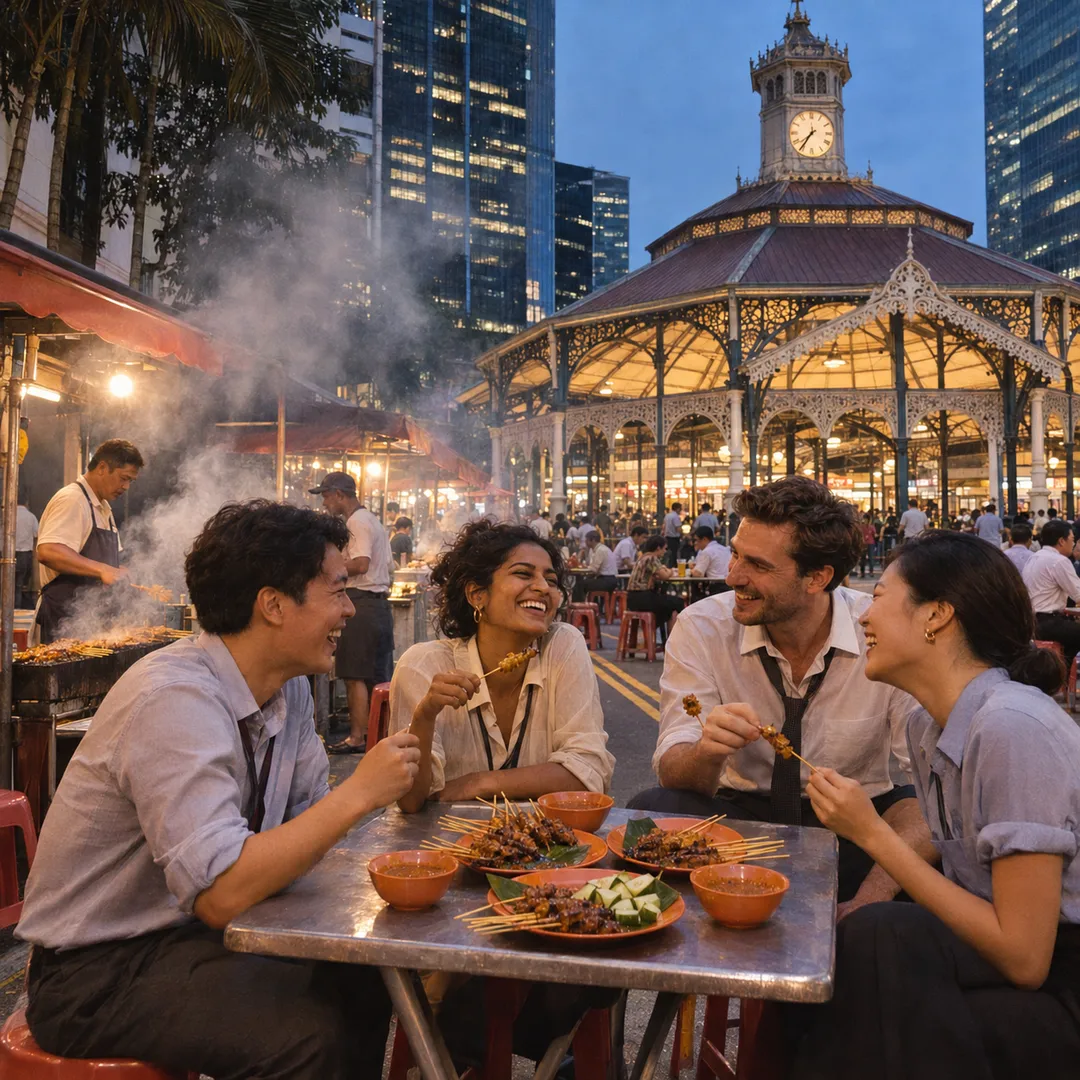
 Marina Bay Food Market Grazing Route After a Conference Day
Neighborhood Guides

Singapore Neighborhood Itinerary Builder: Meet Here, Then Go
Begin a Singapore outing at the meeting point you already chose. Compare a return route with an onward finish, and keep the first move simple for everyone.
A meeting point can be the strongest piece of a Singapore afternoon plan. Your friends already know where they will arrive, yet the conversation keeps drifting toward destinations scattered across the city. Turn the question around: what is worth doing from the place where the outing actually begins? A neighborhood itinerary builder can be approached as a way to work outward from that fixed point. Open the Karpo APP and describe where you intend to meet, what your group enjoys, and where people need to go afterward. Then evaluate suggestions against the route you can comfortably carry out.
A station name is only the beginning
Agree on a recognizable meeting place before discussing the first activity. Naming a transit station establishes an area, but your group still needs to know where to stand and how to recognize one another. Choose a specific public meeting point that you can identify with confidence. If someone is unfamiliar with the area, send a simple description rather than assuming that everyone will interpret “outside” the same way. Your actual meeting instructions belong in the message you share with friends, alongside the time.
Separate that logistical choice from the recommendation request. You might ask: “Our Singapore afternoon starts at a meeting point we have chosen near transit. We want a casual meal and a short neighborhood activity afterward. Suggest options that suit this starting area.” Include the point's name and your intended arrival time when you make the real request. Avoid asking the planning conversation to infer the right entrance, identify your friends, or know which route they have taken. Those details come from the people attending.
Compare returning to the start with moving onward
There are two useful shapes to consider. A return route brings the outing back toward the original meeting area. An onward route finishes elsewhere, perhaps closer to dinner or a later commitment. Neither shape is automatically easier. The return option can make the ending familiar, while the onward option can avoid retracing a stretch you have already walked. Decide based on your group's next journey and the experiences you want between arrival and departure, rather than the visual neatness of a loop.
Ask for the tradeoff in plain language: “Would you keep this outing near our starting point, or let it end in another part of the district? Explain what each choice would mean for our plan.” Treat any comparison as a proposal to assess. You are looking for a clear reason to choose an ending, not an assurance that a route is accessible or that a connection takes an exact number of minutes. Use actual journey information when deciding how the proposed finish works for each person.

Protect the first move after arrival
The first destination should be easy to explain once everyone has gathered. A complicated opening can make the organizer spend the first part of the outing answering messages and giving directions. Choose a first activity that matches the group's state on arrival. Friends coming from work might want food and a seat. Visitors carrying bags might prefer to settle before browsing. These are personal circumstances worth stating directly, because “something nearby” says little about what the group needs from its first stop.
Imagine two proposals with equally attractive destinations. One begins with a meal close to your meeting area and adds a short exploration afterward. The other requires an immediate transfer before the meal. The second may still be worthwhile if the meal is the purpose of the outing, but the extra movement should be a conscious choice. Tell Karpo whether you are willing to travel again after meeting. This gives the conversation a useful boundary and keeps a desirable destination from quietly rewriting the whole afternoon.
Include the departure point in the brief
An outing that starts well can still end awkwardly when nobody considered the trip home. Ask each person whether there is a fixed departure commitment, then distinguish that deadline from a vague preference to leave sometime later. If one friend needs to return toward the original station, that can influence which stop comes last. If everyone is heading in different directions, a convenient public ending may matter more than completing a circuit. The route serves the people, so its final shape should reflect their actual next steps.
For a hypothetical group with an early evening commitment, you could request a plan that finishes with room for an onward journey and keeps the final activity optional. Do not spend every available minute on the activities themselves. Arriving, finding each other, ordering, and settling a bill are all parts of a real outing. Your personal time allowances make the proposal more usable, even when no business-specific duration is known. Label them as planning choices rather than presenting them as verified service or transit times.
Keep alternatives attached to a decision
A useful alternative answers a particular problem. If the group wants less walking, an alternative first stop should reduce movement. If the ending needs to move closer to the starting area, the alternative should solve that departure issue. Asking for unrelated backups can produce another long list with no clear role. Instead, describe the condition that would make you change the route, and ask for one adjustment that preserves the parts of the afternoon you already like.
Suppose the initial proposal feels too ambitious after a long morning. A focused follow-up would be: “Keep the meeting point and the meal, but shorten what follows and bring the finish closer to where we started.” You are editing the route around stable decisions. That is easier to discuss with friends than reopening every choice. If the shortened version no longer contains a meaningful neighborhood activity, it is also fine to keep only the meal and a brief wander. A good afternoon does not need a prescribed number of stops.
Practical notes for the person organizing
Write a compact handoff once the group has chosen. Include the meeting location, the first destination, the general order, and the planned finishing area. Keep one version of those instructions in the group conversation, and update it clearly if the decision changes. Do not imply that Karpo is tracking arrivals or automatically sending changes to everyone. The organizer still needs to communicate the agreed plan, and each attendee should understand which details are fixed and which remain flexible.
Use the Karpo APP when you want to narrow the next decision, whether that is finding an opening activity or comparing two possible endings. A suggestion is a starting point for choosing, and any booking or ticket commitment requires its own explicit confirmation. Once those decisions are settled, let the meeting point do its job: give the group a calm beginning. A route built around arrival and departure can feel more coherent than a collection of famous stops, because it follows the afternoon your friends are actually having.
Ask Karpo for more information.
Keep reading
- Marina Bay Food Market Grazing Route After a Conference Day
 River Valley Food Market Grazing Route With Young Kids
 Serangoon Food Market Grazing Route for a Homecoming Weekend