 Marina Bay Food Market Grazing Route After a Conference Day
Neighborhood Guides

Tiong Bahru Historic Neighborhood Photo Walk: Art Deco Dawn
A Tiong Bahru historic neighborhood photo walk is free and calmest after sunrise, when the curved 1930s flats and spiral back stairs glow in soft light.
A Tiong Bahru historic neighborhood photo walk is a study in curves. Soon after sunrise the estate's pale walk-up flats catch a soft golden light on their rounded corners, ribbon balconies and porthole windows, while the spiral staircases at the back throw elegant shadows across the courtyards. The loop is free, compact and shaded, and it weaves between homes, a temple, murals and one of the city's best-loved hawker markets.
Why Tiong Bahru Looks Unlike Anywhere Else in Singapore
Tiong Bahru was one of the first public housing estates in Singapore, built in the years before the Second World War on land that had once been a burial ground, which is where the name comes from: a blend of Hokkien and Malay meaning roughly new cemetery. The colonial housing authority of the time chose a modern style, and the result is a rare cluster of low-rise flats in Streamline Moderne, an offshoot of Art Deco that loved smooth curves and horizontal lines.
Today the estate is conserved, so the original forms survive almost intact while the shopfronts beneath them change with the decades. For a photographer that creates a constant dialogue between old and new: a rounded balcony from the colonial era above a minimalist café, or laundry poles poking out beside pastel shutters. Low-rise blocks mean the sky stays visible in most frames, which keeps compositions open and airy in a city usually dominated by towers.
Seng Poh Road and the Classic Curved Corners
Start along Seng Poh Road, where the best-known curved blocks wrap around street corners like the prows of ships. Stand across the road and frame a full corner so the stacked balconies read as bold horizontal stripes. Early light from the east grazes the facades and reveals the subtle relief of ventilation grilles, window hoods and the narrow fins that divide each flat. A 35mm lens is ideal here, wide enough for a whole block without distorting it too much.
Then walk slowly along the five-foot ways at street level. These covered walkways were designed for tropical rain and sun, and they create long tunnels of shade punctuated by bright openings. Use the columns as a repeating pattern, wait for a cyclist or a shopkeeper raising a shutter, and you have a quietly cinematic frame. Keep exposure on the bright street beyond so the shaded columns fall into graphic silhouette.
Spiral Back Staircases and Hidden Courtyards
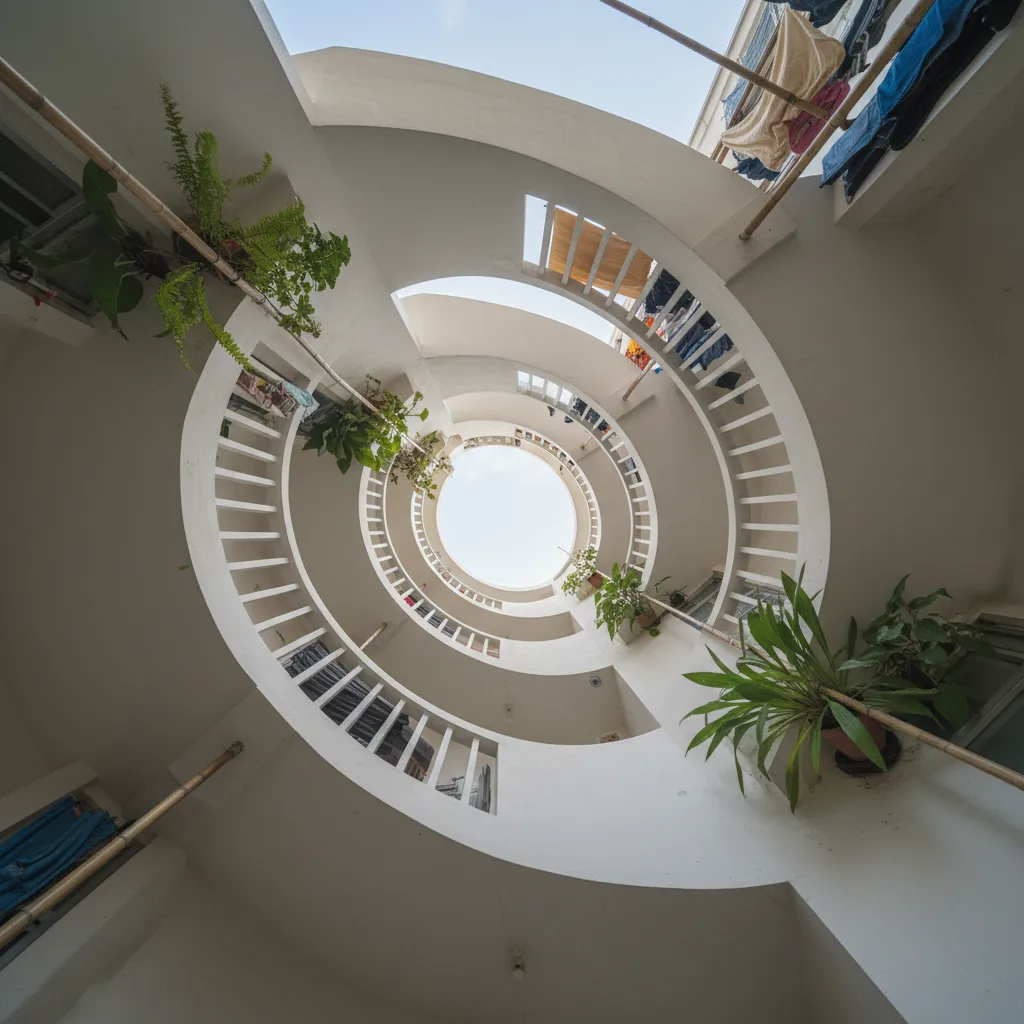
Slip into the service lanes behind the blocks to find Tiong Bahru's signature detail: the white spiral staircases that once served as back entrances for residents and hawkers delivering goods. Some coil upward in tight helixes, others hug the corners of courtyards. Shoot one from directly below for a nautilus-like abstract, or from the side to show the steps climbing past potted plants and laundry. Soft shade in the late afternoon also works well for these.
These lanes are residential, and the stairways lead to people's homes, so stay at ground level and never climb them for a better angle. Speak softly in the courtyards, and if a resident is hanging laundry or tending plants, ask before including them in your frame. A respectful, unhurried approach often earns a friendly nod and sometimes a story about how the estate looked decades ago.
Murals, the Monkey God Temple and Market Mornings
Wander toward Eng Hoon Street and the surrounding lanes to find a series of large murals by local artist Yip Yew Chong. They recreate scenes from old Singapore, such as a traditional market, a fortune teller and the inside of a family home, painted so realistically that real pipes and windows seem to belong to the scene. Photograph them both straight on and at an angle that includes the surrounding wall, so viewers can see how the painting blends into the building.
Nearby stands a small Taoist temple dedicated to the Monkey God, a much-loved neighbourhood shrine with deep roots in the estate. Its red lanterns, incense coils and carved roof ridges make a striking contrast with the white Art Deco blocks around it. Finish at the Tiong Bahru Market, where the upper floor hawker centre is busiest at breakfast. Shoot the steam, the queues and the hand-written menus with consent, then sit down and eat.
A Wartime Shelter and the Yong Siak Street Row
One of the estate's quieter surprises is a public air raid shelter built into the base of one of the blocks, a rare piece of wartime planning that sheltered residents during the Japanese occupation. It opens only for occasional guided heritage tours, so plan around those rather than expecting to wander in, but even the exterior adds a powerful layer to the story you are telling with your photographs.
End the loop along Yong Siak Street, a short, leafy stretch lined with independent shops in the ground floors of the old flats. By mid-morning the tables spill onto the pavement, which offers a lively closing scene. Look for reflections in shop windows that layer the curved balconies over the street, or for a frangipani tree dropping its white flowers onto the pavement.
Timing and Practical Notes
The best light is in the first two hours after sunrise and again in the hour before dusk, when the heat eases and shadows lengthen. Weekdays are quieter in the residential lanes, while weekends bring more energy to the market and cafés. Afternoon thunderstorms are common, so carry a compact umbrella and use the covered walkways to keep shooting through the rain, which often leaves wonderful reflections on the roads.
Keep your kit light, because humidity and heat make heavy bags tiring within an hour. A single prime and a spare battery are enough, and a phone shooting in its wide mode handles the spiral staircases well. Lenses fog when you step out of air conditioning, so let the camera acclimatise for a few minutes before the first frame. Blue hour after sunset is worth staying for, when the curved balconies glow under warm window light and the sky turns deep cobalt behind them.
The estate is a short walk from Tiong Bahru MRT station, and the loop takes about ninety minutes at a relaxed pace. If you want help shaping the morning, open the Karpo APP and ask Karpo to arrange these stops around your time or to suggest a nearby heritage lane to add. It works as a route planning companion so you can keep your eyes on the light.
Ask Karpo for more information.
Keep reading
- Marina Bay Food Market Grazing Route After a Conference Day
 River Valley Food Market Grazing Route With Young Kids
 Serangoon Food Market Grazing Route for a Homecoming Weekend