 Marina Bay Food Market Grazing Route After a Conference Day
Neighborhood Guides
Telok Ayer Historic Neighborhood Photo Walk: Old Shoreline
A Telok Ayer historic neighborhood photo walk is free and best at sunrise, when Amoy Street shophouses and the old seafront temples catch soft light.
A Telok Ayer historic neighborhood photo walk follows a coastline that no longer exists. The street once ran right along the water, where newly arrived immigrants stepped ashore and gave thanks at the temples and mosques that still line it. Today land reclamation has pushed the sea far away, and glass towers rise behind the pastel shophouses, which makes this one of the most layered free photo walks in Singapore.
A Street That Used to Be the Beach
The name Telok Ayer comes from Malay and means roughly bay of water. In the early colonial decades this was the shoreline, and boats from southern China, India and the Malay Archipelago unloaded passengers and goods directly onto the beach. The communities that settled here built houses of worship facing the sea, giving the street an unusually dense mix of faiths within a few hundred metres, each with its own architecture, colour palette and rhythm of daily ritual.
Reclamation gradually filled in the bay and moved the waterfront east, so the temples now look out over a busy road and office blocks rather than waves. That contrast is the heart of the walk. Almost every frame can hold two centuries at once, an ornate roof ridge against a mirrored skyscraper, or a carved doorway framed by a steel and glass canyon. Early morning gives clean light and empty pavements before office workers arrive.
Thian Hock Keng: Dragons Against Glass

Begin at the great Hokkien temple dedicated to Mazu, the goddess of the sea who protected sailors on the long voyage south. Its granite pillars, swallowtail roof ridges and porcelain-shard dragons are among the finest traditional craftsmanship in the city. Arrive soon after the gates open to catch incense smoke drifting through the morning light, and photograph the roofline from across the road so the dragons sit against the towers behind.
Inside, be quiet and mindful, because this remains an active place of worship. Avoid flash, never photograph worshippers' faces without permission, and keep out of the way of anyone lighting joss sticks. Details reward patience: carved stone lions at the entrance, painted door guardians, gilded beams and the play of shadows across the courtyard. A short telephoto lets you isolate ornament high on the roof without stepping into restricted areas.
Return at dusk if you can. As the sky turns violet, the temple's red lanterns light up and the office towers behind begin to glow floor by floor, which produces the classic old-meets-new frame this neighbourhood is known for. Brace against a pillar or a railing rather than setting up a tripod on the narrow pavement, and wait for the moment when the lantern light and the sky are roughly equal in brightness.
A Mosque, a Shrine and a Church Within One Block
Continue along the street to find a striking sequence of buildings from different communities. A mosque founded by Tamil Muslim traders stands close to the temple, its simple white facade and slender minarets offering a calm contrast to the riot of colour next door. Further along, an Indian Muslim shrine with a fanciful facade of tiny arched windows and miniature minarets looks almost like a wedding cake, while a Chinese Methodist church adds its own tower to the skyline.
This is a walk about diversity, so tell that story in your sequencing. Photograph each building in a similar way, perhaps straight on from the same distance, to create a typological series that highlights their differences. Then step back and find a frame that captures two or more side by side. Dress modestly, remove shoes where requested, and respect any signs asking visitors not to take photographs inside prayer halls.
Amoy Street and Ann Siang Hill Shophouses
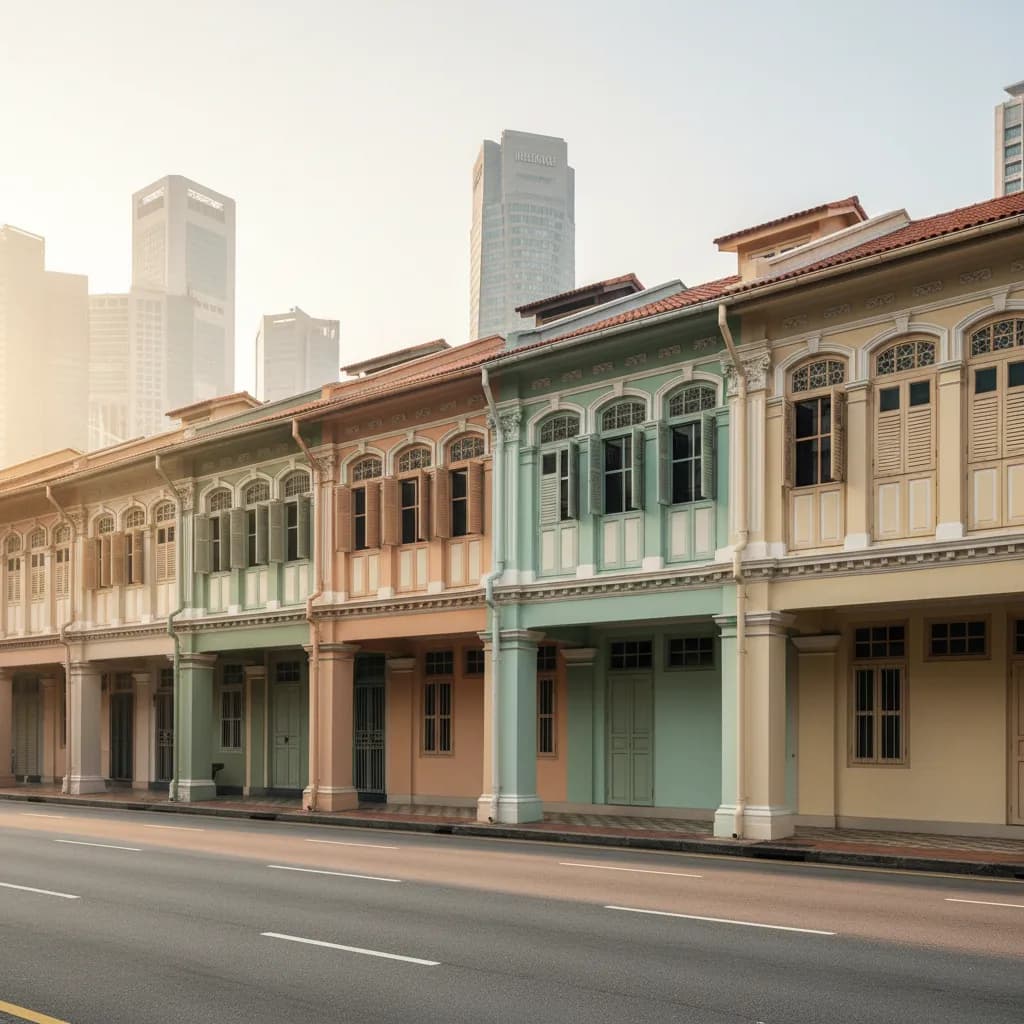
Walk one block inland to Amoy Street, named after the port in southern China that sent many early Hokkien settlers. The restored conservation shophouses here show off their decorative plaster mouldings, timber louvred shutters and pastel paintwork. Shoot the facades early, when the low sun rakes along them and reveals every floral motif, then switch to a tighter lens for details such as carved pintu pagar half doors and ceramic tiles on the five-foot ways.
From there climb the gentle slope of Ann Siang Hill, where a small park and winding lanes lead to Club Street. The topography creates interesting angles rarely found in flat Singapore, such as looking down over rooftops or up at a row of shophouses stepping uphill. Late afternoon light works beautifully on the hill, and by evening the lanes fill with diners, which turns the scene into lively street photography.
Look up as you walk, because the upper floors hold most of the history. Many shophouses keep their original window shapes, decorative vents and painted panels, while the ground floors have been remade for restaurants and studios. A vertical frame that shows an untouched upper storey above a modern shopfront tells the conservation story in a single image, and repeating that idea along the street gives your series a clear visual thread.
Victorian Ironwork and the Evening Hawker Glow
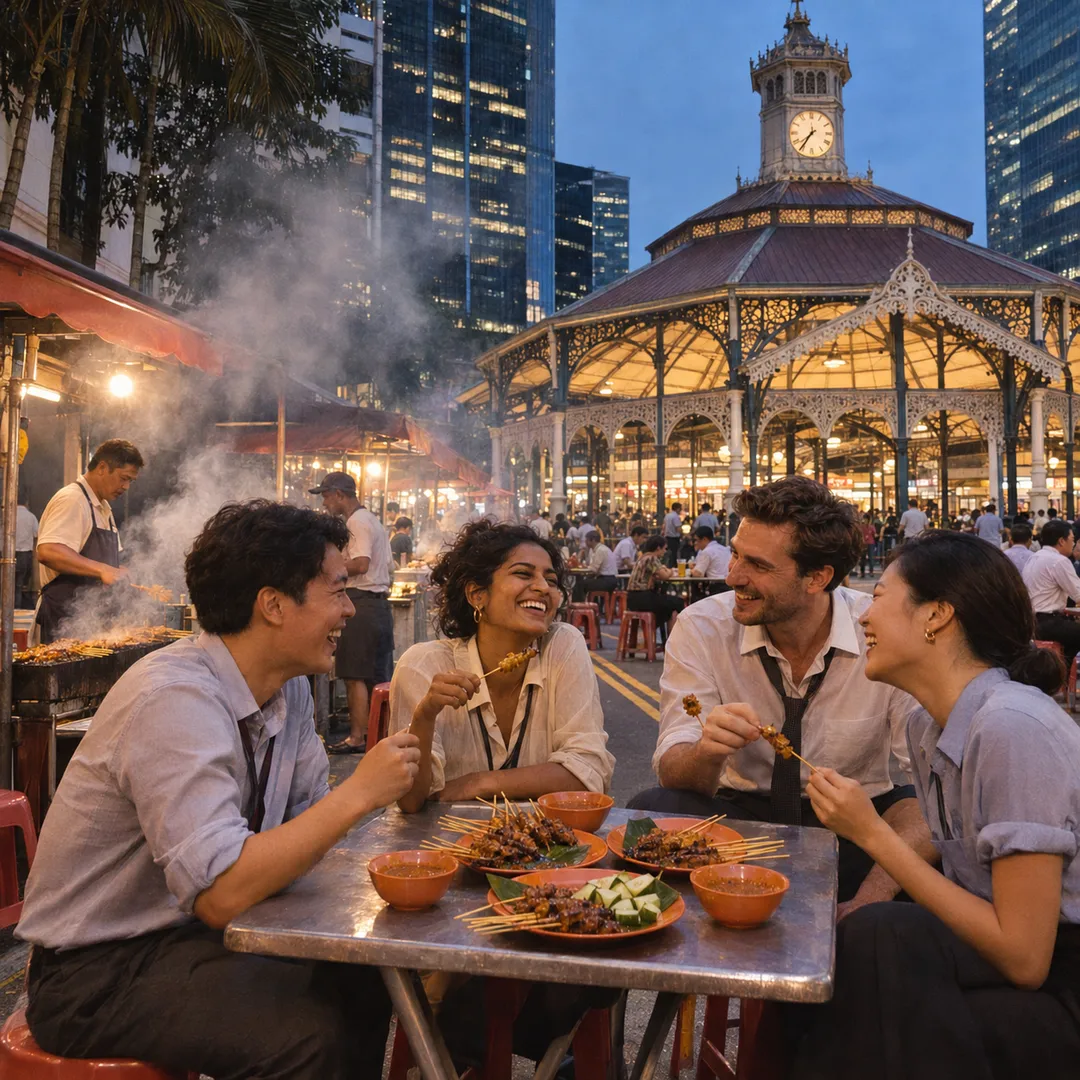
Finish at the octagonal Victorian cast-iron market pavilion nearby, a landmark of colonial-era prefabricated engineering. Its slender columns, filigree brackets and central clock tower make an elegant subject in daylight, but the real magic comes after dark, when the adjacent street closes to traffic and fills with smoky satay grills. The glow of charcoal and the ironwork above create a warm, cinematic closing scene for your set.
Shoot this moment with a fast prime and a slightly higher ISO rather than a tripod, which would obstruct the crowds. Look for silhouettes against the smoke, hands turning skewers, and the cast-iron arches framing the towers above. It is the perfect end to a walk that began at a vanished beach, connecting the city's immigrant past to its everyday food culture.
Timing and Practical Notes
The first two hours after sunrise give the softest light on the temples and shophouses, and weekday mornings are calmer before the business district fills. Heat builds quickly, so carry water and take breaks in shaded five-foot ways. Afternoon storms are common, but the covered walkways let you continue shooting, and wet streets add reflections. The loop sits between Telok Ayer and Tanjong Pagar MRT stations and takes about two hours.
If you want help shaping the route, open the Karpo APP and ask Karpo to arrange these stops in an order that suits your time or to suggest a quieter heritage lane nearby. It works as a planning companion, leaving you to focus on light, composition and the many stories written into these streets.
Ask Karpo for more information.
Keep reading
- Marina Bay Food Market Grazing Route After a Conference Day
 River Valley Food Market Grazing Route With Young Kids
 Serangoon Food Market Grazing Route for a Homecoming Weekend