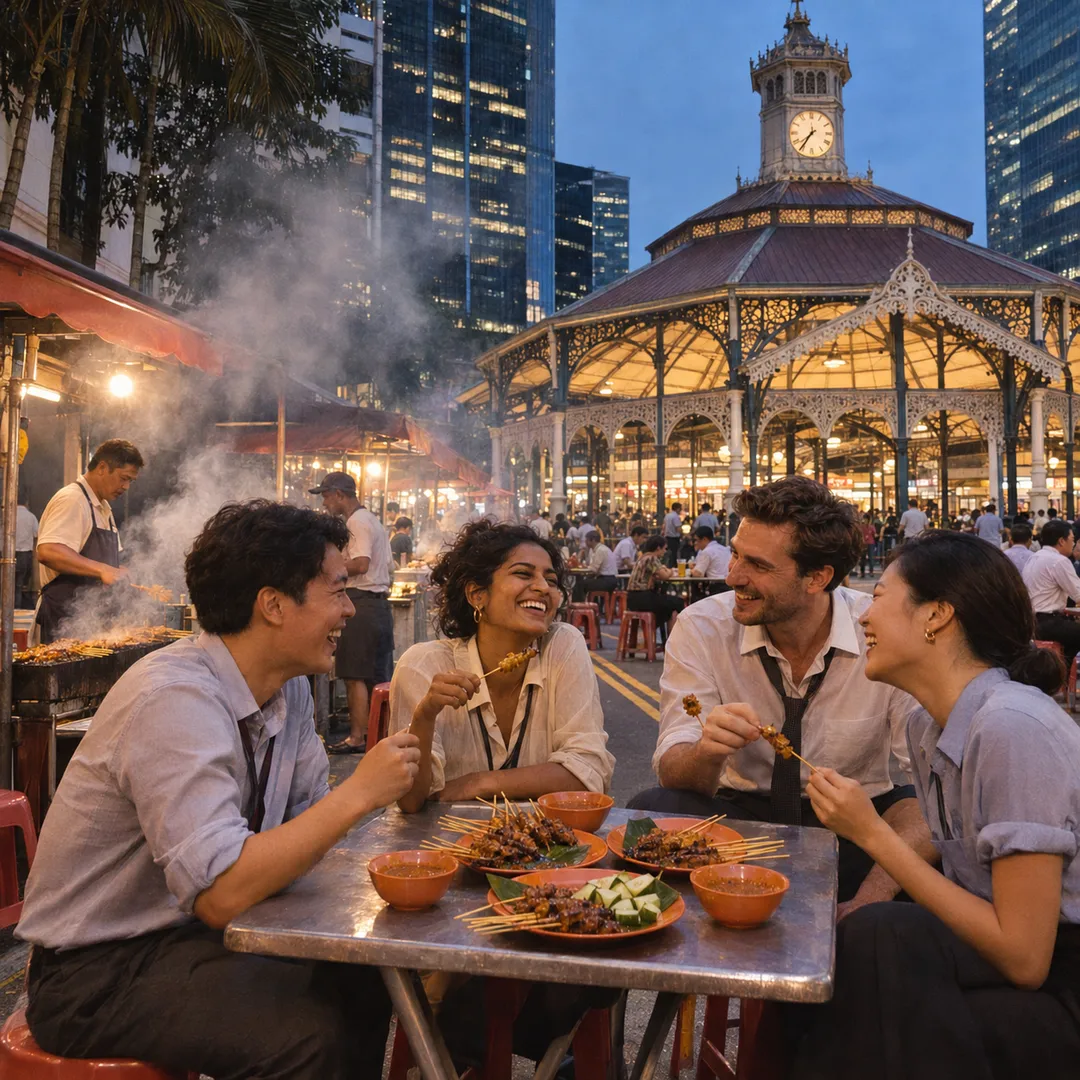
 Marina Bay Food Market Grazing Route After a Conference Day
Neighborhood Guides

Chinatown Historic Covered Passage Walk: Five-Foot Ways
Walk the historic covered passage walk through Chinatown in Singapore, connecting historic clan association five-foot ways, tea rooms, and market cuts.
Singapore's Chinatown is globally renowned for its bustling heritage markets and monumental temples, yet its most architecturally diverse covered walkways lie in the southwest pocket around Keong Saik Road, Bukit Pasoh, and Kreta Ayer. Taking a historic covered passage walk through this conserved quarter guides pedestrians beneath dramatic multi-story curved shophouse loggias, ornate clan association five-foot ways, and secluded rear guild alleys. Supported by the Karpo APP, cultural walkers explore the transition from nineteenth-century Cantonese merchant guilds to twentieth-century tropical Art Deco architecture in complete covered comfort.
Architectural Grandeur of Keong Saik's Curved Corridors
Commencing your walking route at the dramatic junction of Keong Saik Road and Teck Lim Road brings visitors face-to-face with the iconic 1939 building formerly known as the Tong Ah Eating House, constructed in the cylindrical Streamline Moderne style. This landmark building features sweeping curved covered loggias, continuous concrete cantilevered eyebrows, and a triangular corner prow that splits pedestrian traffic into two shaded shophouse corridors. Walking beneath the ground-floor arcade offers an intimate perspective on how pre-war architects merged Western industrial styling with traditional Asian shophouse typologies.
Strolling southward along Keong Saik Road reveals magnificent rows of Late Shophouse and Art Deco facades constructed during the rubber boom of the 1920s. The covered five-foot ways along this stretch are exceptionally wide, paved with geometric encaustic tiles and framed by rusticated masonry piers. Historically infamous as a red-light district and clan territory in the early twentieth century, Keong Saik's conserved covered walkways today house boutique heritage hotels, Michelin-starred culinary dining rooms, and creative design consultancies that preserve historic timber-shuttered fenestration. Cantonese guild records illustrate how early immigrant merchant societies pooled collective resources to construct elaborate multi-story shophouse headquarters equipped with shaded public colonnades.
Bukit Pasoh's Clan Association Colonnades and Cultural Enclaves
Turning uphill onto Bukit Pasoh Road introduces an exceptionally prestigious covered streetscape historically known as 'The Street of the Clans.' Bukit Pasoh features majestic three-story shophouse terraces where prominent Chinese clan associations, musical clubs, and benevolent societies established their headquarters in the late Qing and Republican eras. The covered five-foot ways along this gentle incline are paved with polished terrazzo and ornate mosaic tiles, framed by heavy timber double doors bearing gilded Chinese calligraphic nameplates.
Notable architectural landmarks include the Ee Hoe Hean Club, founded in 1895 as an exclusive gentlemen's club for wealthy Chinese businessmen that served as the headquarters of the China Relief Fund during the Japanese invasion. Walking beneath the shaded colonnades of Bukit Pasoh offers a serene, elevated atmosphere, where the sound of classical Cantonese opera rehearsals and traditional guzheng music occasionally drifts from upper-story timber jalousie windows, echoing through the cool covered arcade.

Optimal Visiting Hours and Shophouse Lighting
Exploring the covered walkways of Keong Saik and Bukit Pasoh is most rewarding during the late morning between nine-thirty and eleven-thirty. At this time, warm morning sunlight washes across the pastel-colored shophouse facades without penetrating the deeply recessed five-foot ways, keeping walking conditions cool and pleasant. Traditional pastry shops along Kreta Ayer Road slide open their wooden display grilles, filling the covered walkways with the comforting aroma of freshly baked egg tarts and traditional mooncakes.
During the midday period from twelve to two, the covered arcades provide essential shelter as neighborhood diners gather for lunch at local kopitiams and contemporary bistros. In the late afternoon between four and six, the setting sun casts a golden glow across the curved corner buildings of Keong Saik, creating spectacular photographic opportunities. As evening falls after seven, ambient amber lanterns illuminate the shophouse loggias, creating an enchanting dining corridor alive with conversation and gentle tropical evening breezes.
Connecting Kreta Ayer Theaters and Sago Street Alleys
Extending your walk eastward toward Kreta Ayer Road connects Keong Saik's refined avenues with the historic theatrical and street-market heart of early Chinatown. Kreta Ayer—meaning 'water cart' in Malay, referencing the ox-drawn water carts that supplied fresh water to the district in the nineteenth century—features continuous covered five-foot ways that linked opera houses, teahouses, and street stalls. Passing beneath the covered portico of the Kreta Ayer People's Theatre evokes the golden era of Cantonese opera in Southeast Asia.
Wandering into Sago Street and Trengganu Street brings pedestrians into vibrant pedestrianized street markets sheltered by continuous overhead glass canopies that span between facing shophouse rows. This modern overhead sheltering system allows visitors to explore traditional souvenir stalls, Chinese herbal medicine shops, and antique calligraphers in complete comfort regardless of torrential rainstorms. Meandering through these historic cuts highlights the layered evolution of Chinatown's covered public space over two centuries.
Navigating Surfaces, Footwear Tips, and Chinatown MRT Hubs
Surfaces throughout Keong Saik and Bukit Pasoh's five-foot ways comprise smooth terrazzo, glazed ceramic tile mosaics, and historic granite curbs that warrant comfortable, low-heeled walking shoes with good traction. Due to the undulating topography of Bukit Pasoh hill, walkers will encounter occasional single-step changes and gentle gradient ramps connecting adjacent shophouse frontages. Handrails are present along steeper curb sections to assist mobility-impaired visitors.
Public transit access is exceptionally comprehensive, with Chinatown MRT station on the North-East and Downtown lines situated a five-minute walk to the northeast, and Outram Park MRT station on the East-West, North-East, and Thomson-East Coast lines positioned four minutes to the west. Both stations offer extensive air-conditioned underground exits leading directly to street-level sheltered walkways. Modern public restroom amenities are available inside Chinatown Point shopping mall and within the Kreta Ayer Community Club.
Chinatown Guild Wayfinding with the Karpo APP
Uncovering Chinatown's rich clan and guild architecture is made seamless through the specialized historical routes embedded in the Karpo APP. The platform documents the migration stories behind each clan association facade, translating calligraphic stone inscriptions and detailing early twentieth-century philanthropic societies. Clear digital trail markers guide walkers through quiet second-story loggias and hidden rear courtyards that reveal forgotten Cantonese opera houses.
Furthermore, the app provides real-time recommendations for heritage tea houses, traditional herbal tonic stalls, and acclaimed noodle counters operating within conserved five-foot ways. Interactive map layers allow travelers to transition smoothly between Keong Saik's trendy dining strip and Kreta Ayer's traditional street market canopies. Navigating Chinatown's architectural diversity with the Karpo APP guarantees a deeply rewarding and historically authentic urban walk.
Ask Karpo for more information.
Keep reading
- Marina Bay Food Market Grazing Route After a Conference Day
 River Valley Food Market Grazing Route With Young Kids
 Serangoon Food Market Grazing Route for a Homecoming Weekend