 Chinatown New in Town Weekend Planner: Errands and Temples
Weekend Plans
Singapore Hidden Courtyard Garden: Raffles for Two Friends
Raffles Courtyard places alfresco socialising among greenery in Singapore. Use its garden setting for a conversation led by leaves, shade and enclosure.
Raffles Courtyard places a hidden courtyard garden experience inside an alfresco social setting in Singapore. The hotel describes greenery around a relaxed bar and lounge, so the appeal is a conversation held within a planted enclosure rather than a solitary ramble through a botanical collection. Choose it for the relationship between people, leaves and surrounding architecture. The garden is part of the atmosphere of a social venue, and that distinction should shape what you expect from the visit.
Decide what kind of pause you want
For a catch-up, the useful question is whether you want a garden to look at or a garden to be in while talking. Raffles Courtyard fits the second idea. Let greenery remain in the corner of your attention, instead of treating every plant as a stop on a tour. Imagine meeting a friend after a busy day and agreeing to leave the next destination undecided. That is a possible visitor scenario, not an account of a conversation observed at the hotel.
If your main wish is to identify plants, make detailed drawings or cover a long walking route, choose a different kind of outing. A courtyard lounge does not become a botanical garden because its setting is leafy. Being honest about that can make the visit more satisfying. Here, the central activity can simply be listening to the person across from you, with the enclosure giving the meeting a different visual character from a table facing an ordinary street.
Let the enclosure change the conversation
Begin by noticing what bounds the view. In an inward-facing courtyard, the surrounding building gives a sense of a room whose ceiling is the sky. Greenery introduces softer lines within that architectural frame. You can observe this without assigning a historical story to every column or doorway. The hotel provides its own account of the property, but the immediate experience does not require you to invent connections between the plants and famous former guests.
Try a conversation prompt drawn from the setting: which would you rather see from a table, an open horizon or a close layer of leaves? The answer often says more about somebody's mood than a general question about how their week has been. It also gives the garden a role beyond decoration. A companion might prefer enclosure because there is less to scan, while another might miss a distant view. There is room for both preferences without declaring one the correct way to relax.
Green is a range, not a single backdrop
The official description places Raffles Courtyard among lush planting. Look for contrasts within that greenery rather than expecting a specific flower or named specimen. A broad leaf can catch light in one way while a finer cluster creates a darker patch behind it. The difference matters more to this sort of visit than memorising a plant list. It gives you something particular to notice during a natural pause in the conversation, without taking attention away from your companion.
Avoid turning the setting into evidence of a guaranteed sensation. Shade, breeze and quiet are things to experience on the day, not promises that follow automatically from the word courtyard. If the light feels strong, the air feels still or the surroundings feel lively, respond to what is in front of you. A good garden meeting does not depend on pretending the city has disappeared. It depends on finding an arrangement that suits the people who are actually there.
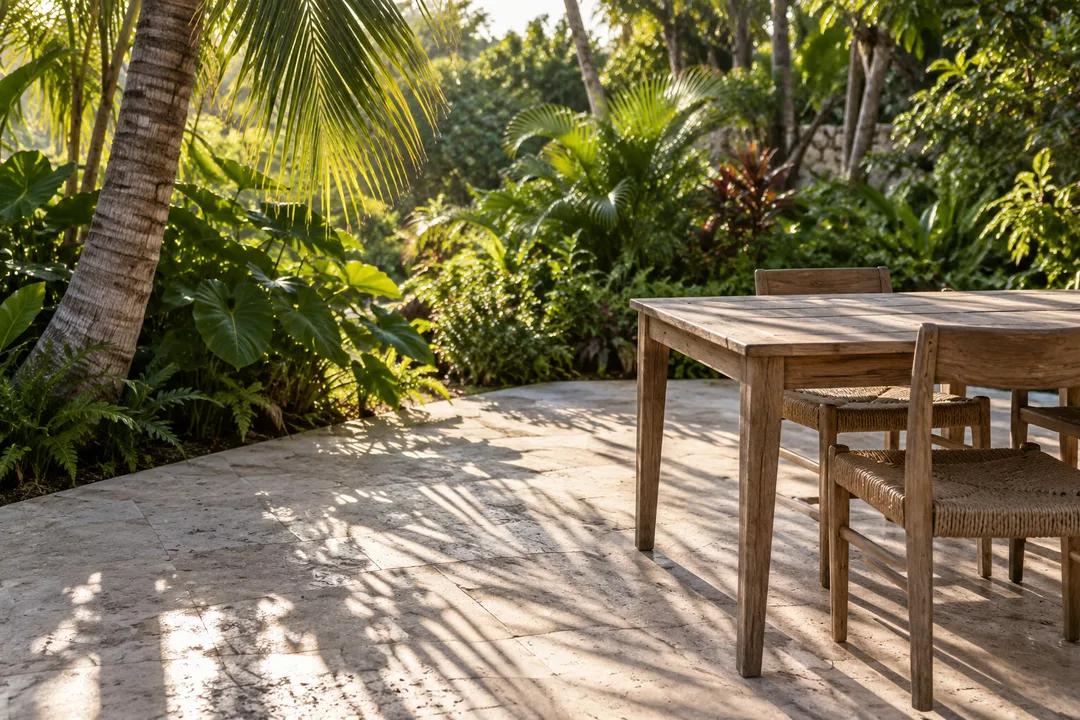
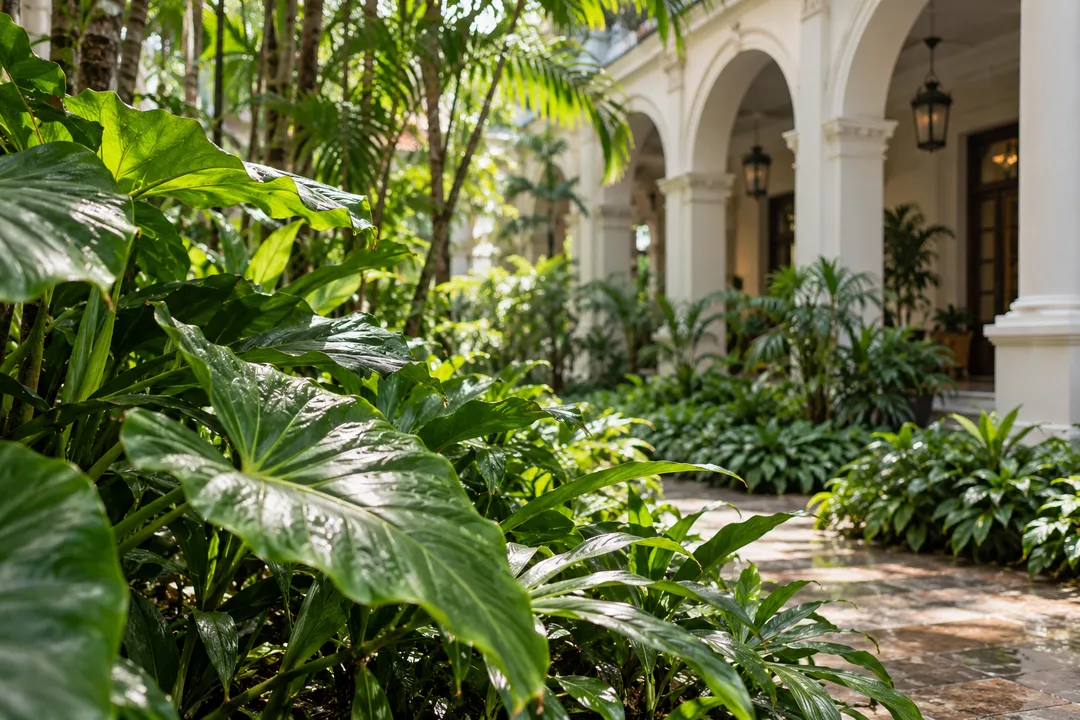
Both images are AI-generated interpretations of a tropical courtyard atmosphere, not photographs of Raffles Courtyard or its tables.
A photograph that leaves the meeting intact
Before taking a picture, decide whether you are remembering the setting or interrupting the catch-up. A single frame of planting and architecture may be enough. Keep other guests out of the composition unless they have agreed to be included, and avoid making staff wait while you arrange an elaborate scene. The point is to remember where the conversation happened, rather than to make the whole courtyard look as though it belongs to your group.
For a detail image, consider the edge between a leaf and a pale surface, or the pattern made by a shadow. Cropping closely reduces the need to photograph people nearby. Leave the plants exactly as they are: moving a frond, bending a stem or placing belongings in a bed changes the space for the sake of a picture. The photographic illustrations accompanying this article suggest texture and enclosure, rather than claiming to document a particular table or arrangement at the hotel.
When company matters more than an itinerary
Two people can share a courtyard without wanting the same activity. One might enjoy discussing the surroundings, while the other wants a place to talk about something unrelated. Make the garden an invitation, not an assignment. A useful compromise is to notice one detail together and then let the conversation move on. You have not missed the garden because you failed to inspect every corner. Its setting can support a meeting without becoming the meeting's entire subject.
For a small group, decide early how the outing will end. People may have different onward plans, and an indefinite pause can become awkward when only one person wants to continue. Offer a clear choice between finishing together and separating for individual plans. This is a social suggestion, not a rule of the venue. It keeps the courtyard visit from becoming a negotiation about a second destination when the original purpose was simply to spend some time together.
Step back into the Civic District
An onward walk around Singapore's Civic District changes the scale from inward enclosure to streets and larger public views. Carry one visual theme with you: the contrast between planting and pale masonry, or between a shaded edge and open sky. Use public pedestrian routes and avoid treating hotel corridors as shortcuts to wherever you want to go next. A courtyard encounter works well when the transition back into the city is part of the pleasure, rather than an inconvenience between attractions.
If you want to keep talking, choose a walk for its simplicity rather than the number of landmarks it can include. Let one person navigate and the other set the pace, then swap if that becomes tiring. If the weather makes walking unattractive, end the route idea without turning it into a disappointment. The courtyard has already served a purpose. There is no need to add another green space to make the outing feel sufficiently full.
Practical Notes for a social garden setting
Use Raffles Courtyard's own dining arrangements for a visit rather than assuming a hotel garden works like a public picnic ground. Respect the distinction between a guest-facing social venue and the hotel's other spaces. Keep belongings within your place, leave service paths clear and follow staff direction. This article focuses on the setting and deliberately makes no promise about a particular table, level of quiet or access to other courtyards within the property.
The Karpo APP can be a starting point for an onward Singapore idea when the group decides it wants one. Ask for the kind of experience you need next, such as a short walk or something indoors, and name the area you want to stay around. Do not let the search replace the conversation you came to have. A successful Raffles Courtyard pause might leave you with only one remembered detail of greenery, and a much clearer sense of what your companion wanted to say.
Ask Karpo for more information.
Keep reading
- Chinatown New in Town Weekend Planner: Errands and Temples
 Kampong Glam New in Town Weekend Planner: Mosque to Murtabak
 Holland Village New in Town Weekend Planner: Meet People