 Kovan Hainanese Curry Rice Lunch Picker: Heartland Plates
Restaurants
Lau Pa Sat Heritage Food Court Finder: Victorian Route
Discover Lau Pa Sat Victorian cast-iron dining halls with targeted historic filters to appreciate colonial filigree arches and lively open-air market walkways.
Positioned in the heart of Singapore's central financial district, Lau Pa Sat stands as a singular architectural triumph where Victorian industrial ironwork meets the vibrant traditions of Southeast Asian communal dining. Utilizing a comprehensive heritage food court finder enables architecture enthusiasts and culinary explorers to navigate this historic octagonal market hall, formally gazetted as a National Monument in nineteen seventy-three. Originally erected along the colonial waterfront before successive land reclamation projects reshaped the shoreline, this magnificent structure shelters hundreds of dining stalls beneath soaring prefabricated cast-iron arches shipped from Scottish foundries in the late nineteenth century. Karpo APP provides an illuminating guide to exploring Lau Pa Sat and the historic Telok Ayer conservation district, blending architectural history with pedestrian-friendly discovery routes.
Victorian Filigree Cast-Iron Engineering And Scottish Origins
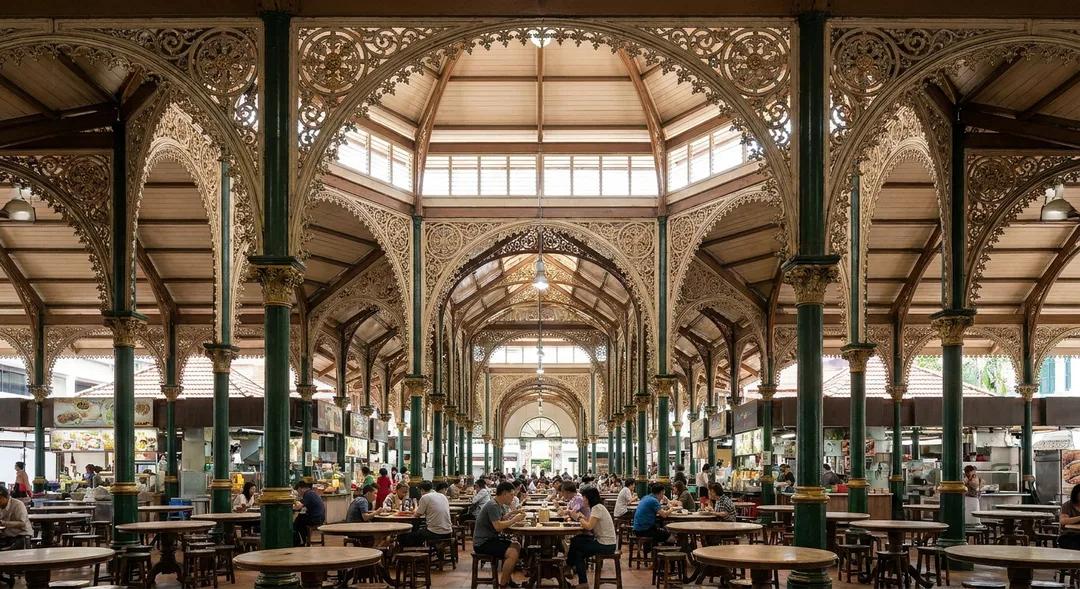
The present octagonal pavilion of Lau Pa Sat was designed by municipal engineer James MacRitchie and constructed between eighteen ninety and eighteen ninety-four, replacing an earlier wooden market structure established during Stamford Raffles' founding era. MacRitchie specified prefabricated cast-iron columns, soaring openwork trusses, and delicate filigree brackets manufactured by P&W MacLellan at the Clutha Ironworks in Glasgow, Scotland. Shipped across the globe as modular components, the iron frame was assembled on site to create an expansive unobstructed hall radiating outward from a central clock tower topped with a brass chiming bell that still tolls over the surrounding financial towers.
Walking beneath these slender Victorian columns today, one is struck by the timeless grace of the engineering design. The octagonal floor plan encourages natural air movement from all eight directions, while the elevated central clerestory allows rising tropical heat to escape continuously through open louvers. Elaborate floral rosettes, fluted column shafts, and geometric fretwork adorn every structural junction, offering a visual elegance seldom encountered in public dining halls. This harmonious union of Victorian industrial precision and equatorial climate design makes Lau Pa Sat one of the world's finest surviving Victorian cast-iron market pavilions.
The Atmospheric Transition To Evening Satay Street
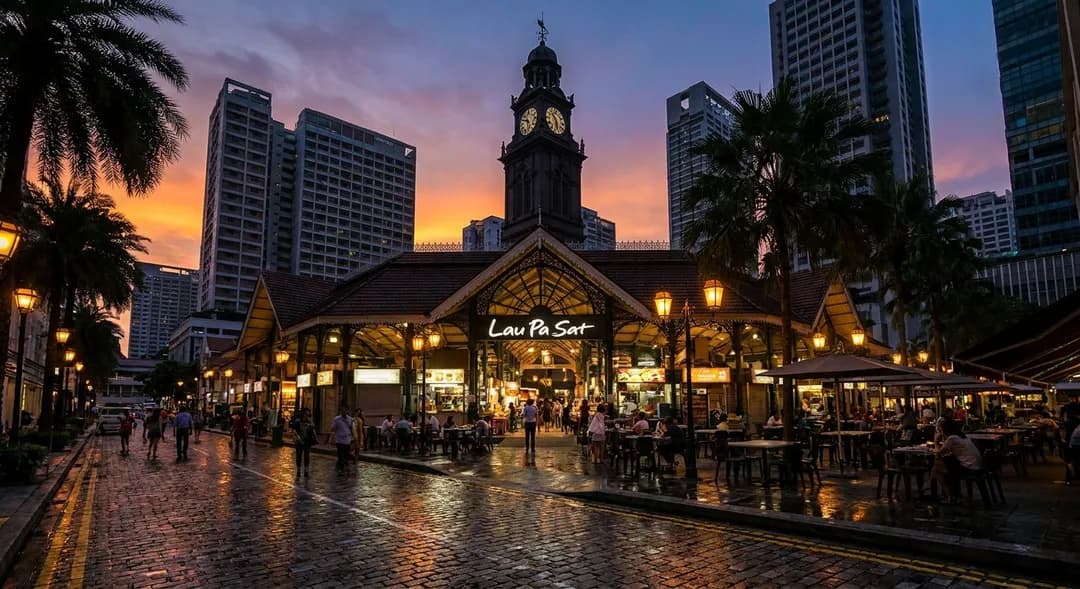
While Lau Pa Sat hums with commercial activity during weekday lunch, its most dramatic social transformation occurs as dusk descends over the surrounding glass skyscrapers. At seven o'clock each evening, Boon Tat Street directly adjacent to the market pavilion is closed to vehicular traffic, swiftly transforming into the famous open-air Satay Street. Experienced vendors roll out dozens of glowing charcoal grills, wooden folding tables, and plastic stools across the asphalt, filling the evening air with the irresistible aroma of caramelizing skewered meats and lemongrass-infused marinades that draws crowds from across the island.
The visual contrast between the glowing charcoal braziers at street level and the towering illuminated corporate towers overhead creates an unforgettable urban spectacle. Diners sit shoulder to shoulder in the warm evening air, dipping tender skewers of chicken, beef, and mutton into rich, spiced peanut sauces topped with grated pineapple. Energetic smoke billows into the night sky, fanned by veteran grillers holding traditional woven wicker fans, while local office workers and travelers mingle over chilled drinks in a celebration of nocturnal street dining culture that continues late into the tropical night.
Pan-Asian Heritage Stalls Inside The Octagonal Hall
Beyond the evening spectacle of Satay Street, the interior aisles of Lau Pa Sat accommodate an extensive variety of culinary offerings celebrating Singapore's multicultural heritage. Stalls arranged along the eight radiating spokes showcase specialties from across the subcontinent, the Malay archipelago, and diverse Chinese provinces. Fragrant North Indian tandoori flatbreads and rich butter curries are prepared fresh in clay ovens, while neighboring stalls serve Hainanese chicken rice, Hokkien prawn noodles, and Indonesian grilled seafood, creating a comprehensive cross-section of regional culinary traditions.
The pavilion also embraces modern interpretations of regional heritage, featuring craft beverage counters and contemporary street food artisans who uphold traditional ingredient sourcing. Hand-pulled tea artisans perform the hypnotic ritual of teh tarik, pouring frothy black tea and condensed milk between metal pitchers from heights of several feet to create a silky, aerated texture. This dynamic coexistence of ancestral recipes and contemporary energy ensures that Lau Pa Sat remains a vibrant living monument rather than a static museum piece, adapting continuously to urban tastes while honoring historical craft.
Exploring Conserved Telok Ayer And Raffles Quay Promenades
A visit to Lau Pa Sat connects effortlessly into an architectural walking tour of the neighboring Telok Ayer conservation precinct. Just a few blocks inland along Telok Ayer Street, the former shoreline of nineteenth-century Singapore reveals a remarkably concentrated corridor of religious and cultural heritage. Here, Thian Hock Keng Temple, the Al-Abrar Mosque, and the historic Ying Fo Fui Kun Hakka clan house stand within walking distance of one another, illustrating the remarkable multicultural harmony that has defined Singapore since its colonial inception as a trading entrepot.
Heading in the opposite direction toward Marina Boulevard brings you to the modern waterfront promenade along Raffles Quay. Paved pedestrian concourses offer wide, level walking surfaces bordered by public art installations, reflecting pools, and manicured tropical landscaping. The transition from the delicate nineteenth-century ironwork of Lau Pa Sat to the dramatic modern vistas across Marina Bay highlights Singapore's rapid evolution from a colonial trading port into a global financial metropolis, all within a compact, walkable radius easily explored on foot.
Transit Connections And Visiting Tips For Lau Pa Sat
Accessing Lau Pa Sat is exceptionally convenient thanks to multiple adjacent stations on Singapore's underground rail network. Telok Ayer MRT Station on the Downtown Line and Raffles Place MRT Station connecting both the North South and East West Lines are each located within a pleasant five-minute walk through sheltered pedestrian arcades. In addition, Shenton Way MRT Station on the Thomson-East Coast Line offers direct access to the southern approach of the market hall, making arrival effortless from any quarter of the island without complex connections.
To experience both the Victorian architectural grandeur and the lively evening atmosphere, consider arriving around six-thirty in the evening. This timing allows you to photograph the intricate cast-iron ceiling details in ambient daylight before heading outside to watch Satay Street come to life as the sun sets behind the financial district towers. Karpo APP provides an indispensable companion guide, offering curated architectural walking circuits and heritage food hall maps across downtown Singapore.
Ask Karpo for more information.
Keep reading
- Kovan Hainanese Curry Rice Lunch Picker: Heartland Plates
 Tampines Mee Rebus Breakfast Picker: Round Market Bowls
 Jurong West Mee Rebus Breakfast Picker: Boon Lay Bowls