 Kovan Hainanese Curry Rice Lunch Picker: Heartland Plates
Restaurants
Little India Curry House Lunch Picker: Banana Leaf Basics
First banana leaf lunch in Little India? Pick a South Indian curry house, eat with your right hand, then fold the leaf toward you to say the meal was good.
Your first banana leaf lunch in Little India goes smoothly if you know one thing before you sit down: you eat with your right hand, and the waiters keep coming back with more rice and curry until you tell them to stop. This curry house lunch picker is for the rookie who has walked past the steel tables and steaming buckets on Serangoon Road a dozen times and never gone in. It covers which kind of room to choose, how the meal unfolds, how to eat it, and where to walk afterwards so the rice settles.
Three Kinds of Curry House You Will Pass on Serangoon Road
Walk the main road and its side lanes and the curry houses sort themselves into three types. The first is the banana leaf room, usually South Indian in spirit, where a waiter lays a leaf in front of you and builds the meal on it with ladles from steel buckets. The second is the North Indian room with tandoor ovens, naan and thick, creamy gravies served in small copper bowls. The third is the casual counter where you point at trays behind glass and get a plate of rice with your picks.
For a first visit, pick the banana leaf room. It is the meal Little India is most known for, it is the most fun to watch, and the format does the deciding for you. You do not need to read a menu or know dish names. You sit, a leaf arrives, and the kitchen fills it. The North Indian rooms are lovely for a slower dinner, and the point-and-pick counters suit a fast weekday bite, but neither teaches you as much in one hour.
How a Banana Leaf Meal Arrives at Your Table
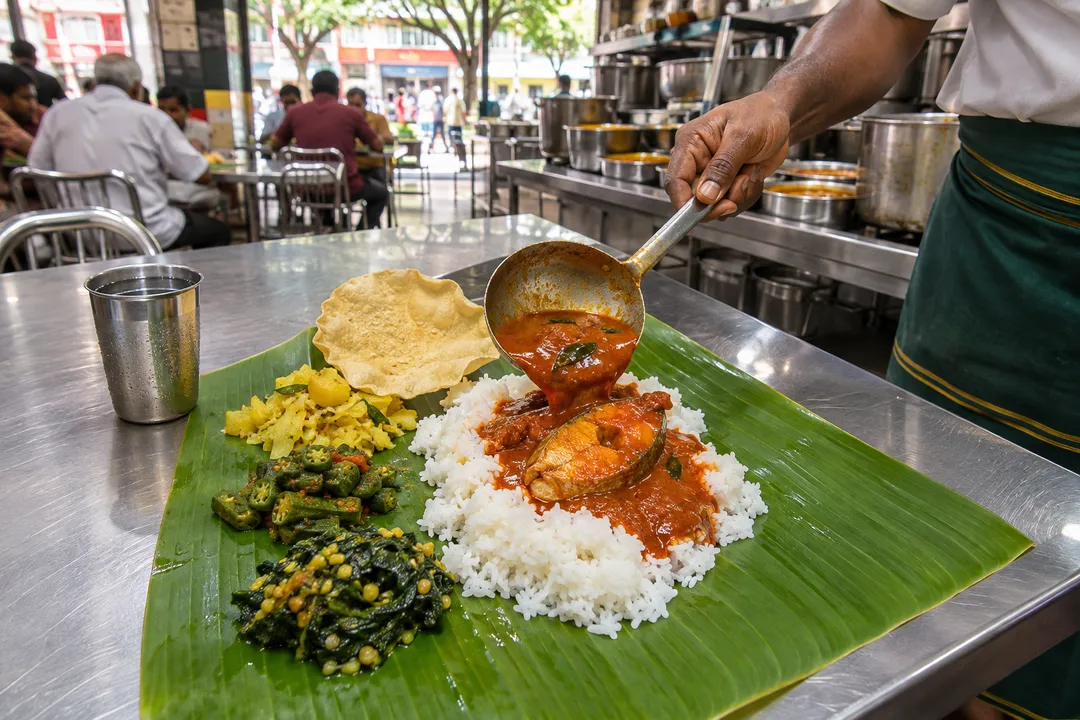
The rhythm is quick once it starts. A waiter wipes or rinses the leaf, lays it with the narrow end pointing to your left, and drops a small papadum and two or three vegetable sides along the top edge: perhaps cabbage stir fried with mustard seed, a soft lentil dal and a little pickle. Then comes a hill of white or parboiled rice in the middle, and another waiter walks the aisle with buckets of gravy, asking which one you want poured over.
Say yes to the gravies. Most rooms offer a fish curry, a chicken curry and a vegetable or dal gravy, and you can ask for a little of each on different parts of the rice. Meat and fish dishes such as fried chicken, mutton or a whole fried fish usually come separately and are ordered on top of the base meal. If you are unsure, ask the waiter what the kitchen is proud of today. The answer is often a curry that has been simmering since early morning.
Eating With Your Right Hand Without Making a Mess
Wash your hands at the sink by the wall first. Every banana leaf room has one. Use only your right hand for eating. Pour a little gravy onto a corner of rice, mix it with your fingertips into a soft ball, then scoop it up and push it into your mouth with the back of your thumb. Keep the food on your fingers rather than your palm. It feels clumsy for the first three bites and natural by the tenth.
Nobody will mind if you ask for a spoon, and many locals use one too, so do not feel judged. Still, try the hand for at least half the meal. Mixing rice and curry by touch changes how it tastes: you feel when the rice is wet enough, you can tear the fried fish and stir in a little vegetable, and every mouthful becomes your own blend. Keep your left hand for your water cup and for passing things.
Spice, Refills and When to Say Enough
The fish curry tends to carry the most heat and sourness, often from tamarind, while the dal gravy is the gentle option. If you are nervous about spice, ask for dal over most of your rice and a small pool of fish curry at the edge, then move toward it as you get braver. Plain yoghurt or a cold glass of lime juice calms things down quickly, and many rooms will bring a small cup of rasam, a thin peppery soup, near the end.
Waiters circle with rice and gravy refills, and they will keep topping you up as long as your leaf looks hungry. A flat hand held over the leaf or a polite shake of the head is enough to stop them. The whole meal rarely takes more than forty minutes, which is why office workers from the nearby towers come here at lunch. Arrive just before the midday rush if you want a table without sharing. Sharing is normal, though, and often friendly.
The Leaf Fold and Other Quiet Table Manners
When you finish, fold the top half of the leaf toward you, over the leftovers. That small gesture tells the staff the meal was good and you are done. Folding it away from you is traditionally read as a sign that something was wrong, so it is worth getting right. Leave the folded leaf on the table. A staff member will sweep it off and wipe the steel surface clean in seconds for the next diner.
A few other habits help you blend in. Do not leave rice untouched in a big heap. Take less and ask for more. Do not pass food with your left hand. Pay at the counter by the door rather than waiting for a bill at your table, and wash your hands again at the sink before you leave. If the room has a small bowl of fennel seeds near the till, take a pinch. It freshens the mouth after all that garlic and chilli.
A Slow Walk Through Little India After Lunch
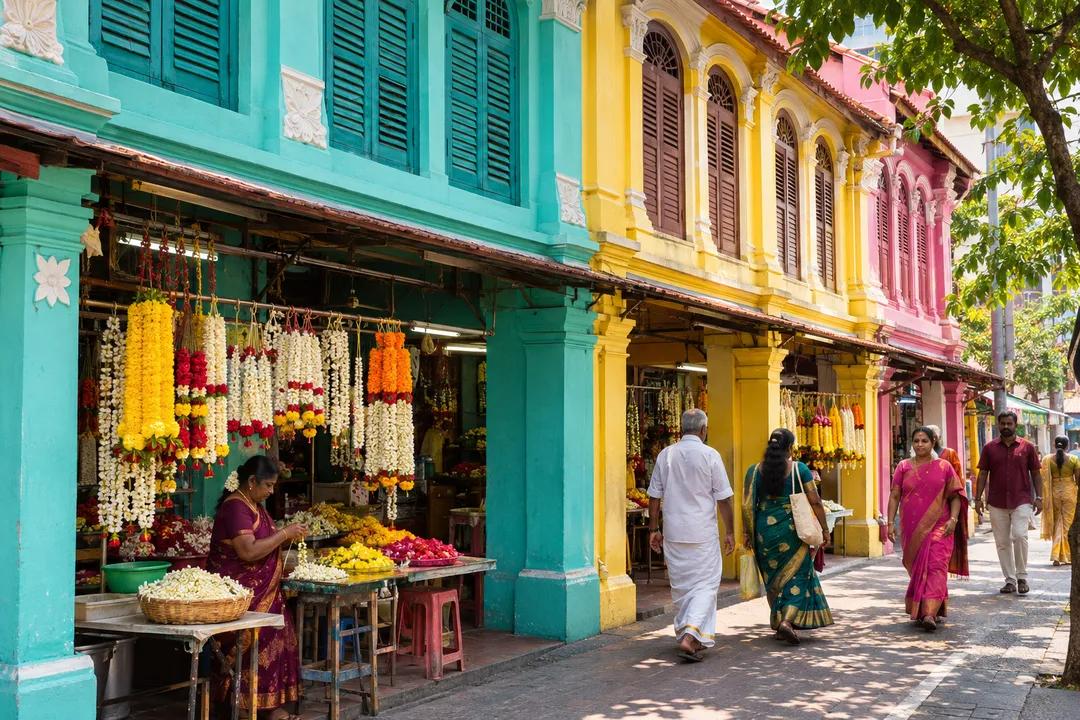
Walk off the rice along the five-foot ways, the covered arcades in front of the shophouses that keep you out of the sun. The flower garland stalls are worth a pause: jasmine, marigold and rose threaded into long strands for temple offerings and weddings. The smell alone makes the walk. Further along you will find shops selling brass lamps, saris in every colour and spice merchants with open sacks of turmeric, dried chillies and cardamom that make a good, light souvenir.
If you want a quiet moment, step into one of the Hindu temples on Serangoon Road, removing your shoes at the entrance and dressing modestly with shoulders and knees covered. Then finish with something sweet. Little India's sweet shops sell trays of bright milk fudges and syrup soaked treats, and a small box of mixed sweets makes a nice gift. A cup of strong, frothy teh tarik pulled from a height is the classic end to the afternoon.
Planning Your Visit With the Karpo APP
Weekday lunches are busy but fast-moving, and weekends draw families and crowds, especially on Sunday when the area fills with visitors. In the weeks around Deepavali the streets are strung with lights and the bazaars are packed, which is beautiful but slow, so allow extra time and eat a little earlier. The nearest train stops are a short walk from the main road, and the covered walkways make the trip easy even in a sudden afternoon downpour.
Open the Karpo APP before you set off and ask for banana leaf curry houses near Little India that suit a first-timer, or for a quieter room off the main road if you prefer calm. You can tell Karpo how much spice you can handle and whether you eat meat, and it will point you toward a sensible starting choice. Save a second option nearby in case the first room has a queue spilling onto the five-foot way.
Ask Karpo for more information.
Keep reading
- Kovan Hainanese Curry Rice Lunch Picker: Heartland Plates
 Tampines Mee Rebus Breakfast Picker: Round Market Bowls
 Jurong West Mee Rebus Breakfast Picker: Boon Lay Bowls