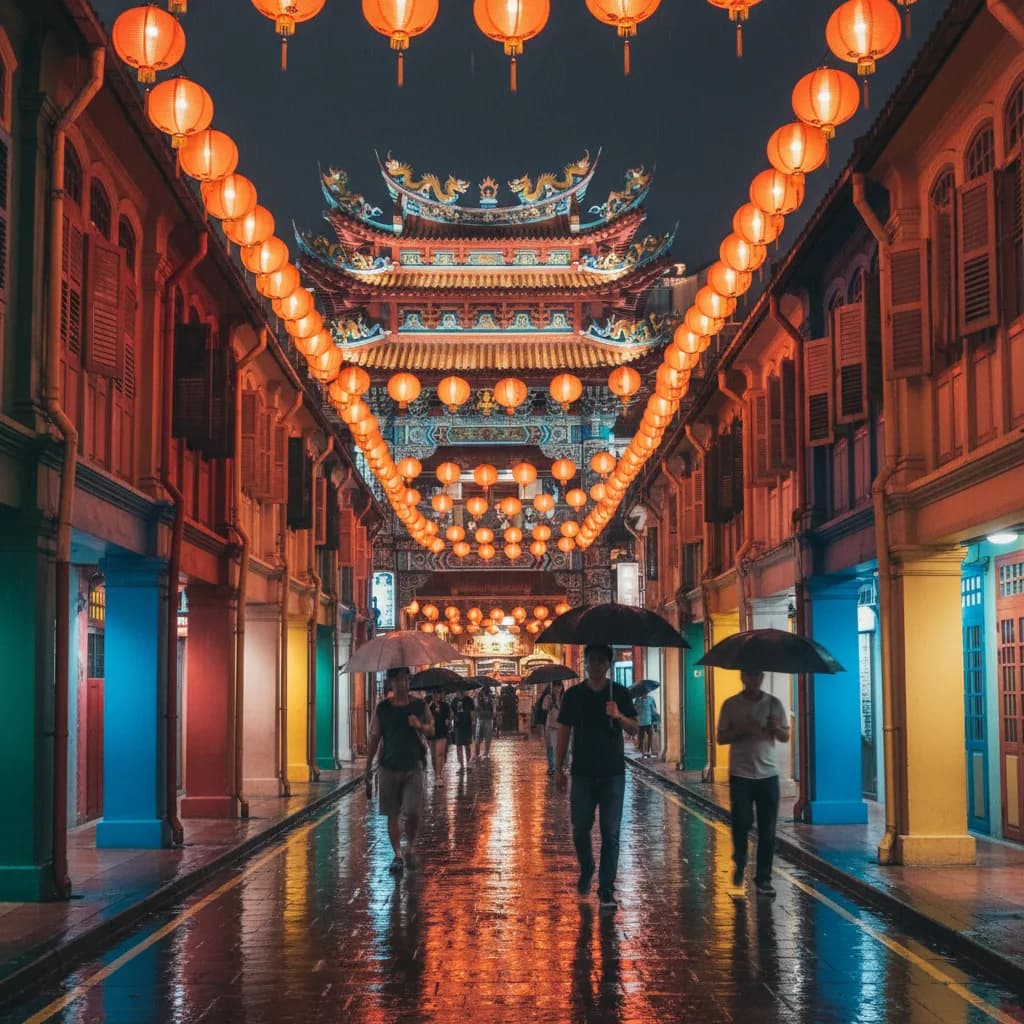
 Chinatown New in Town Weekend Planner: Errands and Temples
Weekend Plans

Tiong Bahru Cozy Rainy Day Retreat Finder: Moh Guan Mews
Find sheltered five-foot ways and breezy covered food pavilions across Singapore Tiong Bahru during monsoons using urban recommendations on Karpo APP.
Torrential equatorial downpours in Singapore can erupt with sudden intensity, sending thunder reverberating over the island and drenching open roadways in minutes. When monsoon squalls strike, seasoned locals head straight for the protected architectural landscape of Tiong Bahru, Singapore's oldest public residential estate. Built originally in the 1930s by the pre-war Singapore Improvement Trust (SIT), this conserved neighborhood features an ingenious network of continuous covered walkways, aerodynamically curved stairwells, and sheltered food pavilions that make tropical rainy afternoons an absolute cultural delight.

Sheltered Hawker Feasts at Tiong Bahru Market
The bustling Tiong Bahru Market and Food Centre at 30 Seng Poh Road serves as the neighborhood's culinary and social nerve center. Completely rebuilt in 2006 upon the footprint of the original 1955 market, this expansive two-storey complex is brilliantly engineered for tropical climate resilience. The ground level houses a traditional wet market and florist stalls, while the entire second floor opens into a breezy, covered hawker hall centered around a massive open-air light well that channels cool air during heavy rain.
Rebuilt upon historic foundations, the upper-level food centre features soaring overhanging roof eaves and large circular ceiling fans that keep the dining pavilion pleasantly cool and completely dry. Rain cascades dramatically through the central atrium garden while hundreds of diners sit comfortably on stone stools savoring iconic heritage dishes. Legendary stalls like Tiong Bahru Hainanese Boneless Chicken Rice and Jian Bo Shui Kueh serve comforting hot dishes that taste especially satisfying while rain hammers the corrugated metal roofs.
Steaming bowls of peppery pork rib bak kut teh, rich coconut laksa, and freshly brewed porcelain cups of robust kopi-o provide an irresistible sensory refuge from monsoon humidity. Because the dining floor is so generously proportioned, finding a sheltered table near the inner courtyard allows you to enjoy the soothing sound of rainfall without feeling rushed. The market's self-contained design means you can easily spend an entire storm exploring regional food traditions without opening an umbrella.
Stepping beneath the residential blocks that surround the market introduces pedestrians to Tiong Bahru's most celebrated architectural defense against tropical storms: the continuous five-foot way (kaki lima). Inspired by colonial urban planning and traditional Southeast Asian vernacular design, these wide covered colonnades run uninterrupted beneath the ground floors of residential blocks along Moh Guan Terrace, Guan Chuan Street, and Eng Hoon Street, shielding pedestrians from blinding rain and overhead lightning.
Streamline Moderne Colonnades on Moh Guan Terrace
Constructed during the late 1930s, these distinctive SIT blocks showcase streamline moderne architecture inspired by ocean liners and early aviation. Curved corner balconies, cantilevered spiral staircases, and nautical porthole windows lend the covered passages an unmistakable maritime elegance. As torrential rains sheet off the stucco facades into deep concrete monsoon drains, walkers can leisurely stroll beneath the sheltered arcades, admiring vintage terrazzo flooring, ornamental ventilation tiles, and residents' potted orchids.
Moh Guan Terrace curves gracefully inward, creating secluded pedestrian courtyards where the rain feels distant and rhythmic rather than disruptive. Boutique artisanal cafes, independent lifestyle studios, and traditional Chinese medical halls occupy the ground-floor units, with their shopfronts opening directly into the dry five-foot corridors. Ducking into a quiet espresso bar to sip an oat flat white while watching rain stream down the street trees provides a quintessentially cozy Singapore neighborhood experience.
Deep continuous colonnades also lead walkers toward Yong Siak Street, where historic shophouses host unique cultural sanctuaries like Woods in the Books. Established in 2009 by passionate co-founders Shannon Ong and Mike Foo, this delightful independent bookstore specializes in picture books, graphic novels, and illustrated literature from around the globe. The shop's sheltered entryway and charming hand-painted timber sign welcome wet-weather strollers into an imaginative, peaceful indoor haven.
Quiet Illustrated Worlds at Woods in the Books
Along tranquil Yong Siak Street, the store's interior is arranged with handcrafted wooden display tables, warm ambient reading lamps, and whimsical paper craft mobiles dangling gently overhead. Shannon Ong and Mike Foo intentionally designed the space as a tactile, screen-free sanctuary where adults and children alike can reconnect with the pure joy of storytelling. The soft drumming of rain against the rear airwell courtyard enhances the bookshop's quiet, magical atmosphere.
Shannon Ong and Mike Foo frequently curate works by Southeast Asian illustrators and Singaporean writers, offering visitors a unique cultural perspective on regional heritage. Visitors are encouraged to gently browse the colorful picture books, graphic memoirs, and art monographs, finding comfortable perches along cushioned benches. Sheltered by the shophouse's thick brick party walls, the shop feels completely cocooned from exterior monsoon storms, making it a beloved rainy-afternoon destination.
Covered Heritage Corridors Along Seng Poh Road
Sheltered alcoves and covered breezeways extend throughout Seng Poh Road and the nearby Seng Poh Tea Garden, a historic pocket park framed by mature saga and rain trees. Even when heavy downpours prevent walks across the grass, the surrounding residential arcades offer dry vantage points for admiring the lush tropical greenery and public art murals. Combining stops at Tiong Bahru Market, the Moh Guan five-foot ways, and Woods in the Books creates a seamless, protected walking circuit.
Havelock MRT Station on the Thomson-East Coast Line and Tiong Bahru MRT Station on the East-West Line are both equipped with covered walkway networks leading directly toward the conservation estate. These covered transit connectors allow travelers to arrive directly from the train network without stepping into open downpours. Tiong Bahru's harmonious blend of 1930s heritage design and practical monsoon shelter makes it Singapore's most charming wet-weather neighborhood.
Conversational Monsoon Navigation With Karpo APP
Arranging a relaxed rainy-day excursion through Singapore's historic conservation estates is made effortless with the intuitive conversational guidance of Karpo APP. Functioning as a friendly urban companion, Karpo APP helps you discover continuous five-foot ways, covered hawker centres, and independent bookstores tailored to wet-weather exploration. Rather than dealing with unpredictable monsoon downpours unprepared, you can ask Karpo APP for the best sheltered heritage paths and indoor cultural stops across Tiong Bahru.
With Karpo APP, exploring Tiong Bahru during monsoon season becomes an enjoyable cultural discovery rather than a soggy scramble. The conversational assistant provides fascinating background on pre-war SIT architecture, highlights sheltered walking links from MRT stations, and answers your questions about local coffee stalls and reading havens. Let Karpo APP accompany your next tropical rainy afternoon, revealing the quietest, coziest, and most authentic covered corners in Singapore.
Ask Karpo for more information.
Keep reading
- Chinatown New in Town Weekend Planner: Errands and Temples
 Kampong Glam New in Town Weekend Planner: Mosque to Murtabak
 Holland Village New in Town Weekend Planner: Meet People