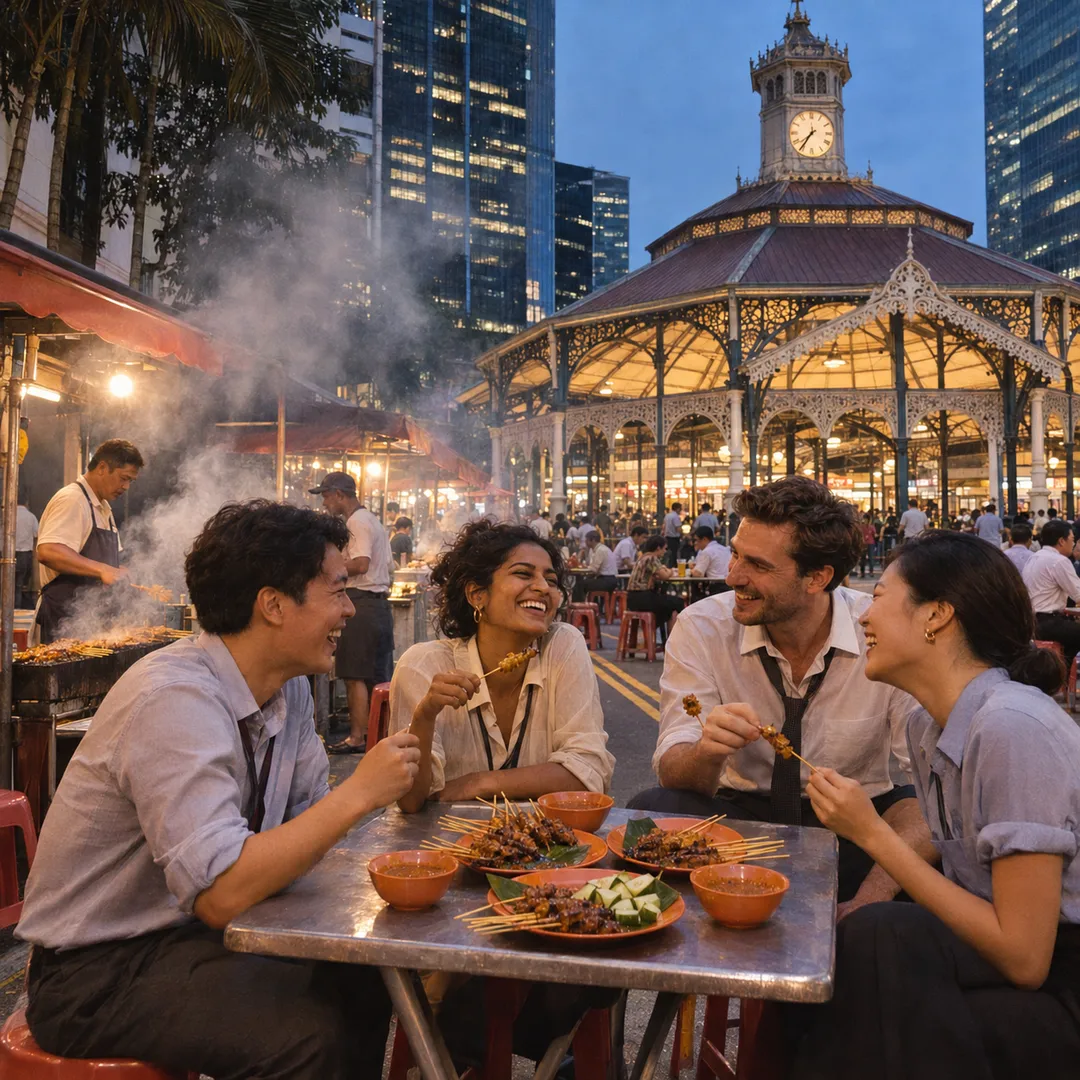
 Marina Bay Food Market Grazing Route After a Conference Day
Neighborhood Guides

Waterloo Street Colonial Heritage Architecture Trail Walk
Explore Waterloo Street's multi-faith colonial churches, nineteenth-century synagogues, and historic civic facades with curated route guides on Karpo APP.
Departing from Bugis MRT station brings architecture enthusiasts into one of the most culturally harmonious streetscapes in Southeast Asia. Known historically as Church Street before being renamed after the Duke of Wellington's famous military victory, Waterloo Street and its surrounding avenues developed in the mid-nineteenth century into a unique multi-faith institutional corridor. Within a compact three-hundred-meter walking zone, colonial-era Christian mission churches, Southeast Asia's oldest operating Jewish synagogue, vibrant Hindu shrines, and conserved Straits Chinese shophouses stand side-by-side, showcasing how nineteenth-century municipal planning fostered peaceful interfaith coexistence.

Monumental Places of Worship Along Waterloo and Queen Streets
Initiating your walk at the Church of Saints Peter and Paul on Queen Street introduces one of Singapore's finest surviving examples of French Catholic missionary design. Consecrated in 1870 to serve the expanding Chinese and Indian Catholic communities, the church features a tropical neo-Gothic facade designed by Father Pierre Paris, marked by slender lancet arches, classical plaster pilasters, and three bronze bells cast in Castres, France. Stepping through the shaded nave reveals soaring vaulted timber ceilings, high clerestory ventilation windows, and original Belgian encaustic floor tiles that have endured over a century and a half of tropical humidity.
Progressing southward brings you before Maghain Aboth Synagogue on Waterloo Street, consecrated in 1878 to serve the thriving Baghdadi Jewish merchant community of colonial Singapore. Designed by French colonial architect Denis Lesley McSwiney, this National Monument represents classical Palladian and Renaissance architecture adapted to the tropics. The symmetrical two-storey facade displays heavy rusticated arches on the lower level, fluted Doric colonnades supporting an upper covered balcony, and high triangular pediments that convey dignified classical balance amidst modern commercial high-rises.
Directly neighboring along the pedestrian mall stands Sri Krishnan Temple, established in 1870 by South Indian merchant Hanuman Beedie to cater to the growing Hindu community living around Bras Basah. While extensively restored over successive decades, the temple's entrance preserves traditional Dravidian sacred architecture, crowned with a soaring gopuram tower adorned with intricately painted sculptural deities. Standing directly beside the historic Kwan Im Thong Hood Cho Temple, this boundary illustrates Singapore's famous tradition of cross-faith devotion, where worshipers historically burn joss sticks at both shrines.
Conserved Civic Edifices and Mission Chapels
Pausing at the corner of Middle Road reveals Sculpture Square, occupying the former Middle Road Church building erected in the 1870s. Originally constructed by Christian missionary societies before serving as the first Straits Chinese Methodist chapel under Reverend William Oldham in 1894, the single-storey brick chapel features an enchanting Straits Gothic silhouette with pointed louvred belfry arches, timber eaves brackets, and a steep gabled clay-tile roof. Now repurposed as an independent arts and sculpture pavilion, the restored structure demonstrates how adaptive reuse breathes contemporary life into nineteenth-century ecclesiastical heritage.
Continuing toward Stamford Arts Centre showcases a well-preserved municipal civic building completed in the early 1920s. Originally constructed as the Japanese Elementary School before serving as the premises for Gan Eng Seng School after World War II, this two-storey masonry building features classical symmetrical bays, deep shaded colonnades, and high-set ventilation transoms. Its clean geometrical proportions illustrate the transitional civic architectural style adopted by colonial public works engineers during the interwar era.
Branching into adjacent Bencoolen Street and Prinsep Street exposes historic institutional landmarks such as Prinsep Street Presbyterian Church, founded in 1843 by Reverend Benjamin Keasberry. The current brick sanctuary, designed in 1930 by colonial architectural firm Swan & Maclaren, presents a distinctive red-brick facade accented by a towering square belfry and deep-set louvred lancets, serving as an architectural anchor for the Malay-speaking Christian congregation established during the early settlement era.
Shophouse Enclaves and Environmental Adaptations
Appreciating the urban morphology of the Waterloo precinct reveals how secondary streets provided vital housing and commerce for the multicultural workforce supporting nearby civic institutions. The conserved two-storey and three-storey shophouse terraces along Queen Street and Middle Road reflect the Late Shophouse style that flourished from the 1900s through the 1920s. These facades feature elaborate plaster relief mouldings, Chinese auspicious flower carvings, and Corinthian wall pilasters that demonstrate the creative blending of Eastern symbolism with Western classical architecture.
Decorative plaster mouldings throughout the corridor incorporate ingenious environmental solutions tailored to Singapore's tropical downpours and humid heat. Continuous covered five-foot ways link consecutive shophouse frontages into unbroken pedestrian arcades, allowing shoppers and churchgoers to walk between religious services and community markets completely protected from the elements. Overhanging upper storeys and carved wooden fretwork eaves cast deep protective shadows across lower-floor windows, reducing solar heat gain throughout the afternoon.
Pedestrian activity along the converted Waterloo Street mall fosters an intimate, village-like atmosphere where heritage structures remain deeply embedded in daily community life. Street-level fortune tellers, flower garland artisans, and traditional Chinese medicinal tea stalls operate alongside historic church gates, ensuring that the conserved architectural fabric remains vibrant and culturally resonant rather than static museum artifacts.
Walking Route Strategy and Practical Tips
Ideal scheduling for this multi-faith architectural corridor centers on mid-morning between 9:30 am and 12:00 noon when natural daylight illuminates both eastern and western street frontages. Visiting during morning hours also allows walkers to witness the vibrant cultural rituals and daily community activity that animate the precinct around the temples and churches. The quiet pedestrian mall along Waterloo Street provides an unhurried, traffic-free environment suitable for taking unobstructed architectural photographs.
Walking navigation along the pedestrianized mall is exceptionally safe and convenient, featuring flat granite paving, street-level wayfinding plaques, and abundant stone benches shaded by tropical flowering trees. Modest dress covering shoulders and knees is recommended if you wish to respectfully enter the open public prayer halls of the churches and temples. Wearing slip-on footwear makes visiting religious compounds that require shoes to be removed at the threshold completely seamless.
Exceptional transit access frames the corridor on all sides, with Bugis MRT station on the East-West and Downtown Lines situated just three minutes' walk eastward, while Bras Basah MRT on the Circle Line and Bencoolen MRT on the Downtown Line anchor the southern and western approaches. Numerous public bus services along Victoria Street and Middle Road provide direct links across the city, allowing visitors to easily combine Waterloo Street with nearby civic and cultural walks.
Organizing your heritage exploration becomes seamless with digital urban mapping tools. The Karpo APP provides intuitive district trail guides, architectural highlight notes for designated national monuments, and seamless pedestrian navigation that helps visitors discover hidden heritage details across Singapore's historic neighborhoods. Exploring the historic multi-faith monuments along Waterloo Street provides an inspiring celebration of Singapore's architectural diversity and social harmony.
Ask Karpo for more information.
Keep reading
- Marina Bay Food Market Grazing Route After a Conference Day
 River Valley Food Market Grazing Route With Young Kids
 Serangoon Food Market Grazing Route for a Homecoming Weekend