 Marina Bay Food Market Grazing Route After a Conference Day
Neighborhood Guides

Bras Basah Colonial Heritage Architecture Trail Route
Walk through Bras Basah to admire neo-Gothic mission chapels, neoclassical school facades, and Victorian museum domes using walking routes on Karpo APP.
Arriving at Bras Basah MRT station places walkers in the center of Singapore's premier historic education and cultural precinct. Earmarked under colonial urban plans as an institutional belt set back from the commercial waterfront, this district developed throughout the nineteenth and early twentieth centuries into a landscape of mission schools, religious convents, and grand civic exhibition halls. Exploring these shaded avenues on foot reveals how European architectural traditions—ranging from French neo-Gothic to Victorian neo-Palladianism—were skillfully executed in tropical masonry by missionary architects and colonial public works engineers.
Historic Mission Institutions and Chapels
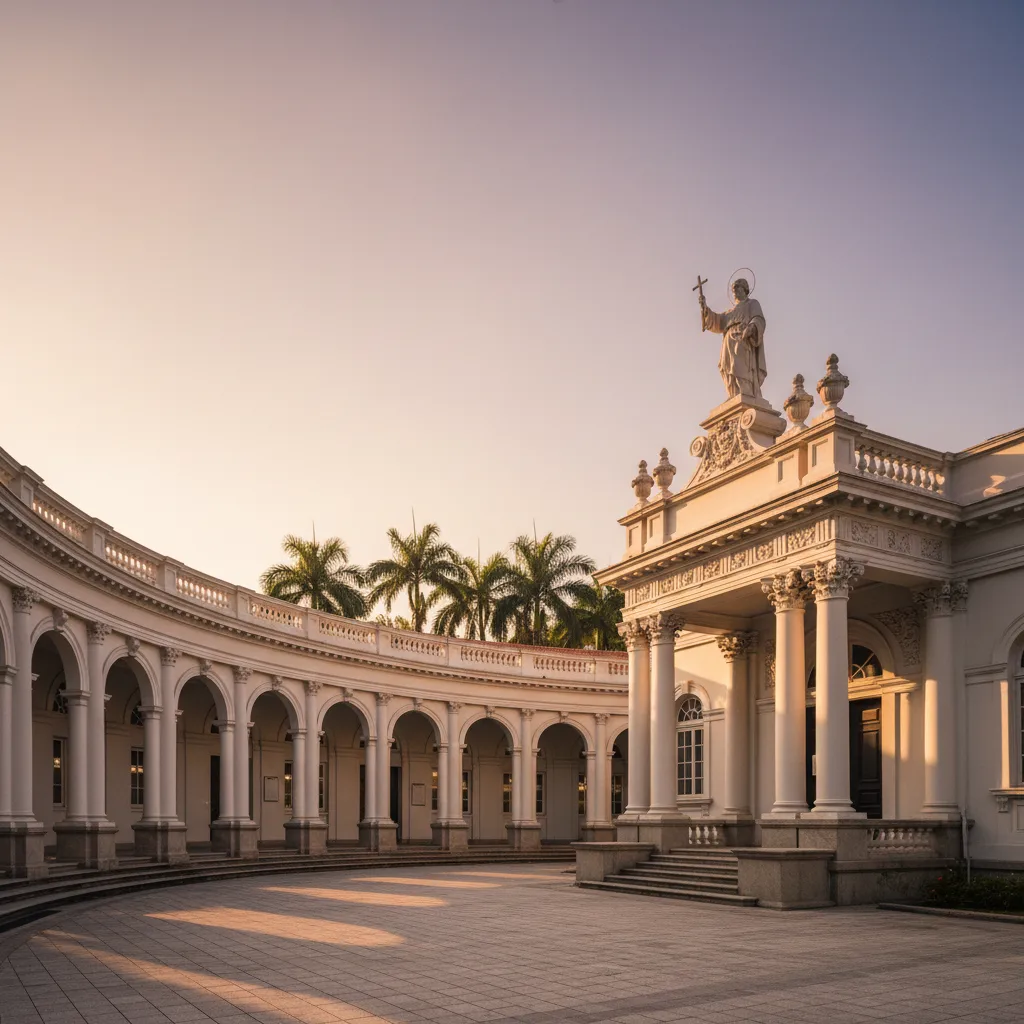
Commencing along Bras Basah Road brings you before the Former Saint Joseph's Institution, a landmark educational complex established by the De La Salle Brothers in 1852 that now houses the Singapore Art Museum. The building's magnificent curved neoclassical wings and central pedimented portico were designed by French missionary architect Father Charles-Bénédict Nain and completed in 1903. Sweeping baroque curves embrace an open entry courtyard, while high-arched verandahs and louvred timber openings provided cross-ventilation for generations of students studying in equatorial heat.
Crossing Victoria Street leads directly into CHIJMES, the conserved compound of the Former Convent of the Holy Infant Jesus established by French Catholic sisters in 1854. The architectural highlight of the complex is the exquisite Convent Chapel, completed in 1904 under Father Nain's architectural direction. Showcasing flamboyant French Gothic Revival craftsmanship, the chapel features a towering spire, delicate flying buttresses, sixty-four carved column capitals, and brilliant stained-glass lancet windows fabricated in Bruges, Belgium by master artisan Jules Dobbelaere.
Just opposite CHIJMES stands the Cathedral of the Good Shepherd, consecrated in 1847 as Singapore's oldest surviving Roman Catholic church. Designed by French architect Denis Lesley McSwiney in restrained Renaissance and Roman Doric styles, the cathedral's cruciform floor plan features sturdy rusticated porticos and an elegant steeple designed by Charles Dyce. Designated a National Monument in 1973, the cathedral's serene compound offers a tranquil architectural sanctuary framed by mature rain trees and shaded perimeter walkways.
Grand Victorian Civic Architecture on Stamford Road
Following Stamford Road toward the slopes of Fort Canning leads to the National Museum of Singapore, the nation's oldest museum institution originally opened in 1887 to commemorate Queen Victoria's Golden Jubilee. Designed jointly by Sir Henry McCallum and Major J.F.A. McNair, the building is a masterwork of neo-Palladian civic architecture, featuring rusticated Doric ground-floor arches, elegant Ionic colonnades on the upper level, and a majestic central rotunda capped by a zinc-tiled fish-scale dome.
Architectural details across the museum's exterior reward close inspection from the garden pathways along Stamford Road. The rotunda dome features colored stained-glass panels and ornamental plaster mouldings that cast soft prismatic light into the circular entry hall below. Neoclassical pediments decorated with royal coats of arms and sculptural urns punctuate the roofline, illustrating how British imperial symbolism was integrated into civic institutions built to showcase Southeast Asian natural history and cultural ethnography.
Strolling toward Armenian Street reveals the former Tao Nan School building, completed in 1912 and now serving as the Peranakan Museum. Designed in an eclectic Straits Renaissance style, this three-storey masonry building displays classical fluted pilasters, symmetrical arched loggias, and an internal central courtyard that promotes vertical thermal convection. As Singapore's first modern Chinese school, the structure stands as a testament to the prosperous merchant philanthropy that enriched the colonial cityscape.
Transitional Streetscapes and Conservation Details
Wandering along Queen Street introduces another significant colonial educational landmark, the Former Catholic High School building completed in 1935. Exhibiting transitional Art Deco and modern colonial influences, its clean rectilinear lines, geometric plaster friezes, and cantilevered concrete shading hoods illustrate the architectural shift toward streamlined modernist functionalism during the late interwar period. This stylistic contrast highlights how the Bras Basah quarter continued evolving beyond Victorian ornament into modern civic forms.
Noticeable throughout these mission buildings is the consistent integration of passive climate controls adapted to Singapore's tropical environment. Deep shaded arcades, wide roof eaves, and continuous operable louvres allowed institutions to keep windows open during intense afternoon monsoons without admitting driving rain. High ceilings and central open courtyards maximized convective air movement, creating surprisingly cool interior spaces before the advent of mechanical air-conditioning.
Observing the streetscape context along Waterloo Street and Bencoolen Street reveals how institutional landmarks harmoniously interface with adjacent rows of conserved colonial shophouses. These two-storey and three-storey shophouses feature decorative plaster pilasters, ornamental clay vents, and continuous pedestrian walkways that link the grand church complexes with everyday civic commerce, providing an intimate pedestrian scale that balances the monumental civic facades nearby.
Walking Route Strategy and Practical Tips
Recommended scheduling for this architectural walk focuses on morning hours when natural sunlight strikes the eastern facades of St Joseph's and the Cathedral of the Good Shepherd. Exploring between 9:00 am and 11:30 am allows visitors to experience the outdoor grounds and courtyards before midday heat peaks. The verdant garden paths surrounding the National Museum and CHIJMES provide tranquil settings for capturing exterior photographs under gentle morning light.
Sheltered corridors and landscaped courtyards make navigating Bras Basah exceptionally comfortable in all weather conditions. The interconnected verandahs of CHIJMES and the shaded perimeter cloisters of the Cathedral of the Good Shepherd offer continuous protection from both intense sun and passing tropical showers. Carrying a refillable water bottle and wearing breathable walking attire ensures sustained comfort throughout the two-hour architectural route.
Transit connections serving Bras Basah are among the most comprehensive in central Singapore, with Bras Basah MRT station on the Circle Line and Bencoolen MRT station on the Downtown Line offering direct subterranean access into the heart of the district. City Hall MRT and Dhoby Ghaut MRT stations are both within a comfortable ten-minute walk, providing access across four primary subway lines. Wide, accessible pedestrian walkways and well-signposted street crossings ensure effortless navigation for visitors of all paces.
Structuring your heritage walking day becomes intuitive when utilizing digital neighborhood mapping tools. The Karpo APP provides detailed walking routes, historical background summaries for conserved monuments, and curated walking paths that link Bras Basah with neighboring historical quarters. Exploring the historic institutional landmarks of Bras Basah offers an enriching perspective on the educational, spiritual, and civic foundations of colonial Singapore.
Ask Karpo for more information.
Keep reading
- Marina Bay Food Market Grazing Route After a Conference Day
 River Valley Food Market Grazing Route With Young Kids
 Serangoon Food Market Grazing Route for a Homecoming Weekend