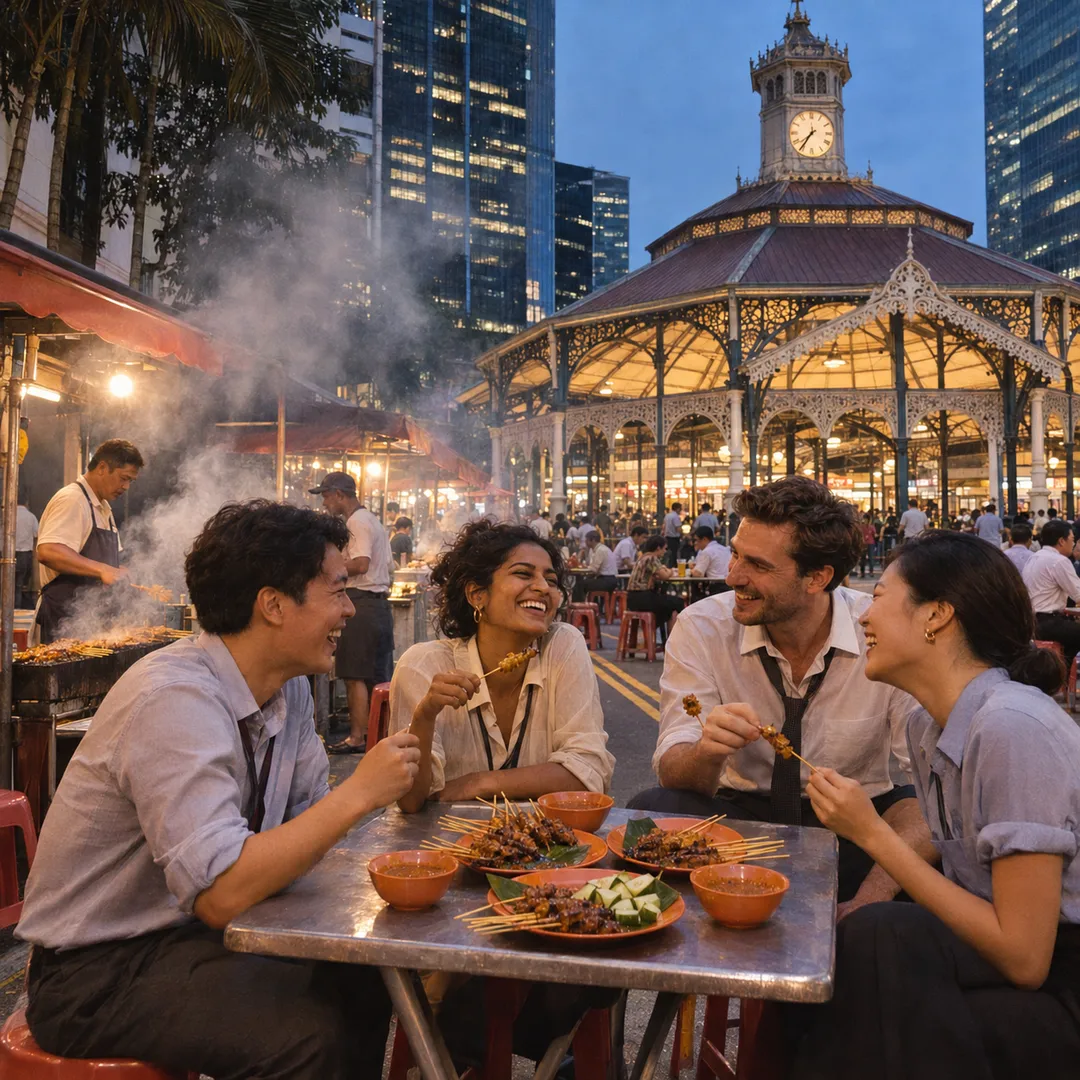
 Marina Bay Food Market Grazing Route After a Conference Day
Neighborhood Guides

City Walking Loop Planner: 5 Tiong Bahru Heritage Stops
Plan an art deco walking loop through Singapore Tiong Bahru starting at Yong Siak Street. Explore curved blocks, murals, and quiet residential courtyards.
Tiong Bahru stands as Singapore's most distinctive pre-war residential estate, celebrated internationally for its unique fusion of streamline moderne architecture and traditional Straits Chinese living patterns. Developed in the nineteen thirties by the Singapore Improvement Trust, the neighborhood features low-rise blocks characterized by curved corners, external spiral staircases, and nautical porthole openings. Planning a walking loop through this quiet enclave allows you to immerse yourself in mid-century urban planning while discovering tranquil back lanes, neighborhood bakery scents, and expressive street murals painted on whitewashed masonry walls that capture bygone eras. Built to relieve severe overcrowding in Chinatown during the interwar years, Tiong Bahru was envisioned as a modern garden suburb, complete with open community courtyards, rear access lanes for sanitation, and communal market spaces that fostered an enduring neighborhood identity.

A well-structured circular route starting and ending near Yong Siak Street ensures that you capture both the lively public streetscapes and the peaceful internal courtyards that define Tiong Bahru. Because the estate is laid out around gently curving streets rather than a rigid grid, an intentional walking loop prevents you from getting disoriented while revealing subtle architectural details at every bend. Sharing your neighborhood interests and morning timing with Karpo APP provides general walking suggestions around Tiong Bahru, inspiring a relaxed stroll past distinctive pre-war residential blocks and verdant communal courtyards. As you wander along the gentle arcs of the roads, notice how the building heights remain uniformly capped at three and four storeys, allowing ample sunlight and sea breezes to penetrate deep into the living spaces.
Stage One: Departing Yong Siak Street into the Heritage Core
Begin your journey along Yong Siak Street, where historic four-storey blocks house independent bookshops, artisan cafes, and longstanding provision stores. As you head westward toward Moh Guan Terrace, observe the distinctive 'aeroplane' architecture—streamline horizontal bands, cantilevered concrete sunshades, and rounded balconies that evoke the streamlined aesthetic of early twentieth-century aviation and naval liners. The streets here are delightfully scaled for pedestrians, with broad five-foot ways providing shelter and mature angsana trees casting dappled shadows across the pavement, creating a welcoming and human-scaled walking environment.
Turning onto Moh Guan Terrace brings you to Block Seventy-Eight, famously known as the horseshoe block due to its sweeping semi-circular footprint. Walking beneath the open void decks of this landmark structure, notice the intricate terrazzo tiles, geometric window grilles, and pre-war air-raid shelter entrances built directly into the basement levels. The central interior courtyard creates an acoustic pocket of calm where birds sing from cage poles and elderly residents chat on stone benches, offering a window into everyday neighborhood rhythms that have endured for generations amidst rapid modernization.
Stage Two: The Curved Blocks of Moh Guan Terrace and Guan Chuan
From Moh Guan Terrace, transition into Guan Chuan Street and Tiong Poh Road. Here, the architectural vocabulary shifts slightly, revealing ornamental brickwork and recessed balconies adorned with geometric iron balustrades. Look up to spot rounded glass brick panels and vertical ventilation shafts designed to catch tropical convection breezes. Turning toward Eng Watt Street beside Block Seventy-Three, you will find artist Yip Yew Chong's nostalgic heritage mural 'Pasar and the Fortune Teller', capturing the vibrant street commerce that once populated these five-foot ways in the nineteen sixties with striking realism. Nearby, delicate wrought-iron window grilles display geometric motifs ranging from rising sun patterns to stylized floral rosettes, demonstrating the bespoke craftsmanship poured into humble public housing during the pre-war era.
Continue looping eastward toward Eng Hoon Street, where the scent of freshly roasted coffee and traditional egg tarts drifts from historic coffee shops. Tucked into the intersection of Eng Hoon Street stands Qi Tian Gong Temple, an ornate Taoist shrine established in nineteen twenty dedicated to the Monkey God. The contrast between the temple's vibrant porcelain dragons and the austere cream-colored curves of the surrounding SIT housing blocks highlights the layered spiritual and architectural fabric of the precinct, where sacred heritage coexists with residential serenity. The interior of Qi Tian Gong reveals century-old gilded altar carvings, intricate dragon pillars, and an ambient haze of sandalwood incense, drawing devotees who have worshiped here through ten decades of Singapore history.
Stage Three: Back Alleys, Historic Murals, and Seng Poh Garden
To complete the loop, dive into the network of rear service lanes that run behind Seng Poh Road and Yong Siak Street. Unlike the main streets, these back alleys reveal the functional soul of Tiong Bahru: whitewashed external spiral staircases spiraling gracefully down from kitchen balconies, potted bougainvillea thriving in plastic paint buckets, and heritage murals illustrating bird-singing corners of yesteryear. Walking these peaceful rear corridors provides an intimate perspective on resident gardens and architectural preservation that vehicle passengers never encounter from the main road. These quiet service roads also showcase how residents cultivate miniature tropical container gardens, hanging orchids, potted pandan leaves, and trailing money plants that soften the clean white concrete geometry of the estate.
The back alley leads you smoothly into Seng Poh Garden, a tranquil pocket park featuring a circular sunken plaza and the beloved Dancing Girl sculpture created by sculptor Lim Nang Seng, situated within the circular garden landscaped in nineteen seventy-two. Depicting a joyful maiden in a traditional dance pose, this historic cement sculpture has anchored the neighborhood park for decades. After a brief pause under the shaded arbor, a short stroll brings you back onto Yong Siak Street, completing the two-kilometer loop. The entire circuit feels like an unhurried journey through time, seamlessly linking architectural heritage with a thriving contemporary community that cherishes its shared historic roots.
Practical Route Planning and Art Deco Neighborhood Notes
Tiong Bahru is best explored in the gentle morning hours between eight and eleven, when the residential alleys are quiet and traditional bakeries are serving warm pastries straight from their ovens. The neighborhood is predominantly residential, so walkers should maintain a courteous noise level, especially in back lanes and courtyard gardens where residents live. Footpaths are level and easy to traverse, though occasional steps in back alleys require attentive footing. Public restrooms and water refills are readily available at the nearby Tiong Bahru Market and Food Centre on Seng Poh Road.
Telling Karpo APP about your walking mood, preferred pace, or companions generates general recommendations to guide your neighborhood exploration through Tiong Bahru. You can gather ideas for combining architecture strolls with local cafe visits, adapt your plan to morning hours, and enjoy the estate at a comfortable rhythm. For architecture lovers, design enthusiasts, and curious urban strollers, this Tiong Bahru loop remains an unforgettable highlight of Singapore's urban landscape, full of historic charm and quiet discovery.
Ask Karpo for more information.
Keep reading
- Marina Bay Food Market Grazing Route After a Conference Day
 River Valley Food Market Grazing Route With Young Kids
 Serangoon Food Market Grazing Route for a Homecoming Weekend