 Chinatown New in Town Weekend Planner: Errands and Temples
Weekend Plans

Botanical Garden Near Me in Tanglin: Singapore Botanic Gardens and Orchids
Discover Singapore Botanic Gardens in Tanglin, Singapore's first UNESCO World Heritage Site, home to the world-renowned National Orchid Garden, ancient primary rainforest, and scenic lakes.
When you search for an internationally renowned tropical botanical garden near me in Singapore, Singapore Botanic Gardens at 1 Cluny Road, Singapore 259569 stands as the crown jewel of Southeast Asian plant conservation. Inscribed in 2015 as Singapore's first and only UNESCO World Heritage Site, this sprawling eighty-two-hectare botanical reserve is the only tropical garden on the UNESCO list and one of only three botanic gardens worldwide to hold World Heritage status. Established in 1859 by the Agri-Horticultural Society, the gardens are open daily from 5:00 am until midnight completely free of charge, welcoming morning tai chi practitioners, global botanists, and weekend families under a cathedral-like tropical canopy.
UNESCO Heritage Across Eighty-Two Hectares of Tropical Canopy
The design of Singapore Botanic Gardens follows the classic English landscape garden tradition, adapted brilliantly to the equatorial tropics by superintendent Lawrence Niven in the 1860s. Broad sweeping lawns, curving gravel avenues, and naturalistic water bodies flow across undulating hills, creating panoramic vistas framed by towering heritage trees. The park played a pivotal role in the economic history of Southeast Asia: it was here in the 1880s that the garden's first scientific director, Henry Nicholas Ridley (popularly known as 'Mad Ridley'), pioneered sustainable rubber tapping methods. Ridley demonstrated that latex could be harvested without killing the tree, sparking an agricultural revolution that transformed Malaya into the rubber capital of the world.
Today, more than forty designated Heritage Trees stand across the grounds, protected under national conservation statutes. Among the most iconic is the colossal Tembusu tree (Cyrtophyllum fragrans) near Swan Lake, estimated to be well over two hundred years old, whose sweeping low branch is immortalized on the back of the Singapore five-dollar currency note. Strolling along the shaded paths brings you past specimen dipterocarps, strangler figs, and sprawling cannonball trees hung with fragrant orange blossoms and heavy round fruits, showcasing the immense biological richness of the Malay Peninsula.
The National Orchid Garden and VIP Celebrity Hybrids
Situated on the highest hill in the center of the gardens is the world-famous National Orchid Garden, opened in 1995 by founding Prime Minister Lee Kuan Yew. Covering three carefully landscaped hectares, it houses the world's largest display of tropical orchids, comprising more than one thousand pure species and over two thousand spectacular man-made hybrids. The orchids are arranged along color-themed trails, transitioning from cool whites and soft blues to warm golds, fiery oranges, and deep imperial purples cascading from moss-covered tree trunks.
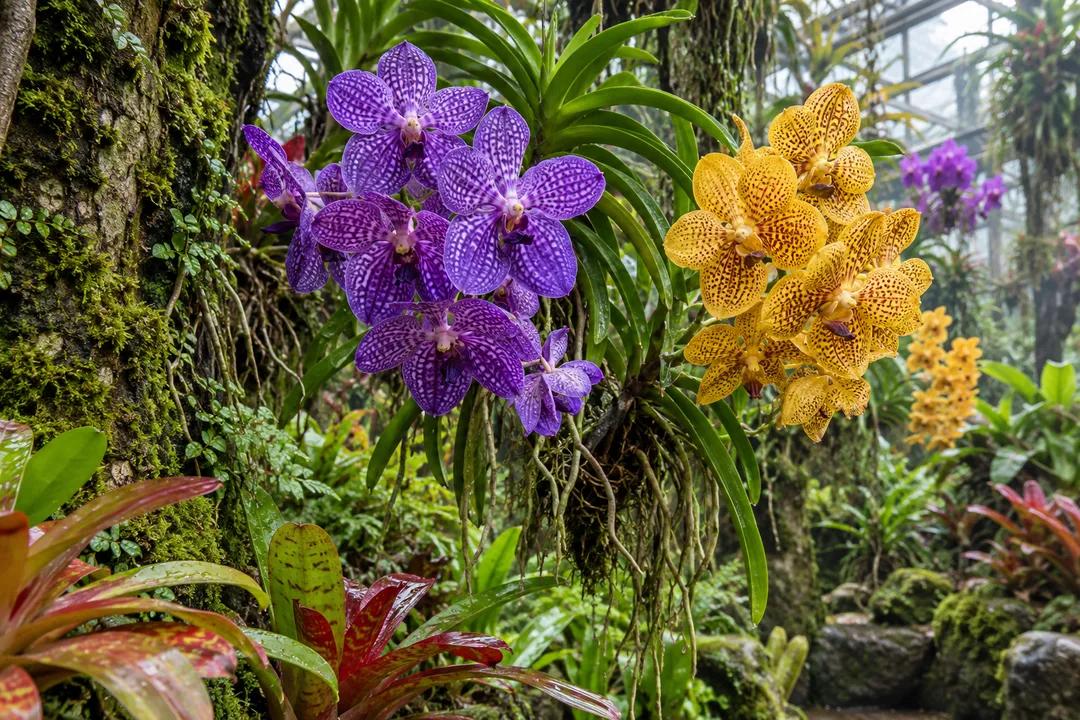
A major highlight is the VIP Orchid Garden, where hybrid orchids bred by the garden's master hybridizers are officially named after visiting heads of state and global dignitaries. Visitors can view vibrant blooms named after Nelson Mandela, Margaret Thatcher, Queen Elizabeth II, Prince William, and Catherine Middleton, as well as celebrity orchids honoring stars like Jackie Chan and Stefanie Sun. Nearby, the Tan Hoon Siang Mist House and the Sembcorp Cool House maintain controlled microclimates that shelter rare high-elevation cloud forest orchids, carnivorous pitcher plants (Nepenthes), and delicate montane ferns that flourish in humid mountain air.
Primary Rainforest Older Than Modern Singapore Itself
Few visitors realize that Singapore Botanic Gardens protects a genuine six-hectare patch of primary tropical rainforest, an ancient ecological relic that predates the founding of modern Singapore in 1819. Singapore is one of only two major global metropolises to retain primary rainforest within its urban territory, the other being Rio de Janeiro. A raised wooden boardwalk winds through the forest understory, allowing visitors to walk beneath a thirty-meter-tall canopy of indigenous trees, including giant red meranti, Jelutong, and towering rattan palms.
The rainforest patch is alive with biodiversity, home to over three hundred plant species, flying lizards, giant Asian toadstools, and native birdlife like the crimson sunbird and banded woodpecker. The dense multi-layered canopy drops the ambient temperature significantly, offering an immersive jungle experience just minutes from the bustling traffic of Orchard Road. Educational signboards explain the delicate ecological web connecting soil mycorrhizae, climbing lianas, and canopy pollinators that have functioned uninterrupted for thousands of years.
Sunrise Joggers and Early Morning Visiting Strategies
Because equatorial Singapore experiences intense midday heat and afternoon thunderstorms, timing your botanical excursion is essential. The general gardens open at 5:00 am, and arriving between 6:30 am and 8:30 am allows you to explore in cool, gentle morning air alongside neighborhood joggers and bird photographers. Morning mist hovering over Swan Lake, built in 1866 and home to graceful imported mute swans, creates ethereal sunrise scenes with water lilies opening their petals to the early light.
General admission to Singapore Botanic Gardens is completely free (S$0). The National Orchid Garden operates on separate hours from 8:30 am to 7:00 pm daily (with last ticket sales at 6:00 pm). Standard adult admission to the National Orchid Garden is S$15, while students and seniors over sixty pay just S$3, and children under twelve enter free of charge. Singapore citizens and permanent residents enjoy discounted rates of S$5 for adults and S$1 for seniors. After walking the trails, grab breakfast at Bee's Knees at The Garage, where an iced cold brew costs S$6.50 and eggs Benedict costs S$18, or head to The Halia in the Ginger Garden for iced ginger tea at S$7.50.
Practical Gate Navigation and Strolling to Dempsey Hill
Navigating the eighty-two-hectare property is easiest when you plan your entry and exit gates. Botanic Gardens MRT station (interchange for the Circle line CC19 and Downtown line DT9) connects directly to the northern Bukit Timah Gate, making it the fastest entrance for travelers coming from Marina Bay or Bugis. If you prefer to start near the heritage trees and Swan Lake, use Napier MRT station (Thomson-East Coast line TE12), which brings you right to the historic Tanglin Gate on Cluny Road. Multiple city buses, including routes 7, 75, 77, 105, 106, 123, and 174, stop along Napier Road and Holland Road outside the southern boundary.
After touring the garden's southern trails, exit through the Tyersall Gate or Tanglin Gate and take a ten-minute walk up the hill to Dempsey Hill. This former British colonial army barracks has been converted into a charming culinary and lifestyle village nestled among giant banyan trees. Browse independent antique emporiums, sample artisanal ice cream, or enjoy wood-fired sourdough pizzas and local seafood at one of the open-air veranda restaurants. Singapore Botanic Gardens remains an unparalleled national treasure, merging world-class tropical botany, deep colonial history, and accessible urban wilderness in the very heart of the Garden City.
Ask Karpo for more information.
Keep reading
- Chinatown New in Town Weekend Planner: Errands and Temples
 Kampong Glam New in Town Weekend Planner: Mosque to Murtabak
 Holland Village New in Town Weekend Planner: Meet People