 Chinatown New in Town Weekend Planner: Errands and Temples
Weekend Plans
Botanical Garden Near Me in Fort Canning: Historic Spice Trail Walk
Uncover the Fort Canning Spice Garden in central Singapore, tracing Sir Stamford Raffles' original 1822 experimental botanical plot through restored spice terraces and historic heritage trees.
Perched atop the verdant slopes overlooking central Singapore, the Fort Canning Spice Garden represents an extraordinary historical botanical garden near me that preserves the living origins of modern Southeast Asian agriculture. Situated within the sprawling green landmark of Fort Canning Park at 51 Canning Rise, Singapore 179872, this historic garden traces its roots back to 1822, when Sir Stamford Raffles established the island's very first experimental botanical plot on Government Hill. While many travelers associate Singapore's botanical prestige exclusively with the UNESCO site in Tanglin, this elevated hillside terrace is where systematic scientific cultivation first began in colonial Singapore, forever transforming the economic trajectory of the port.
The 1822 Legacy of Raffles' Experimental Botanical Terraces
When Raffles founded the experimental botanical garden in 1822, his primary motivation was both scientific and commercial. Eager to break the Dutch monopoly on the regional spice trade, he allocated forty-eight acres along the gentle slopes of Bukit Larangan (Forbidden Hill) to cultivate high-value economic crops imported from the Moluccas and Penang. Under the supervision of botanist and zoologist Nathaniel Wallich, workers cleared terraced plots and planted over one hundred and twenty-five nutmeg trees, one thousand clove plants, and dozens of pepper vines. Although economic downturns and soil diseases eventually closed the initial plantation by 1829, the botanical specimens established here laid the groundwork for Singapore's enduring reputation as an international center of tropical botany.
Throughout the late nineteenth and twentieth centuries, the hill evolved into a fortified British military garrison and later a scenic urban park. Archaeological excavations conducted on the surrounding terraces have unearthed fourteenth-century porcelain shards, glassware, and gold ornaments, proving that the hill was a royal seat long before colonial arrival. Recognizing the deep historical significance of Raffles' early agricultural trials, the National Parks Board meticulously recreated the original Spice Garden on its authentic historical footprint along the northeastern flank of the hill, allowing modern visitors to walk among the very spice cultivars that launched Singapore's merchant era.
Fragrant Nutmeg Groves, Cloves, and Indigenous Southeast Asian Herbs
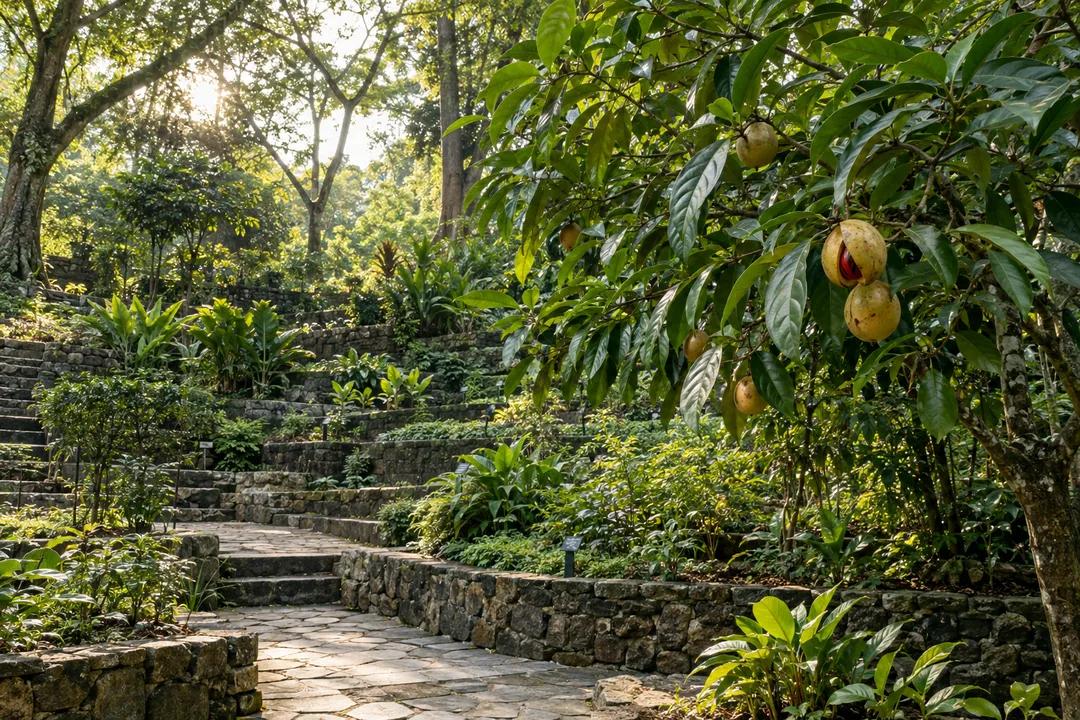
Walking along the stone-lined terraces of the Spice Garden exposes visitors to an astonishing variety of aromatic, medicinal, and culinary flora native to Southeast Asia. Towering mature nutmeg trees (Myristica fragrans) dominate the canopy, their yellow apricot-like fruits splitting open when ripe to reveal dark seeds wrapped in brilliant scarlet arils known as mace. Nearby, glossy-leaved clove trees (Syzygium aromaticum) perfume the humid morning air, reminding walkers of the dried flower buds that once commanded higher prices than gold on European trading exchanges.
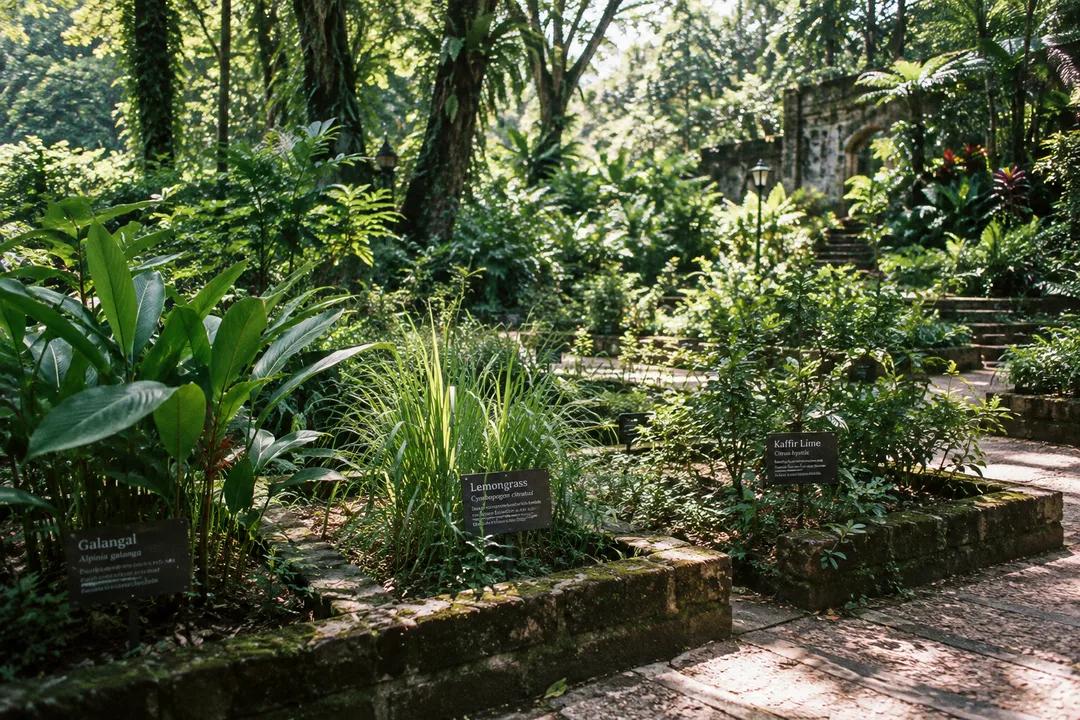
The understory beds feature a dense living catalog of traditional regional ingredients essential to Malay, Peranakan, and Chinese culinary heritage. Visitors can examine vigorous clusters of wild betel leaves (daun kaduk), fragrant pandan, pungent laksa leaves (Polygonum odoratum), and four distinct ginger species, including torch ginger with its sculptural pink inflorescence. The collection also includes medicinal herbs historically used in indigenous Jamu healing remedies, such as turmeric, galangal, kaffir lime, and bitter neem foliage, accompanied by detailed botanical plaques explaining their traditional uses.
The 2022 Expansion and Interactive Botanical Galleries
In 2022, the National Parks Board completed a comprehensive revitalization and major expansion of the Spice Garden, tripling its accessible footprint to over zero point four hectares and introducing the brand new Fort Canning Spice Gallery. This modern pedestrian gallery incorporates shaded timber pergolas, tactile display stations, and interactive digital touchpoints that explain the maritime spice trade routes that connected Singapore to India, Arabia, and Europe. Outdoor planting zones were reorganized into four thematic quadrants covering culinary herbs, medicinal greenery, commercial cash crops, and traditional perfumery plants.
The expanded garden also features restored stone walls, rain gardens designed to naturally filter surface runoff, and heritage fruit orchards featuring pomelo, starfruit, and breadfruit specimens. Special care was taken to maintain barrier-free access, with gently graded ramps connecting the lower Canning Rise entrance to the upper terraces. The integration of QR-coded botanical guides enables curious visitors to identify obscure edible weeds and study traditional drying and curing processes used by nineteenth-century spice merchants who processed harvests in woven rattan baskets along the riverbank.
Shaded Paths, Gate Entrances, and Best Times to Visit
Visiting the Fort Canning Spice Garden is an exceptionally accessible outing, as admission to Fort Canning Park and the entire Spice Garden grounds is completely free for all members of the public. The outdoor garden terraces remain open twenty-four hours daily, while the covered Spice Gallery exhibition welcomes guests daily from 7:00 am until 7:00 pm. Because the garden is nestled beneath the dense tree canopy of Fort Canning Hill, morning walks between 7:30 am and 10:00 am offer pleasantly shaded conditions and the strongest herbal aromas as morning dew evaporates from the leaves.
The garden is easily reached from multiple public transportation hubs surrounding Fort Canning Hill. The most convenient route is via Fort Canning MRT station along the Downtown Line; exiting at Gate B brings visitors to the hillside escalator that glides directly up toward the spice terraces. Alternatively, arriving via Dhoby Ghaut MRT station or City Hall MRT station allows guests to enter through Canning Rise or Stamford Road, ascending the historic staircase past the National Museum of Singapore. The shaded pathways are paved with non-slip flagstones and well-marked with directional wayfinding signage.
Continuing from Sang Nila Utama Garden to Clarke Quay
A visit to the Spice Garden naturally pairs with exploring the surrounding heritage gardens scattered across Fort Canning Hill. Just a two-minute stroll along the contour path lies the Sang Nila Utama Garden, named after the fourteenth-century Palembang prince who founded ancient Singapura. This serene enclave is modeled after traditional Javanese palace gardens, featuring split brick candi bentar gates, tranquil lily ponds, and fragrant white frangipani blossoms that create a contemplative historical atmosphere.
After completing your circuit of the hill's botanical displays, descend the southwestern slope toward the bustling riverfront of Clarke Quay and Robertson Quay. Here, waterfront dining spots and riverside cafes provide the perfect venue to unwind over lunch while watching bumboat river taxis glide along the Singapore River.
Ask Karpo for more information.
Keep reading
- Chinatown New in Town Weekend Planner: Errands and Temples
 Kampong Glam New in Town Weekend Planner: Mosque to Murtabak
 Holland Village New in Town Weekend Planner: Meet People