A Park That Is Older Than the Country
The Singapore Botanic Gardens has been at its current site at the foot of Tanglin Hill since 1859 — sixty-six years before Singapore gained self-governance and one hundred and six years before independence. It is the oldest continuously operating botanic garden in Southeast Asia and, in July 2015, became Singapore's first and only UNESCO World Heritage Site.
The UNESCO designation is for the garden's cultural landscape — the surviving Victorian-era plant collections, the historic features and buildings, and the role the garden played in developing the rubber industry that built modern Southeast Asia. The garden's first director, Henry Nicholas Ridley, was the one who figured out how to extract latex from Hevea trees without killing them, which he did in this garden in the 1890s.
The garden is 82 hectares — about 200 acres. Free admission, except for the National Orchid Garden inside, which has its own modest fee. Open from 5:00 a.m. to midnight, every day.
For most Singaporeans, the garden is the city's primary jogging, walking, and picnic park. For visitors, it is one of the few places in Singapore where you can spend a full morning under tropical canopy and forget you are in a city of six million people.
Why This Walk
The walk from the Tanglin Gate of the Botanic Gardens, south through the gardens, out the southern Bukit Timah entrance, and across the small Holland Road overpass into Dempsey Hill, is one of Singapore's most pleasant Sunday-morning rituals. It is about 2.5 kilometers of shaded path, ending at a hillside neighborhood of converted British military barracks that is now Singapore's most relaxed restaurant-and-brunch district.
The walk pairs two very different versions of Singapore's colonial heritage: the British scientific institution that is the garden, and the British military infrastructure that is Dempsey Hill. Both have been preserved and adapted into very contemporary Singaporean uses — the garden is a working research institution and public park, and Dempsey Hill is the kind of low-key brunch destination that the locals call their "Sunday neighborhood."
Through the Gardens
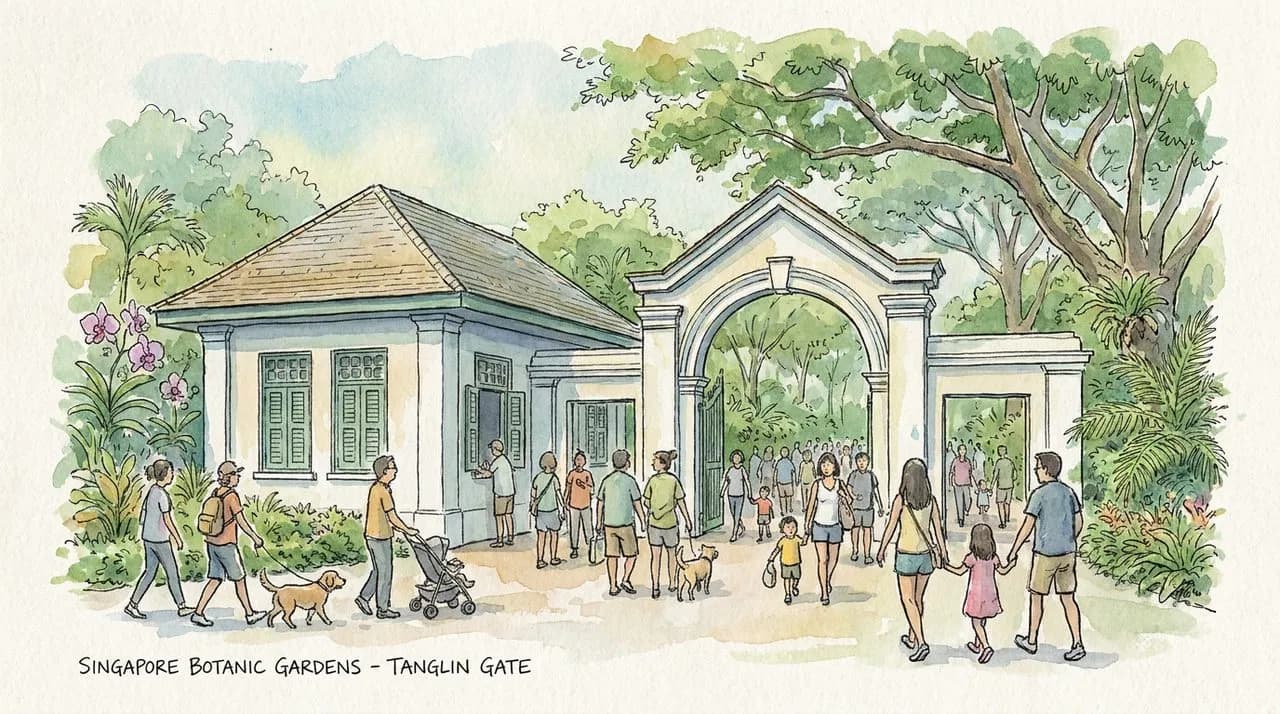
Enter at Tanglin Gate, the northwest entrance on Cluny Road. This is the original 1859 entrance and the part of the garden with the most historic buildings: the Burkill Hall (the director's house, 1868), the Bandstand (1930, the small white pavilion at the top of the first hill), and the Swan Lake (the artificial lake at the foot of the bandstand hill).
The Tanglin section of the garden is the oldest. The plant collections here include the Heritage Trees — a series of giant tropical trees individually labeled and preserved, some of them over a hundred and fifty years old. The Tembusu tree near the Bandstand, one of the largest in the garden, is the tree pictured on the back of Singapore's five-dollar note.
Walk south. The Symphony Lake — Singapore's outdoor classical-music venue, with free Sunday-evening concerts on the lake's floating stage — is on your left. The Healing Garden, a small section dedicated to medicinal tropical plants, is on your right.
The National Orchid Garden is in the middle of the park, off the central path. Admission is S$15 for visitors, free for Singaporeans. It is worth the detour if you have the time — about 60,000 orchid plants in a designed garden over three hectares, including the Vanda Miss Joaquim, Singapore's national flower. If you are in a hurry, you can skip it; it adds about 45 minutes.
Through the Eco Lake Section
South of the National Orchid Garden, the path widens into the Eco Lake section. This is the newer part of the garden — the section developed in the 1990s and 2000s to bring rainforest and freshwater-swamp ecosystems back into the park.
The Eco Lake itself is a large artificial pond designed for native bird species. The boardwalk that loops around it gives you a slow lap through the swamp forest. The lap takes about twenty minutes. Egrets, kingfishers, and the occasional water monitor lizard — Singapore's largest urban reptile — are visible from the railings.
South of the Eco Lake, the path continues to the Bukit Timah entrance and out onto Holland Road.
The Crossing to Dempsey Hill
The transition from the garden to Dempsey Hill is short — about a five-minute walk across Holland Road and up the small road called Loewen Road. The crossing is not signed for tourists. It is the kind of route Singaporeans take by default and visitors mostly do not know about.
Dempsey Hill — Singapore's general name for the cluster of restaurants and shops in the old Tanglin Barracks — was a British military compound from the 1860s until the British withdrew from Singapore in 1971. The barracks buildings, low colonial-era brick structures with red roofs and wide verandas, were repurposed in the 2000s as a restaurant-and-shopping district.
The district is intentionally low-rise and shaded. The buildings sit on a small ridge, mostly under mature rain trees. The roads through the district are narrow, the parking is in clusters, and there are no high-rise buildings within line of sight. The atmosphere is closer to a village than a commercial district.
What to Eat at Dempsey
The choice is wide and skews toward brunch. PS.Cafe Dempsey is the local default — outdoor seating, a long brunch menu, and one of the better flat whites in the area. Open Farm Community is the more ambitious choice — a farm-to-table restaurant with its own herb garden, a full Sunday brunch, and reservations needed by 9:00 a.m. for an 11:00 a.m. seating.
For coffee without the full brunch, Common Man Coffee Roasters has a Dempsey outpost. For the local Singaporean breakfast, Samy's Curry — a hawker-style banana-leaf-and-curry institution that has been at Dempsey since 1980 — opens at 11:00 a.m. and serves the most authentic South Indian fish-head curry in the city.
The pricing is upper-middle-class Singapore — about S$25 to S$45 per person for brunch, S$15 to S$25 for a coffee-and-pastry stop. The crowd is half Singaporean families, half visitors, mostly relaxed.
When to Walk It
Sunday morning is the canonical time. Start at the Tanglin Gate at 7:30 a.m. — yes, that early, because Singapore's heat is the heat — and you will be at Dempsey by 9:00 for the first coffee. The garden in the morning is full of joggers and the occasional tai chi class. By 8:00 the temperature is already 28°C; by 10:00 it is 31°C.
Saturday afternoon also works, with the caveat that the heat is more aggressive. The garden is more crowded with families. Dempsey is mostly empty until 6:00 p.m., when the dinner crowd shows up.
For a rainy day — Singapore gets a lot of rainy days — the route still works. The garden's paths are largely shaded, and Dempsey's restaurants are largely covered. Bring an umbrella; the brief afternoon thunderstorms that happen most days are short but heavy.
How to Get There
The MRT does not run directly to the Botanic Gardens. The closest station is Botanic Gardens MRT (on the Downtown and Circle Lines), about a five-minute walk from the gardens' Bukit Timah entrance. To start at the Tanglin Gate, take a taxi or a Grab from the MRT — it is about S$5 — or walk through the garden from the Bukit Timah side to the Tanglin Gate first, then back south to Dempsey. The full loop adds about 30 minutes.
To return, the easiest option is a Grab from Dempsey Hill back to your hotel. The cars are plentiful, the ride is short — Dempsey is fifteen minutes from anywhere in central Singapore — and the cost is between S$8 and S$15.
Why It Is the Local Sunday
The walk's specific virtue is that it gives you Singapore at one of its most legible moments. The garden is the deep history — colonial-era, scientific, the rubber industry, the orchid breeding. Dempsey is the recent history — the British military, the redevelopment, the brunch economy.
The garden is free and public. Dempsey is private and expensive. The walk between them is the transition from one Singapore to the other.
This is the version of the city most Singaporeans will, if asked, tell you they would spend their own Sunday morning doing. It is a low-key, mostly outdoor, food-and-trees, no-itinerary kind of morning. The kind of Sunday a city does for itself.
If you are visiting and you have one Sunday morning, this is the one to take. The rest of Singapore — Marina Bay Sands, the Gardens by the Bay, Sentosa — will still be there in the afternoon.
Practical notes
- Start: Tanglin Gate, Singapore Botanic Gardens, 1 Cluny Road, Singapore 259569.
- End: Dempsey Hill, Singapore.
- Distance: ~2.5 km. ~90 minutes walking, half-day with brunch.
- Garden admission: Free. National Orchid Garden inside: S$15 (free for Singapore residents).
- Don't miss: The Bandstand, the Tembusu tree on the five-dollar note, the Eco Lake boardwalk.
- Brunch: PS.Cafe Dempsey, Open Farm Community, or Samy's Curry for the local version.
#singapore #botanicgardens #dempseyhill #singaporetravel #longwayhome #sundaywalk #singaporefood #karpofinds #localknowledge #weekendsg #hiddensingapore #singaporeparks #sgwalks #singaporebrunch #colonialheritage
Sources consulted: National Parks Board Singapore · UNESCO World Heritage Centre · National Heritage Board · Lonely Planet · Time Out Singapore
All trademarks are the property of their respective owners.