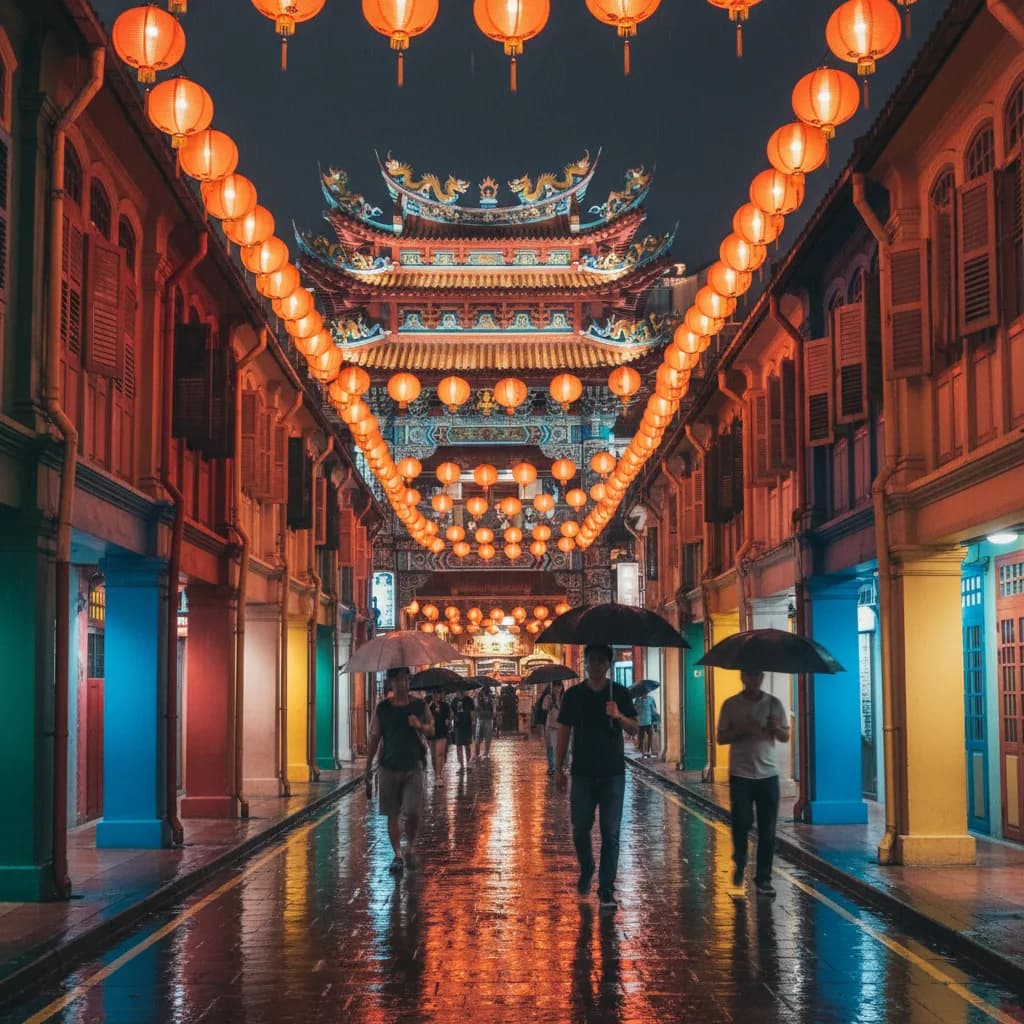
 Chinatown New in Town Weekend Planner: Errands and Temples
Weekend Plans

Singapore Art Museum Guide to Stamford Road's National Museum
Discover the National Museum of Singapore on Stamford Road, showcasing 19th-century neoclassical architecture, historical art collections, and teamLab installations.
When urban explorers seek a magnificent and historically profound art museum near me in Singapore, the National Museum of Singapore on Stamford Road stands as the grand matriarch of the nation's cultural landscape. Situated at 93 Stamford Rd, Singapore 178897 along the verdant foothills of Fort Canning, this venerable institution fuses nineteenth-century neoclassical grandeur with visionary contemporary digital art. Home to Singapore's most comprehensive collection of historical artifacts, ethnographic treasures, and modern multimedia exhibitions, the museum invites travelers into a luminous narrative tracing seven centuries of Southeast Asian maritime and creative history.

Neoclassical Rotunda Architecture and Nineteenth-Century Heritage
The museum's origins date back to 1887, when it was originally founded as the Raffles Library and Museum under British colonial governance. Designed by municipal engineer Henry McCallum, the landmark building showcases Renaissance-inspired symmetry with arched pediments, classical ionic porticos, and an imposing central rotunda rising twenty-seven meters above ground. The dome is crowned with fifty individual stained-glass panels and twelve arched clerestory windows that cast warm, patterned natural light across the sweeping grand marble staircase.
In December 2006, the historical monument underwent a landmark modern expansion that seamlessly connected the nineteenth-century masonry wing with an innovative steel-and-glass contemporary pavilion. The modern wing introduces expansive subterranean gallery caverns, suspended glass skybridges, and an exterior glass curtain wall that reflects the surrounding banyan trees of Fort Canning. This harmonious dialogue between colonial heritage and contemporary civic architecture earned the institution global acclaim as a pinnacle of sensitive adaptive reuse.
The integration of historical craftsmanship with high-performance modern engineering extends to the museum's acoustic design and climate management. Subterranean galleries maintain stable humidity and temperature environments necessary to protect delicate paper archives and ancient archaeological metals, while insulated double-glazed skylights filter ultraviolet radiation. Floating timber bridges bridge the airy lightwells, offering visitors striking vantage points overlooking both the ornamental Victorian brickwork and the minimalist steel columns of the modern atrium.
Immersive Digital Installations and teamLab's Story of the Forest
Ascending to the upper level of the modern wing, visitors encounter the museum's crowning artistic wonder: Story of the Forest, a mesmerizing site-specific digital art installation created by world-famous Japanese collective teamLab. Housed inside the soaring Glass Rotunda, the artwork transforms sixty-nine nineteenth-century natural history watercolors from the William Farquhar Collection into a breathtaking, interactive three-dimensional digital ecosystem. Visitors descend along a spiral ramp as animated tapirs, sun bears, leopards, and flying foxes move seamlessly through virtual rainforest canopies.
At the base of the spiral, the cavernous rotunda floor opens into a celestial viewing area where blooming tropical flora, fallen leaves, and cascading waterfalls respond dynamically to visitors steps. In the adjacent Goh Seng Choo Gallery, the original delicate nineteenth-century botanical sketches are displayed in rotated climate-controlled vitrines, allowing guests to study the exquisite hand-painted botanical pigments of indigenous pepper vines, mangosteens, and nutmeg trees that laid the groundwork for modern scientific illustration in Southeast Asia.
The Singapore History Gallery on Level 1 provides a sprawling immersive voyage through four distinct eras: Singapura, Crown Colony, Syonan-To, and Singapore. Among its eleven national treasures on permanent view are the enigmatic Singapore Stone fragment bearing an undeciphered ancient Majapahit script from the fourteenth century, the gold armlet excavated from Fort Canning Hill, and the 1965 national independence broadcast recordings. Cinematic audio-visual projections and ambient soundscapes immerse travelers deeply into the lived experiences of everyday pioneers.
Artefacts recovered from archaeological excavations along the Singapore River shed light on early trading networks that flourished under the Temasek kingdom. Rare celadon bowls, blue-and-white porcelain shards from the Yuan dynasty, and Javanese bronze bells demonstrate how the island served as an international entrepot centuries before colonial arrival. Interactive multimedia touchpoints and audio handsets offer personal accounts from rubber plantation workers, harbor lightermen, and pioneer educators who shaped the young nation.
Museum Dining at Cafe Brera and Fort Canning Park Greenery
After exploring the extensive gallery collections, visitors can unwind inside the museum's tranquil hospitality spaces. On Level 1, Cafe Brera at Reunion provides a warm, sunlit gathering spot serving artisanal sourdough sandwiches, slow-cooked beef pastrami, and signature flaky Basque burnt cheesecakes alongside freshly pulled specialty flat whites. Floor-to-ceiling glass doors open directly onto the shaded lawn, where century-old angsana trees offer a restful respite from equatorial sunshine.
Stepping out through the rear exit, visitors immediately access the picturesque trails of Fort Canning Park. A leisurely walk takes guests past the historic Gothic Gate, the Old Christian Cemetery with its evocative brick headstone plaques, and the serene Sang Nila Utama Garden, designed in classical fourteenth-century Javanese royal palace aesthetics with ornate split gates and reflective lily pools. The neighborhood also houses the Singapore Philatelic Museum and the Peranakan Museum just a short five-minute walk downhill.
Visitor Information, Ticketing Guidelines, and Transit Directions
The National Museum of Singapore is open daily Monday through Sunday from 10:00 am to 7:00 pm, with final admission granted at 6:30 pm. Singapore Citizens and Permanent Residents receive free general admission to all permanent galleries upon presenting valid Singapore identification. For overseas travelers, standard all-access adult admission is priced at S$15, while concession tickets for foreign students, seniors aged sixty and above, and guests with disabilities are available for S$10. Children aged six and below enter free of charge.
The museum boasts full barrier-free accessibility, providing step-free street ramps along Stamford Road, motorized entrance doors, tactile floor indicators for visually impaired visitors, and spacious elevators linking all exhibition wings. Strollers and wheelchairs are available on loan without charge at the Level 1 visitor concourse.
Reaching the museum via Singapore's public transport network is straightforward. Bras Basah MRT station (CC2 Exit C) and Bencoolen MRT station (DT21 Exit B) are both located within an easy four-minute walk. Dhoby Ghaut interchange (NS24/NE6/CC1 Exit A) and City Hall station (NS25/EW13 Exit B) are situated less than eight minutes away on foot. Multiple municipal bus routes, including 7, 14, 16, 36, 111, 124, 162, and 174, stop right along the Stamford Road bus shelter in front of the main portico.
To discover more historical museums, digital art spectacles, and architectural heritage trails across Singapore, consult the Karpo APP. From pinpointing quiet reading gardens to reserving heritage afternoon teas, the platform guides every step of your cultural adventure.
Ask Karpo for more information.
Keep reading
- Chinatown New in Town Weekend Planner: Errands and Temples
 Kampong Glam New in Town Weekend Planner: Mosque to Murtabak
 Holland Village New in Town Weekend Planner: Meet People