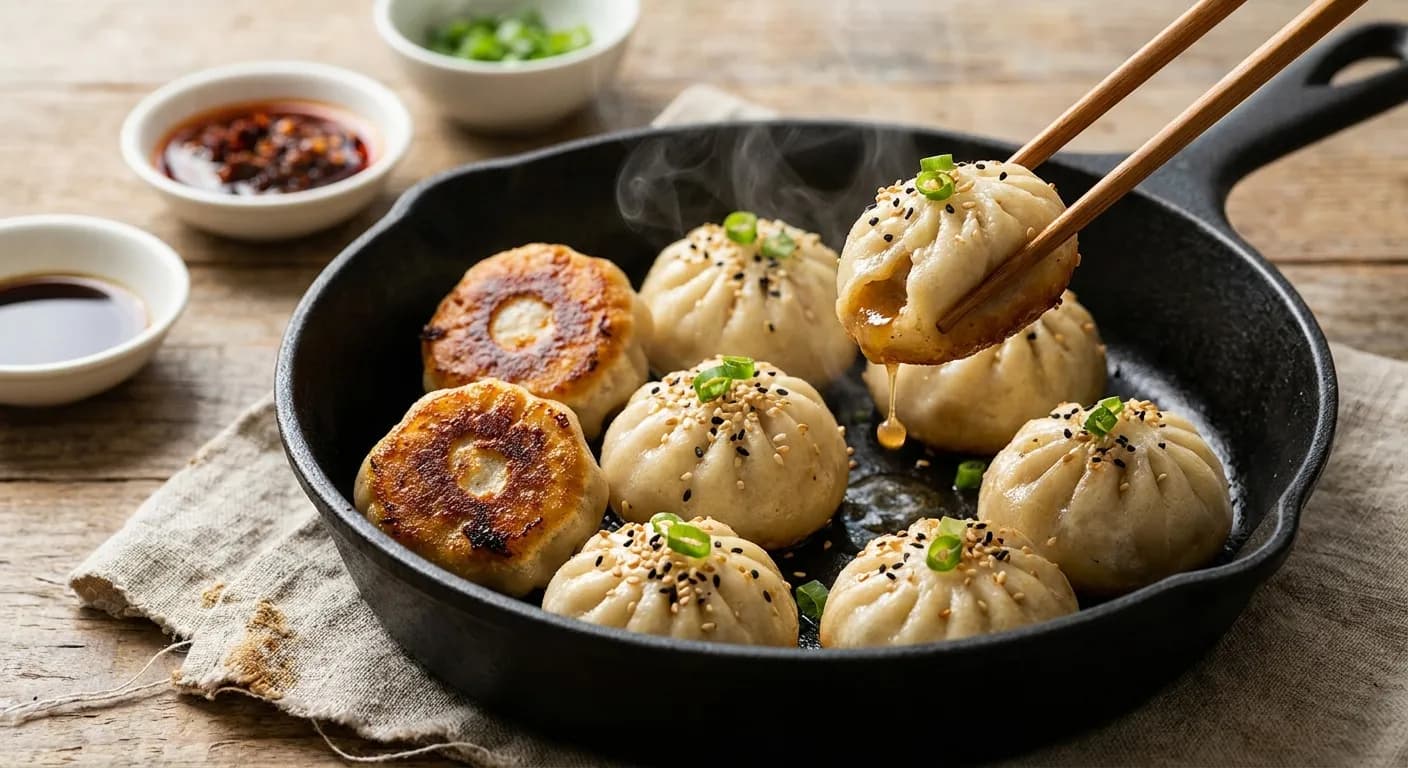
Xiao long bao get the headlines, but Shanghai's other soup dumpling is the one that rewards a hunt. Sheng jian bao — SJB if you're texting a friend from the line — are pan-fried buns with a caramelized, crackling bottom, a pillowy steamed top, and the same scalding broth waiting inside. Where XLB are all delicacy, SJB are contrast: crunch, chew, and soup in a single bite that has ended more than one white shirt's career.
San Francisco does them well, but not everywhere, and the scene churns — several one-time SJB destinations have closed or gone dark in the past year or two. This guide sticks to rooms that are actually frying right now, spread from Chinatown to the fog belt, plus a field guide to eating one without a lap burn.
What Makes Sheng Jian Bao Different From XLB
Both dumplings seal hot soup inside a wrapper; the resemblance ends there. XLB wrappers are thin, unleavened, and steamed to translucence. SJB dough is thicker and lightly leavened, closer to a bun, and it cooks in a shallow pan — fried on the bottom until deeply golden, then finished with a splash of water and a lid so the tops steam soft. The good ones come showered with sesame seeds and scallions, and the bottom should shatter slightly when you bite it. Because the dough is sturdier, SJB usually hold more soup at a higher temperature, which is a warning disguised as a selling point.
- The tell of a great SJB: a bottom that's evenly bronzed, not scorched, and a top that stays fluffy.
- Fresh from the pan matters even more than with XLB — a rested SJB loses its crunch in minutes.
- Expect a wait at the good spots. SJB are typically fried to order in batches, and rushing them ruins the sear.
- Black vinegar still applies. The richness of the pork and soup wants that acid.
Shanghai House: The Outer Richmond Standard
Out on Balboa Street in the Outer Richmond, Shanghai House is the kind of place you'd walk past if you didn't know — roughly eight tables, homemade everything, and a sheng jian bao that regulars treat as the point of the trip. The skin runs thicker and more traditional than the trendy downtown versions, which means it holds a serious payload of broth, and the bottoms come out crisp and savory. It's cash only, the room fills fast at peak hours, and the fried chicken wings have their own fan club if you need a second act. This is the closest SF gets to a neighborhood Shanghai joint that happens to be surrounded by fog.
China Live: The Gateway SJB
At China Live on Broadway, at the seam of Chinatown and North Beach, the sheng jian bao isn't a side quest — the restaurant bills it as its number-one seller, made daily and served in orders of five. The version here is polished: juicy pork, a soft chewy top, and a proper crispy bottom, delivered in a big, buzzy marketplace room where you can watch the stations work. Purists will note you're paying a premium over a Chinatown counter, and they're right. But if you're introducing someone to SJB and want comfortable seats, a full bar, and a reliable rendition, this is the easiest yes in the city.
Today Food: Chinatown's Window-Side Masters
A few blocks into Chinatown proper, Today Food is a tiny Shanghainese operation where the dumplings are made daily by chefs working right at the window — thin, chewy wrappers packed with pork, shrimp, or chicken, then pan-fried, boiled, or dropped into broth to order. The menu is short on purpose, and the pan-fried tray is the move. Seating amounts to a handful of small tables inside and out that are usually taken, so plan on taking your haul to go. Portsmouth Square is a short walk if you want to eat them while they're still dangerous.
The Westside Sleepers: Dumpling Zone and Dumpling Kitchen
The city's western neighborhoods hide two very different SJB stops. Dumpling Zone, on Dewey Boulevard in Forest Hill, turns out pan-fried pork bao that eat like puffy balloons full of savory soup and tender pork — generous, soft-topped, and worth the detour into a neighborhood most visitors never see. Down in Parkside, Dumpling Kitchen on Taraval Street serves Shanghai-style pan-fried pork buns six to an order alongside a deep menu of soup dumplings and noodles, which makes it the practical choice when your table wants SJB and everything else too.
The XLB Heavyweights That Also Fry
If you've read our steamed soup dumpling guide, you know Dumpling Home in Hayes Valley and its Fillmore Street sibling Dumpling Story. Both also run crispy-bottomed shengjianbao — soup-filled but still crackling underneath — and they're excellent. We're keeping them as footnotes here only because they're already famous for the steamed stuff; if you're standing in one of their lines anyway, adding an SJB order is not a decision that requires deliberation.
How to Eat One Without a Lap Burn
SJB are hotter than XLB and less predictable, because the thick dough insulates the soup and the bun doesn't telegraph how much is inside. The technique matters:
- Never bite straight in. Nibble a small hole in the soft top — not the crispy bottom — and let steam vent for a few seconds.
- Sip some broth through the hole first, or tip it into a spoon. This is the step everyone skips exactly once.
- Hold it over the plate or a spoon the whole time. A mid-air SJB is a loaded weapon aimed at your jeans.
- Then eat bottom-side up, so the crisp layer lands on your tongue instead of steaming soft against the plate.
Sheng Jian Bao FAQs
Are sheng jian bao the same as pan-fried potstickers?
No. Potstickers are crescent-shaped dumplings with a thin unleavened wrapper and no soup inside. Sheng jian bao are round, made with a thicker leavened dough closer to a bun, and sealed around hot broth like their steamed XLB cousins. The only real overlap is the crispy fried bottom — and the fact that SF does both well.
Why do sheng jian bao take so long to arrive?
They're fried in batches in a covered pan, and a proper sear plus a steamed top can't be rushed — at some spots the wait runs well past what you'd expect for dumplings. Order them first, before anything else on the menu, and treat the wait as proof the kitchen isn't holding pre-cooked buns under a heat lamp.
Where should a first-timer start?
China Live is the low-friction introduction: comfortable room, reliable SJB, easy to book into a bigger night out. Once you're hooked, graduate to Shanghai House on Balboa with cash in your pocket for the more traditional, broth-heavy version. And since small spots' hours shift, check before you cross town — or ask Karpo, and it'll point you to whichever pan is hot right now.