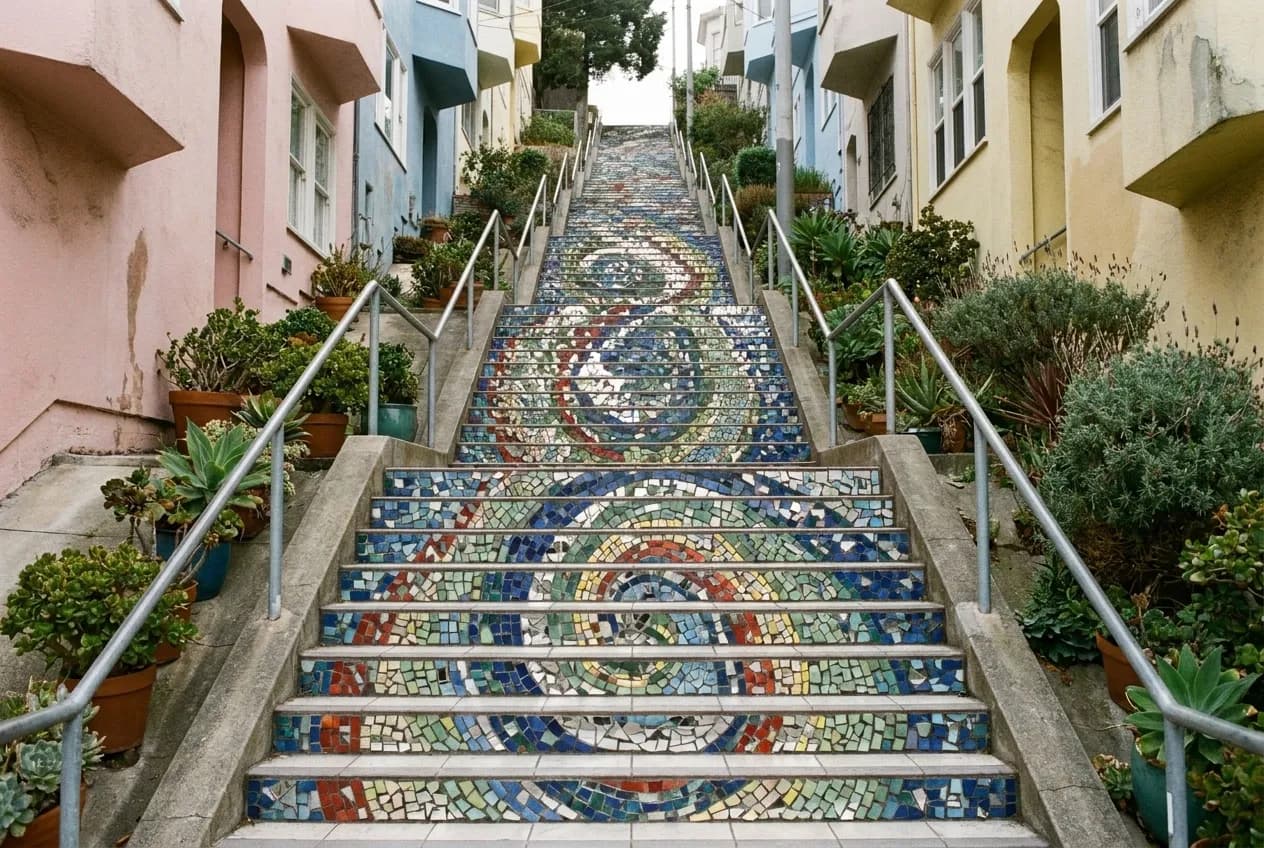
San Francisco has hundreds of public staircases, built because the grid was drawn on paper by people who had not walked the hills. Most of them are plain concrete. The flight running up 16th Avenue at Moraga Street in Golden Gate Heights is not: one hundred and sixty-three steps, ninety feet of climb, and a continuous mosaic covering every riser from the bottom of the hill to the top. It is free, it is a public right of way, and it is somebody's front garden at the same time.
Ask Karpo when the steps are quiet, which staircase to take back down, and what else in the Sunset is worth the climb while you are up there.
The neighbours made it
This was not a city arts commission dropped onto a street. The project began in 2003 when residents organised to transform an unremarkable staircase, worked with artists Aileen Barr and Colette Crutcher, raised the money locally and opened the finished flight on 27 August 2005. Neighbours sponsored individual tiles, which is why the mosaic reads as an accumulation of small decisions rather than a single design gesture.
The scale of the thing is easy to underestimate from a photograph. The surface is made up of well over two thousand handmade tiles alongside tens of thousands of fragments of glass, mirror and ceramic, all set by hand. The composition runs from sea to sky as you climb, which is a simple idea that works far better in person than it does when described.
Climb it slowly and look down as well as up
The instinct is to walk up while looking at the risers directly in front of you, which misses half of it. Stop two or three times on the way and look back down the flight: the mosaic reads as a continuous image from above in a way it does not from below, and the mirror fragments do different things depending on where the light is coming from.
Ninety feet of stairs is a real climb if you are not used to it. There are handrails the whole way and no shortcuts, and the surface is tiled rather than plain concrete, which means it is slick in the rain. On a wet morning take it slowly or take the road instead.
The steps are the halfway point, not the destination
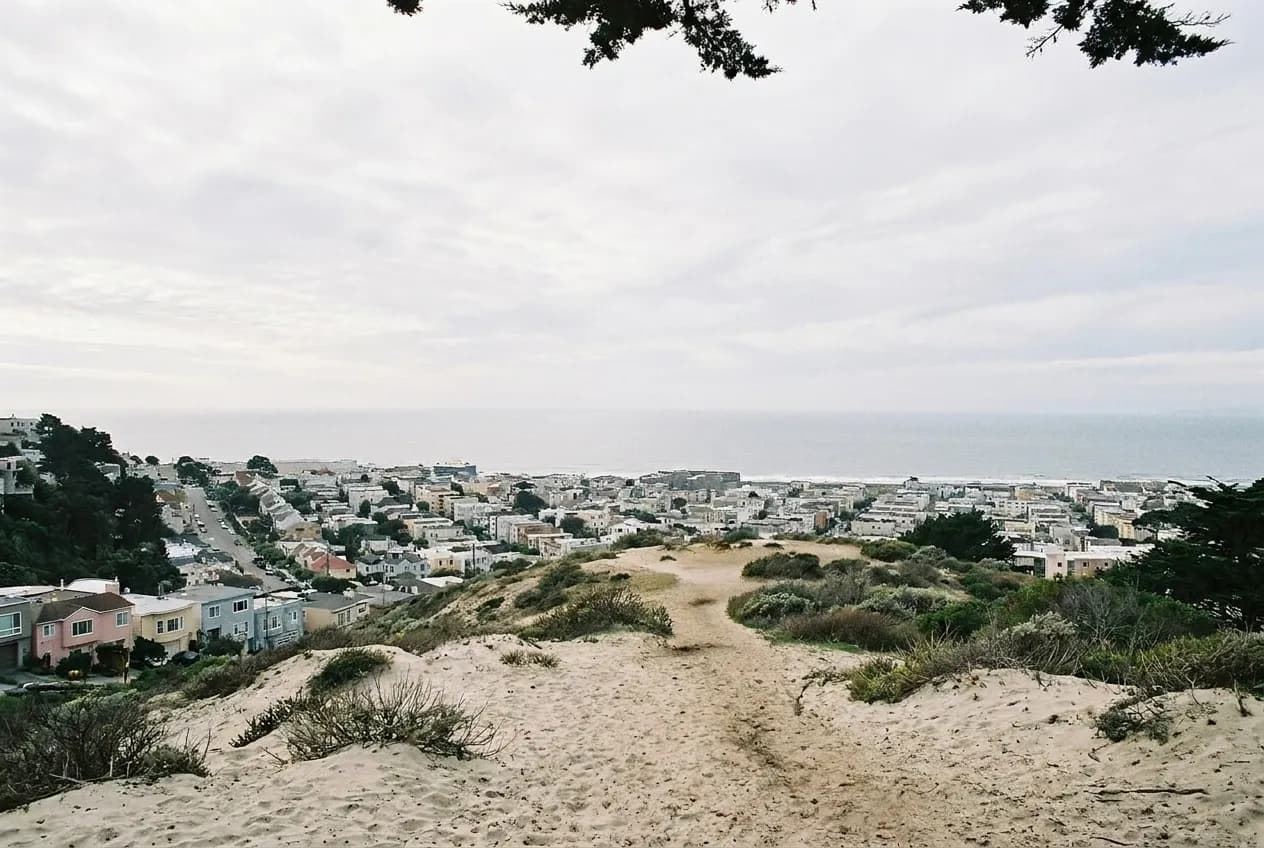
At the top of the flight you are standing at the base of Grandview Park, a sandy summit with another set of steps running up to it. Locals call it Turtle Hill. The climb is short and steep and the reward is a genuine three-hundred-and-sixty-degree view: the Pacific and Ocean Beach to the west, Golden Gate Park and the Marin hills to the north, downtown and the bay to the east.
The summit is also a rare surviving fragment of the dune landscape that covered this whole side of the city before it was built over, with native coastal scrub holding the sand in place. Stay on the paths. The vegetation is the only thing keeping the hilltop from eroding, and the informal routes people cut across it do visible damage.
It is a residential street, and that changes the etiquette
This is the part most visitors get wrong. The staircase runs between private houses, and the people living either side of it did not sign up to have a queue outside their bedroom windows. Keep the volume down, do not block the flight for a photo session, do not use anyone's steps or driveway, and take rubbish with you.
Practically, that also means going early. Before about nine in the morning the street is quiet, the light is soft and you will have the flight to yourself. Weekend afternoons are when it gets busy enough to be unpleasant for both visitors and residents, and the mosaic does not look any better with twenty people standing on it.
The other thing worth knowing is that the fog decides what kind of visit this is. From roughly June through August this side of the city sits under the marine layer for much of the day, and a summit in cloud gives you a staircase and a white wall where the view should be. The mosaic looks good in any weather; Grandview does not. If the view is the reason you are coming, check whether the western half of the city is clear before you set out, and be prepared to swap the plan to an afternoon, when the layer often burns back for a couple of hours.
Getting there and what else is nearby
The steps sit in Golden Gate Heights, uphill from the Inner Sunset. The N line and the shops along Irving Street are about a fifteen-minute walk downhill, which is the sensible way to arrive: transit or park in the flat part, climb the hill, come back down to eat. Driving directly to the base means dealing with steep, narrow residential parking for no benefit.
There is a second mosaic staircase on Moraga at 15th Avenue nearby, and Golden Gate Park's southern edge is a short walk north, which means the climb can be the middle of a longer walk rather than a single stop. Do the steps first while it is quiet and leave the park for afterwards.
Practical notes
The 16th Avenue Tiled Steps run up 16th Avenue at Moraga Street in Golden Gate Heights, San Francisco: 163 steps, about ninety feet of climb, free and open at all times. The mosaic was a neighbourhood project completed with artists Aileen Barr and Colette Crutcher and opened on 27 August 2005. Grandview Park sits above the flight with a further short climb and a full panoramic view. It is a residential street, so keep noise down and go early. The tiles are slippery when wet.
Tags: #ThingsToDoNearMe #InnerSunset #TiledSteps #GoldenGateHeights #GrandviewPark #SanFranciscoStairs #FreeThingsToDoSF #SFNeighborhoods #WhatToDoInSF #SFViews #SFOutdoors #MosaicArt #SunsetDistrict #SFWalks
All trademarks are the property of their respective owners.
Ask Karpo first
Want to know when the steps are quiet, which staircase to take back down, and what else in the Sunset is worth the climb while you are up there? Ask Karpo for a time of day that avoids the crowd, a loop that ends on Irving Street, and a second staircase nearby for the same walk.


