Why the counter, why Sunday
There's a particular cadence to Sunday lunch at a sushi counter that differs from every other meal of the week. The Friday night omakase crowd has dissipated. Saturday's celebratory energy has passed. What remains on Sunday is space—literal and temporal—and the people who seek it tend to be those comfortable with quiet, with watching hands work, with the idea that eating can be both social and solitary. The sushi counter offers a front-row education in knife work, rice temperature, and the micro-seasons of fish. In Japantown, a neighborhood that has withstood displacement pressures since the 1960s, this tradition persists with particular integrity. The counter seat on a Sunday becomes a place to observe not just food preparation but the preservation of a practice that refuses to accelerate for convenience.
Japantown's sushi landscape: anchors and evolutions
San Francisco's Japantown, centered around the Japan Center complex on Post Street between Fillmore and Laguna, hosts several long-standing sushi establishments where counter seating remains the preferred vantage point. Establishments like Kui Shin Bo and Hinodeya have served the neighborhood for years, their longevity a testament to consistent sourcing and technique. Mifune, located within the Kintetsu Mall section of Japan Center, offers sushi alongside udon and tempura in a more casual setting. For those seeking traditional edomae-style preparation, checking the current status of spots like Ju-ni or consulting recent reviews will reveal which chefs are currently emphasizing Tokyo-style techniques. The neighborhood's sushi offerings exist on a spectrum from approachable lunch sets to high-touch omakase, but the common thread is proximity—both to the source material flown in from Tokyo's Toyosu Market and to the itamae who shapes it. Sunday service often operates on slightly reduced hours or limited menus, so verifying schedules ahead of the visit is prudent.
The counter seat as performance space
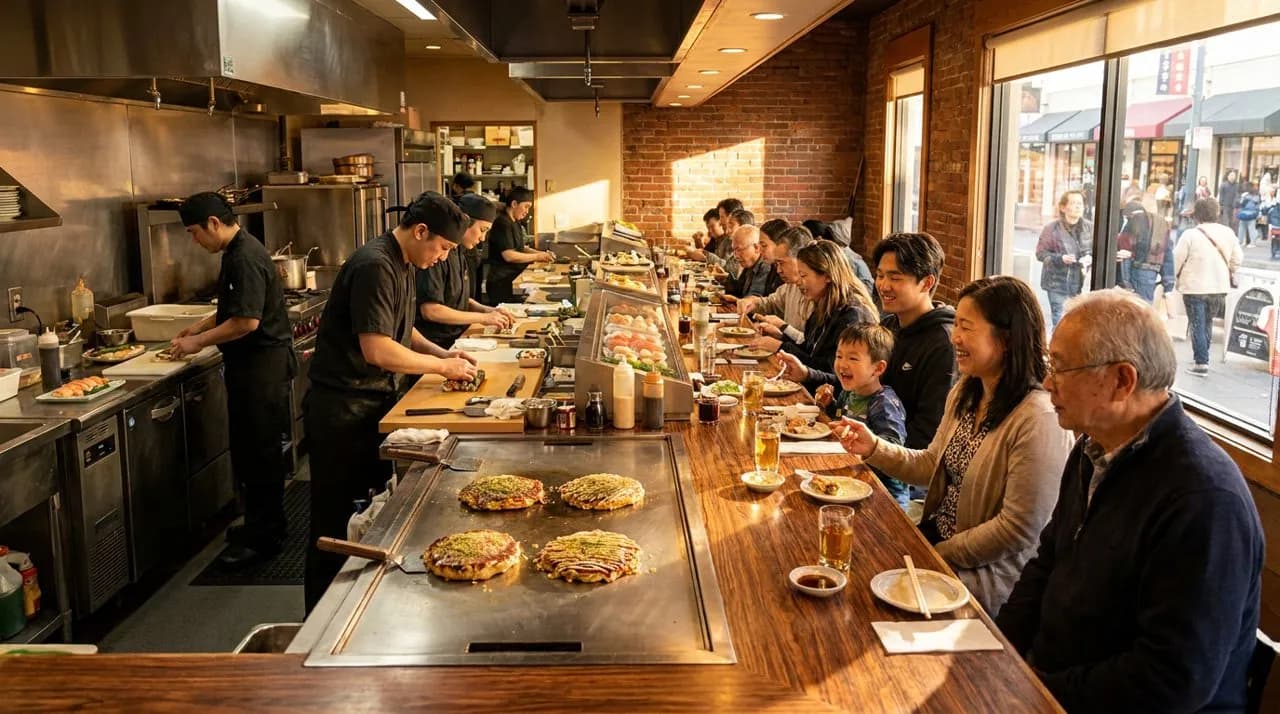
Taking a counter seat transforms the meal into theater without pretense. The itamae's movements—the way a knife glides through toro, the palm-heat applied to shape shari, the split-second decision about when ginger has steeped long enough—become the narrative. Unlike table seating, where conversation dominates, the counter invites observation. You notice the angle of the blade, the barely perceptible nod when a piece is ready, the choreography of reaching for wasabi and nori in sequence. In traditional sushi counters, the wood itself—often hinoki cypress—is chosen for its subtle fragrance and antimicrobial properties. The distance between diner and chef is deliberate, close enough for exchange but calibrated to respect working space. On Sundays, when the pace is less frenetic, itamae are often more inclined to explain sourcing details: where the hamachi was landed, why today's uni is from Hokkaido rather than Santa Barbara, how the day's humidity affects rice vinegar ratios. These are not scripted interactions but the natural byproduct of unhurried service.
What to order when restraint is the point
Sunday lunch at the sushi counter rewards strategic ordering. The nigiri set—often featuring eight to ten pieces chosen by the chef—provides a survey of what's best that day without requiring encyclopedic fish knowledge. Chirashi bowls, while not counter-specific, showcase knife skills and allow the kitchen to feature a wider variety of cuts. For those inclined toward structure, starting with something cooked—grilled mackerel, tamago, or a small dish of ankimo—eases the palate into the progression. Sake, served slightly chilled in a small ochoko, pairs better with the subtleties of high-quality fish than wine, which can overwhelm delicate flavors. The Sunday lunch special sets, common in Japantown establishments, typically run between eighteen and thirty-five dollars and include miso soup, a small salad, and rice. These sets are designed for the neighborhood regular, not the tourist seeking spectacle. They assume familiarity with the format and trust in the chef's judgment. Requesting omakase on a Sunday is possible but checking availability in advance avoids disappointment, as some counters reserve full omakase service for dinner seatings.
The neighborhood as context
Japantown's five-acre footprint, formally known as the Western Addition's Nihonmachi district, carries weight beyond its culinary offerings. Established in its current configuration after the 1906 earthquake displaced the original settlement south of Market Street, the neighborhood was further reshaped by World War II internment and subsequent urban renewal projects in the 1960s. The Japan Center, designed by Minoru Yamasaki and opened in 1968, represents both community resilience and the complicated legacy of redevelopment. Eating sushi here on a Sunday means participating in an ecosystem that includes Benkyodo Company's mochi, Soko Hardware's kitchen tools, and the Peace Pagoda's symbolic presence. The neighborhood's scale—walkable in fifteen minutes—creates an intimacy missing from more sprawling ethnic enclaves. Before or after lunch, browsing Kinokuniya Bookstore's design magazines or stepping into the compact Konko Church reveals layers of Japanese-American cultural continuity. This context doesn't make the sushi taste different, but it does make the act of eating it feel less transactional.
The quiet work of a Sunday reset
There's something restorative about eating food prepared with precision when the rest of the weekend has been improvised and sprawling. The sushi counter on a Sunday functions as a gentle re-entry into structure: fixed seating, deliberate pacing, minimal decision fatigue. The itamae has already made the hard choices—what to buy at four in the morning, how to break down a whole fish, which cut deserves the front position on the plate. The diner's job is simply to receive and to notice. In a city where brunch culture dominates Sunday dining with its endless mimosas and wait lists, the sushi counter offers an alternative rhythm. The meal rarely exceeds an hour. There's no lingering over bottomless drinks, no performative catching-up. It's a brief, calibrated experience designed to satisfy without overwhelming. Leaving the counter, there's often a sense of having witnessed something made well, which in turn creates a small pocket of calm to carry into the week ahead. This is not transformative in any grand sense, but it is reliable, and reliability has its own quiet value.
Practical notes
**Getting there:** Japantown is accessible via Muni bus lines 2, 3, and 38, with the 38 Geary offering the most frequent service along Geary Boulevard. Street parking is available but competitive on weekends; the Japan Center garage (entrance on Geary between Fillmore and Webster) offers the most convenient paid option. **Timing:** Sunday lunch service typically runs from 11:30 AM to 2:30 PM, though individual restaurants may vary—confirm hours directly or via current online listings closer to your visit. Arriving by noon usually avoids waits at counter seats. **Counter etiquette:** Sit where the host directs. It's acceptable to ask questions between courses but avoid interrupting active knife work. Tipping follows standard San Francisco norms, typically 18-20% on the total bill. **What to expect price-wise:** Lunch sets range from $18-$45 depending on the venue. Full omakase, if available at lunch, starts around $80 and climbs from there. Cash is accepted everywhere; cards are standard but occasionally subject to minimums at smaller spots. **Dress:** Casual is fine. This is a neighborhood lunch, not a formal occasion. **Dietary notes:** Most sushi counters can accommodate basic preferences (no raw fish, vegetarian options) with advance notice, but the format rewards openness to the chef's selection.
Tags: #SushiCounter #SFJapantown #SundayLunch #PullUpAChair #SFDining #NihonmachiSF #SushiCulture #EdoMaeStyle #CounterSeating #JapanCenterSF #NeighborhoodEats #SFFood #JapaneseCuisine #WeekendReset #LocalSF
Sources consulted: Japantown, San Francisco — Wikipedia · San Francisco Japantown — Official Community Site · Japan Center — Wikipedia · Sushi in San Francisco — Eater · Japantown Restaurants — Time Out San Francisco
All trademarks are the property of their respective owners.