 Twin Peaks Hilltop Staircase Walk Planner for City Lights
Free Things to Do
Russian Hill Hilltop Staircase Walk Planner for Sketchers
Sketching Russian Hill at dawn? Climb the Vallejo Street stairs, slip through Macondray Lane, draw from Ina Coolbrith Park and reach the crooked block early.
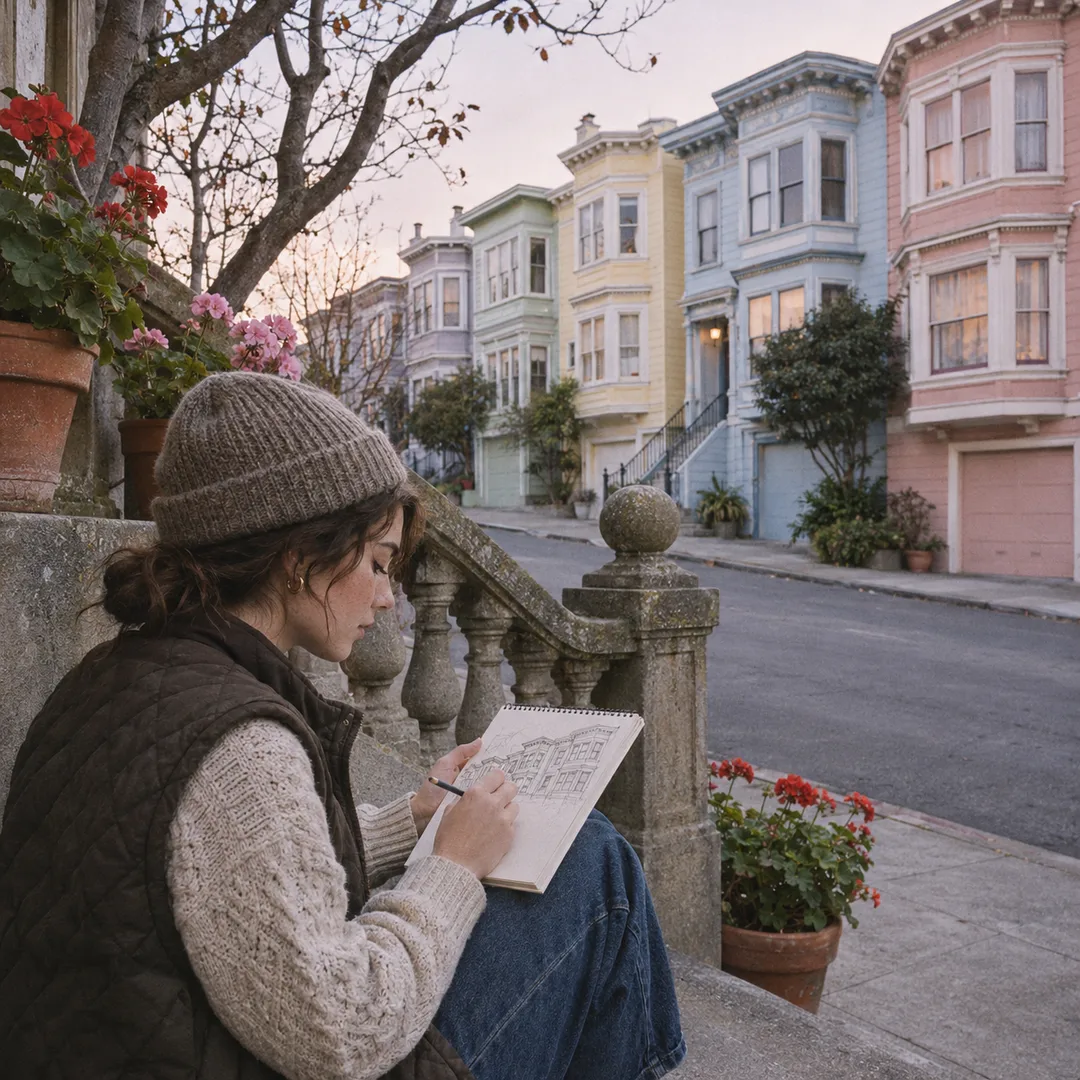
Russian Hill rewards a hilltop staircase walk planner who arrives before the tour buses. Its stairways are short, steep and stitched between quiet residential blocks, and at first light they belong to dog walkers, joggers and the occasional neighbour carrying a coffee. For anyone who draws, that early hour is a gift, because the light is soft, the lanes are empty and you can sit on a step for twenty minutes without blocking anyone's way.
Why Sketchers Start Here Early
Russian Hill packs a lot of drawing material into a small area. Within a few blocks you have shingled cottages, Edwardian flats with deep bay windows, terraced gardens, cable car tracks and the famous switchbacks of Lombard Street. By mid-morning, though, the crooked block fills with cars and visitors holding phones up to the hedges, and sketching there becomes awkward. Arriving around sunrise gives you an hour or more of quiet on the stairs.
Pack lightly. A pocket-size pad, two pencils, a fine pen and a folding stool or a small cushion are enough, because most of the time you will sit on steps or low walls. Fog is common on winter mornings, but it often lifts in patches, and those patches make for lovely grey washes if you carry a small watercolour set. Bring a thermos rather than hoping a cafe is ready at dawn, and a pair of thin gloves, because cold fingers make for shaky lines on the first drawing of the day.
The Story Behind the Name
The hill takes its name from a small cemetery that early settlers found on the summit, said to hold the graves of Russian sailors who had come down the coast on trading or supply voyages. The graves are long gone, but the name stayed. Later the slopes drew writers, painters and bohemian thinkers who prized the views and the cheap cottages, and the neighbourhood still carries that literary, slightly secretive mood.
Sketchers tend to love this background because it explains what they are drawing: modest wooden houses hidden behind gardens, squeezed between grand apartment buildings that came later. The contrast between the two is the visual character of the hill. Look for the shingled cottages near the summit that survived the great earthquake fire, when a few determined households stayed behind and fought the flames block by block. Drawing one of those survivors next to a taller neighbour tells the whole history of the hill on a single page.
Climbing the Vallejo Street Stairs
Start on the east side of the hill, where Vallejo Street turns from a road into a stepped walkway lined with balustrades and planting beds. The climb is short but steep, so pace it and stop on the landings. Each stop gives you a different composition: steps rising toward a lamp post, a terrace edged with stone urns, or a view down toward the bay framed by rooftops. Make quick thumbnails here rather than finished drawings.
Near the top, the stairs open onto a small summit enclave of quiet streets and handsome old houses. Respect the residents. People live right beside the steps, so keep conversation low and do not set up in front of doorways or garages. Sketchers who sit to the side, say good morning and pack up tidily rarely have any trouble, and some neighbours will stop to look at the page.
Slipping Through Macondray Lane
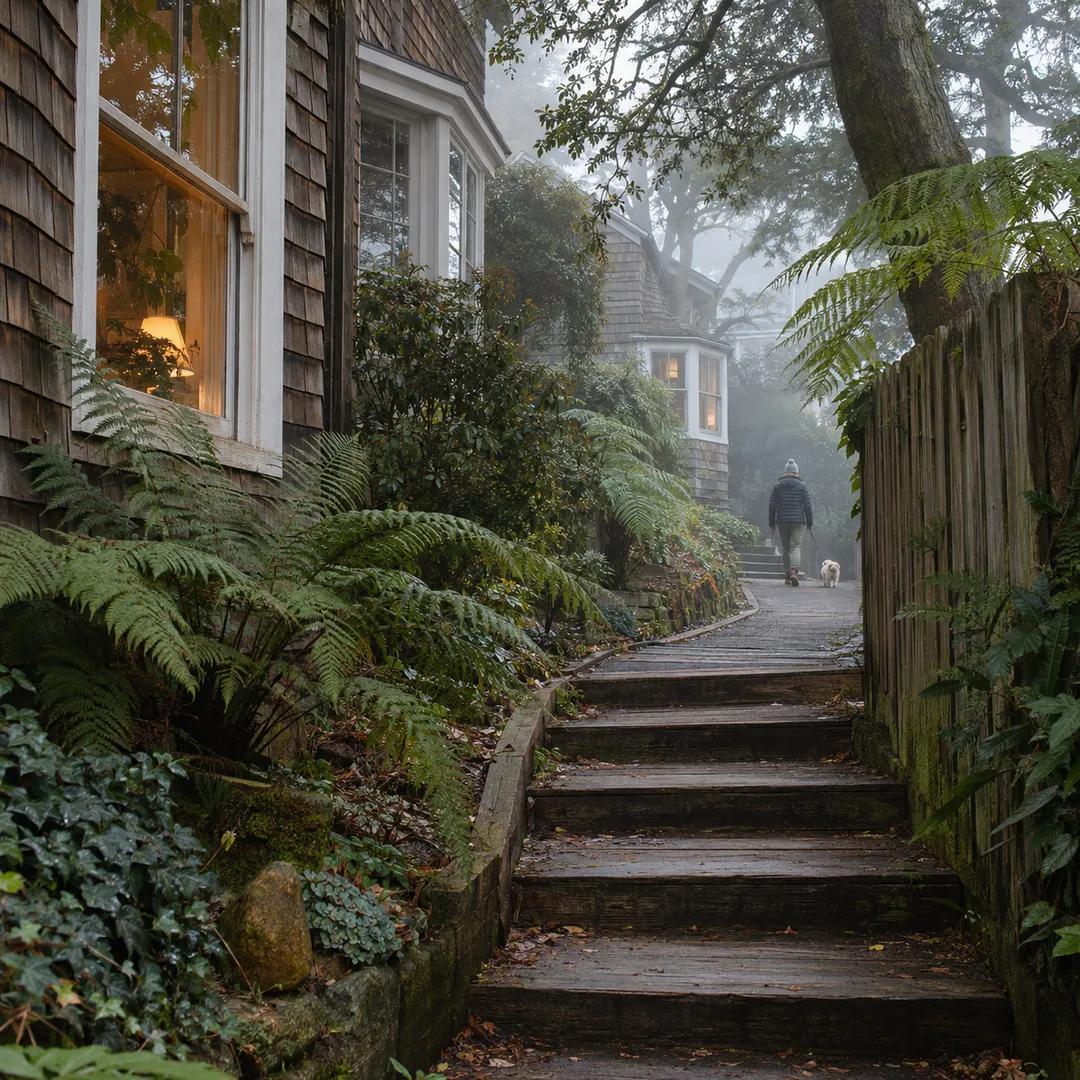
From the summit area, walk west and look for the entrance to Macondray Lane, a narrow pedestrian path shaded by trees and ferns that runs between garden fences and wooden houses. Readers of Armistead Maupin's Tales of the City know it as the inspiration for Barbary Lane, home to Mrs. Madrigal and her tenants, and fans still walk it slowly looking for the cottage they imagined.
The lane is excellent for practice in drawing depth, because the path curves, steps drop away and the greenery layers from dark to light. Expect damp boards after rain and watch your footing at the wooden steps at one end. Do not linger right outside windows, since the cottages sit close to the path. A quick pencil study from a wider spot, then moving on, is the polite rhythm here.
Drawing From Ina Coolbrith Park
Ina Coolbrith Park, named after California's first poet laureate, is a terraced garden that steps down the hillside with benches facing east. At sunrise this is the spot for a longer drawing. The bay, the bridges and the tower on Telegraph Hill line up across the view, and the light changes fast enough that two quick sketches ten minutes apart will look entirely different.
Choose a bench that is not directly in the main path, because joggers use the steps as a training climb and tai chi groups sometimes gather on the flatter terraces. If a group arrives, shift to the side and draw them, since figures add scale to a landscape. On very windy mornings, clip your pages down or use a heavier block so the paper does not flap away down the slope.
Reaching the Crooked Block Before the Crowds
Finish by walking over to the top of the crooked block of Lombard Street. Early, before traffic, you can stand on the stairway beside the switchbacks and sketch the hydrangea-packed curves almost alone. Use the pedestrian stairs, not the roadway, and stay on the side of the steps. Once cars start queuing at the top, pack up and step away, because the space gets cramped quickly.
If you only have time for one drawing here, skip the classic view down the curves that everyone photographs. Draw it sideways instead, from a landing partway down, with a house and its garden in the foreground and the curves bending behind. It makes a more personal page, and it keeps you out of the main line of visitors trying to take the same picture.
Breakfast, Cable Cars and Planning With Karpo
By the time you are done, Hyde Street will be waking up. Watch a cable car grind up the hill and add it to your pages, then walk down toward Polk Street, where cafes and bakeries fill with neighbours in the morning. A late breakfast is a good moment to look through the sketches, add colour and write a few notes about the light while you still remember it.
Use the Karpo APP to plan the next session. Save the stairways and benches that worked, look up other quiet hillside steps in the city for a different neighbourhood, and find early cafes near your starting point. If rain is forecast, Karpo can point you to a museum with a drawing-friendly gallery instead, so the morning is not lost when the hill is wet.
Ask Karpo for more information.
Keep reading
- Twin Peaks Hilltop Staircase Walk Planner for City Lights
 Inner Sunset Hilltop Staircase Walk Planner for Trekkers
 Bernal Heights Hilltop Staircase Walk Planner With Kids