 SoMa Bowling Group Night Planner to Welcome New Hires
Sports Social
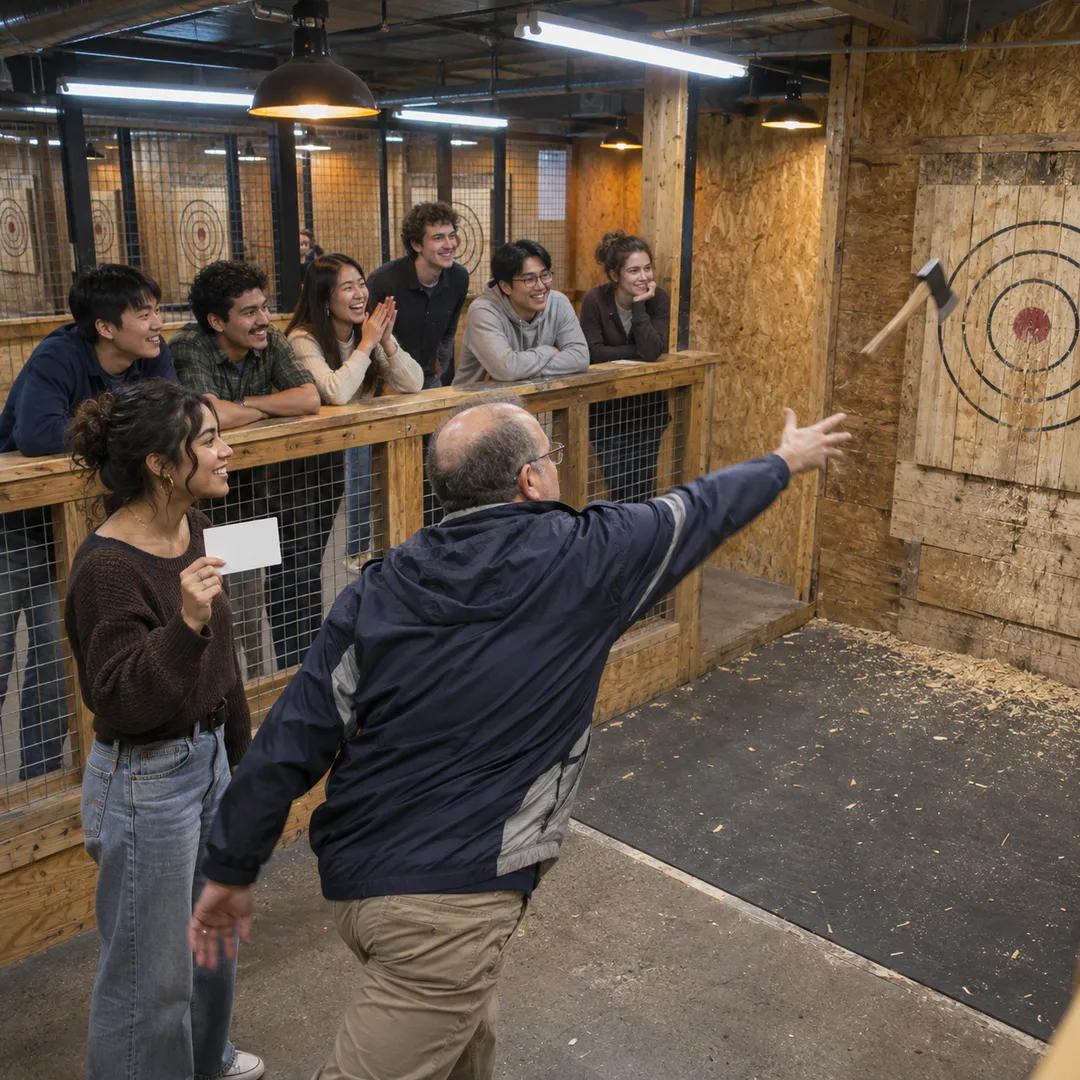
Chinatown Axe Throwing Group Night Picker: Cantonese Class
Chinatown Cantonese classmates can close out the term with an axe night where every score is called out in Cantonese. Here is how to choose a lane and plan it.
Adult Cantonese learners in San Francisco often start for personal reasons: a grandmother whose stories they want to understand, a partner's family dinners, or a childhood language that slipped away at school. By the end of a term the class has shared a lot of awkward tones and wrong numbers. This axe throwing group night picker is for that group, eight to twelve classmates who want a celebration that also sneaks in practice, with every score shouted out in Cantonese.
Why a Language Class Belongs at the Lanes
Learning Cantonese as an adult is humbling. Six tones, or nine depending on who is counting, mean that a small slip can turn a polite request into a joke, and most classes include at least one evening where the whole room dissolves laughing. That shared embarrassment builds a surprisingly close group, often mixing heritage learners, spouses of local families and people who simply love the language.
An axe night suits that group because it is loud, physical and full of numbers. Scoring needs counting, cheering needs short phrases, and the coach's instructions are something you can quietly translate in your head. Nobody needs perfect grammar to shout a number at a target, and the stakes are refreshingly low compared with ordering dim sum while a busy server waits.
Setting the Cantonese-Only Scoring Rule
The key rule is simple: every score gets called out in Cantonese by the thrower's team. One to ten is enough for most target games, and the class can add a handful of phrases for the night, such as cheering a good throw or teasing a miss. Write the list on a card or in the class chat so the beginners have something to glance at.
Keep it kind. The point is to practise, not to correct. Let the stronger speakers act as quiet helpers rather than referees, and give a small prize for the clearest tones of the night as well as the highest score. If your teacher joins, they will probably enjoy hearing the class use real phrases in a noisy room, which is exactly the kind of setting the textbook never prepares you for.
Comparing Venues for a Mixed Class
A language class is often a broad group: retirees, students, parents and people who came straight from work. When comparing venues, look for a private or semi-private lane, a coach who runs the briefing clearly, and seating where non-throwers can still follow the game. Venues that feel like a sports session tend to suit this crowd better than ones built around a loud bar.
Most axe venues in the city sit in roomy former industrial spaces rather than inside Chinatown's dense blocks of family associations, shops and apartments, so expect a short trip. That works in your favour. The ride gives classmates time to chat, and coming back to Chinatown afterwards turns the evening into a little loop, from the lanes to Grant Avenue and back to where the class first met.

Using the Karpo APP to Find the Right Lane
Rather than juggling a dozen tabs, describe the evening in the Karpo APP: axe throwing for ten adult classmates starting from Chinatown, a private lane, a coach, a calm atmosphere, a couple of older learners who may prefer to watch, and somewhere close by for dessert afterwards. You can mention that some classmates rely on public transit and want an easy trip back.
Karpo can help you compare a shortlist and think through getting there from the Chinatown station or by a shared ride. Post the options to the class chat, let people vote, and then follow the venue's own reservation process to secure the lane. Karpo is there to help you pick and plan; the booking and any venue rules are handled directly with the venue.
Running the Night Like an End-of-Term Exam
Frame the evening as a friendly oral exam. Start with practice throws while everyone warms up their voices as well as their arms, then run a round-robin where each throw is scored aloud. In the final, add a twist: the thrower must say the score, the target ring and a short cheer in Cantonese before the next person steps up, and the team can help them if they freeze.
Keep a written record on a phone, with numbers written in characters if anyone wants the extra practice. At the end, hand out silly certificates for categories such as best comeback, most improved tones and most creative wrong word. Classmates will remember the phrases they shouted that night far longer than the vocabulary lists they cram before each lesson.
Safety Notes the Coach Will Cover
Every reputable venue starts with a safety talk, and it is worth listening closely even if the instructions come quickly. Stay behind the line until it is your turn, wait for the lane to be clear before collecting your axe, and follow the coach's directions on stance and release. Closed-toe shoes are commonly required, so remind classmates in the group chat to wear sneakers.
Throwing is about rhythm and a smooth motion rather than force, which is good news for older learners. Anyone with a bad shoulder or wrist can keep score, run the clock or act as the official Cantonese announcer, a role that often turns out to be the most fun of the night. Follow the venue's rules about drinks and keep them well away from the throwing area.
Getting There From Chinatown and Back
Meet at a familiar landmark, such as the Dragon Gate at the southern entrance to Grant Avenue or Portsmouth Square, where elders play cards and chess in the afternoons. The Central Subway now has a Chinatown station near Stockton Street, and it links to Union Square and South of Market, which makes many trips across the city straightforward. For other routes, split rides in groups.
Plan the return with care. Chinatown streets are steep and narrow, and some classmates will be heading on to North Beach, the Richmond or the East Bay. Agree who is going home after the final, who is coming back for dessert, and check that nobody is left waiting alone for a bus at the end of the evening.
Egg Tarts and a Practice Chat on Grant Avenue
Coming back to Chinatown for something sweet is the natural end to the night. Bakeries in the neighbourhood are known for flaky egg tarts, pineapple buns and coconut pastries, and a paper bag of tarts is easy to share on the street. Order in Cantonese if you can, keep it short and polite, and do not worry if the reply comes back faster than you can follow.
If the bakeries have closed, a casual noodle or congee spot can work for a final round of conversation. Try a short rule at the table: Cantonese first, English only when stuck. It is a gentle way to keep practising, and many classes find this last half hour is when quieter learners finally speak up, encouraged by the energy of the lanes.
A Morning Walk Through the Alleys
For classmates who want more, plan a weekend morning walk through Chinatown's alleys and side streets. Waverly Place, with its painted balconies and temples on upper floors, and the produce and seafood shops along Stockton Street are full of signs, sounds and everyday phrases. It is a living classroom that rewards slow walking and careful listening.
End at Portsmouth Square or the small parks nearby, where you can sit, watch neighbourhood life and talk about next term. Some groups turn the axe night into an end-of-term tradition, with the alley walk as the first lesson of the new one. Either way, the class leaves with stronger bonds and a few new words they actually used out loud.
Ask Karpo for more information.
Keep reading
- SoMa Bowling Group Night Planner to Welcome New Hires
 Lower Haight Bowling Group Night Planner for Kitchen Crews
 Bernal Heights Bowling Group Night Planner for Parents Out