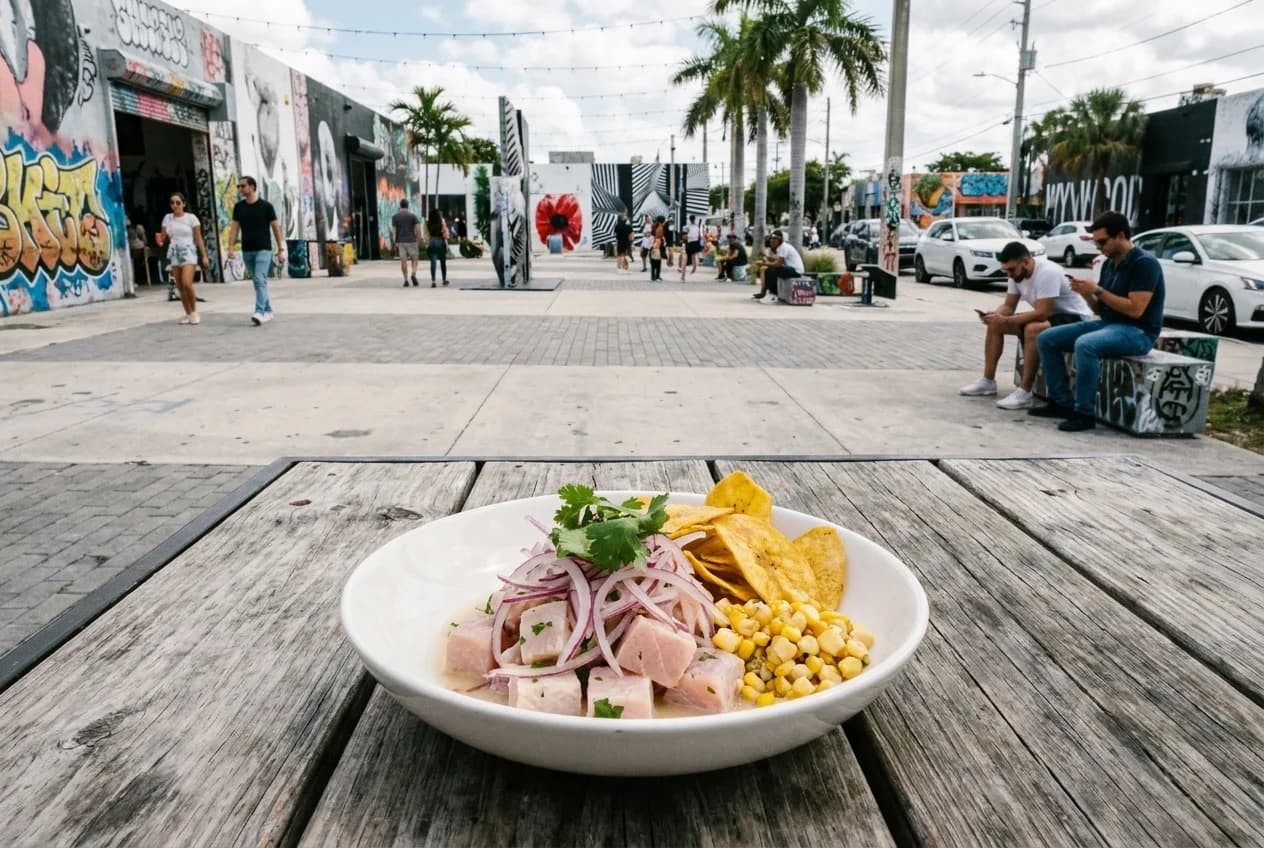
When you search seafood near me in Wynwood, the results skew toward the preparations that happen before cooking: ceviche cured in lime and ají, tiradito sliced thin and dressed in leche de tigre, conch pounded and tossed with citrus. The neighbourhood's seafood trade is anchored by Peruvian, Colombian, and Caribbean kitchens where acid and heat—not flame—do the first and most important work. What follows is the operational map: which addresses run these lunch-only or all-day, what a portion costs, how much heat the kitchen builds into the cure, and the differences between a Peruvian leche de tigre and a Bahamian conch salad. This is not the oyster-bar article; that exists elsewhere. This is the guide to the cured, the cut, and the fried whole.
Karpo maps every ceviche counter and tiradito lunch window in Wynwood by opening hour, portion size, and the days they're dark. Ask which kitchen runs the cleanest leche de tigre on a Tuesday afternoon.
Peruvian leche de tigre as the structural liquid
Leche de tigre—the acidic, spicy liquid that cures ceviche—functions as both marinade and sauce in Peruvian preparations, and Wynwood's Peruvian kitchens treat it as the backbone of the menu. Manta, at 102 NW 25th Street, runs a menu where leche de tigre appears in multiple formats: the Cebiche Clásico uses a traditional preparation with mahi mahi, chulucanas lime, cilantro, ají limo, and red onions for twenty-three dollars, while the Cebiche 305 adds rocoto leche de tigre and crispy fried calamari for twenty-six dollars. The kitchen is open Sunday through Thursday noon to ten, Friday and Saturday noon to eleven, and the menu's tiraditos layer leche de tigre over sliced raw fish rather than cubed chunks.
Manta's Tiradito Toho puts olive sauce, cilantro oil, and Nikkei sauce under sliced catch-of-the-day and tuna for twenty-nine dollars, a format that borrows from Japanese sashimi plating but anchors the flavour in Peruvian acid. The Causa de Tuna Tartare, thirty-three dollars, stacks yellow-pepper mashed potato over tuna tartare and cured egg yolk, a cold preparation that uses the same ají amarillo base as leche de tigre but thickened into a terrine. The portions are sized for sharing, and the kitchen's rhythm is reported to hit its best pace Thursday and Friday evenings without the room tipping into chaos.
Late-night sandwiches as the post-ceviche anchor
When the ceviche service ends and the appetite shifts toward something that can be carried out the door or eaten at a counter past midnight, La Sandwicherie at 169 NW 23rd Street steps in. Open daily from seven-thirty in the morning to five in the morning, it functions as the neighbourhood's all-hours fallback, serving French-style sandwiches on fresh-baked bread with lettuce, tomato, cucumber, Swiss cheese, and your choice of protein—roast beef, turkey, tuna, smoked salmon—dressed in vinaigrette and Dijon. Prices run ten to twenty dollars per sandwich, and the kitchen also serves smoothies, fresh juices, and salads for those coming off the gallery walk or finishing a night out.
The Wynwood location sits steps from the Wynwood Walls, and the outdoor terrace seating allows you to eat under the open air while watching the foot traffic move between murals. A ten percent late-night service charge applies after ten, but the trade-off is being able to eat fresh food when most of the neighbourhood has gone dark. The sandwiches are built to order, which means you can adjust for heat, skip the cheese, or double the protein, and the staff works bilingually. It is not a ceviche kitchen, but it fills the gap when you need something substantial after the aguachile has worn off.
Nikkei fusion and the Japanese-Peruvian overlap
Nikkei cuisine—the Japanese-Peruvian hybrid that emerged from Japanese immigration to Peru in the late nineteenth century—runs through Wynwood's Peruvian menus as a secondary thread, visible in the tiraditos, the soy-spiked leche de tigre, and the use of sesame, togarashi, and hondashi. Manta's menu flags several dishes as Nikkei: the Tataki Ahumado de Tuna y Pulpo, thirty-five dollars, layers sliced tuna tataki on sesame seeds and diced anticuchero octopus over loche squash purée with pepperonata sauce and tomato powder. The format borrows tataki's seared-outside, raw-inside approach from Japanese technique but anchors the flavour in Peruvian ají and anticuchera marinade.
The Nikkei thread is also visible in Manta's use of panko-fried shrimp and the way the kitchen finishes ceviches with crispy fried calamari, a textural contrast that reads as Japanese tempura technique applied to Peruvian formats. The Causa Oriental uses avocado, crispy fish, and togarashi aioli over yellow-pepper mashed potato, merging the Peruvian causa format with Japanese spice and crunch. These dishes demonstrate how Nikkei cooking builds bridges between two culinary traditions without diluting either one, using shared techniques like curing, slicing, and precise knife work to create something that tastes both rooted and inventive.
Heat levels and regional chili differences
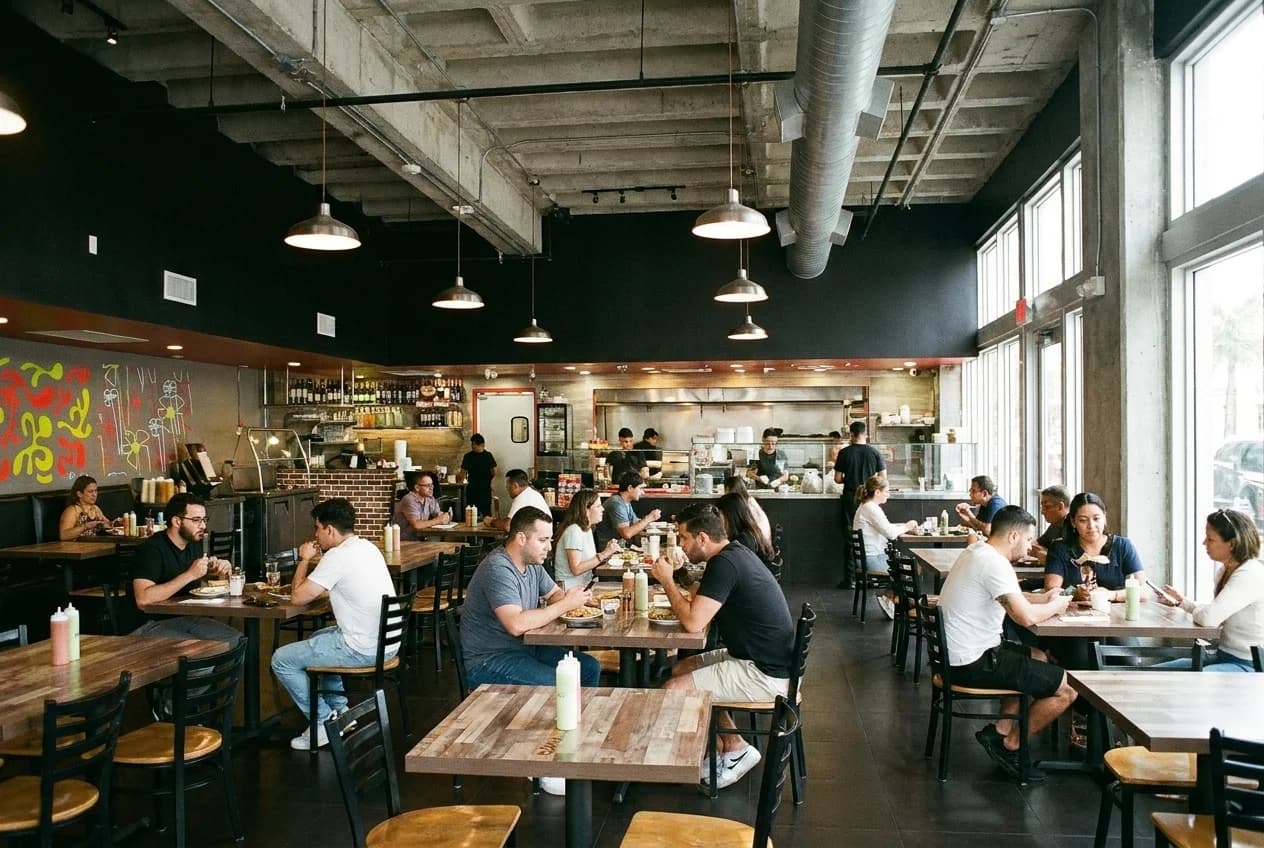
The heat in a ceviche or tiradito is not a single dial but a combination of the chili variety, the quantity, and whether the seeds are left in. Peruvian kitchens typically use ají amarillo for a fruity, medium heat, ají limo for a sharper, hotter punch, and rocoto for the top end of the scale. Mexican kitchens reach for cascabel, chipotle, and habanero, each with a different burn profile. Manta's Cebiche 305 uses rocoto leche de tigre, which is noticeably hotter than the classic preparation and arrives with crispy fried calamari to cut the acid.
The way to read a menu is to look for the chili name: ají amarillo and chipotle sit in the medium range, ají limo and rocoto push toward hot, and habanero is the top. If the menu doesn't specify, the kitchen is likely using ají amarillo as the default. The other variable is the leche de tigre itself: some kitchens build it with fish stock, others with lime alone, and the thickness and intensity vary by recipe. Manta's leche de tigre is described as home-made, which typically means a base built from fish trimmings, lime, and chili rather than a bottled concentrate.
Mayami Wynwood as the dinner-party hybrid
Mayami at 127 NW 23rd Street brings Mexican-Asian fusion to an eight-thousand-five-hundred-square-foot outdoor courtyard that blends Oaxacan, Mexican, and Yucatán architectural influences with open-air dining and live entertainment seven nights a week. The kitchen runs a Latin-Mediterranean menu that includes seafood preparations—ceviches, aguachiles, and grilled whole fish—alongside tacos, robata skewers, and sushi rolls, a format that reads as maximalist but works because the space is built for immersive dinner parties rather than quiet solo meals. Bottle parades, live music, and high-energy ambiance run through the evening, and the restaurant functions as both a dinner destination and a nightlife venue, staying open until three in the morning Monday through Friday and from noon to three on weekends.
The seafood menu at Mayami leans into the acid-forward preparations common in Wynwood but adds Asian technique: yuzu-spiked ceviches, soy-glazed grilled fish, and crispy whole snapper served with Thai chili and lime. The format is shareable, the portions are generous, and the pricing sits in the mid-to-upper range, reflecting the live entertainment and the scale of the space. Happy hour runs Monday through Friday from five to seven and Sunday from six to eight, with brunch service on weekends from noon to six. The restaurant has two entrances—the main at 127 NW 23rd Street and a second at 130 NW 24th Street—and the courtyard seating allows for large groups without the noise becoming oppressive.
Museum of Graffiti and the gallery walk as the pre-meal anchor
Before the ceviche, the neighbourhood's rhythm typically begins with the galleries, and the Museum of Graffiti at 276 NW 26th Street serves as the formal anchor point. Open Monday, Wednesday, and Thursday from eleven to six, and Friday through Sunday from eleven to seven—closed Tuesdays—the museum is the world's first dedicated to graffiti and street art, with rotating exhibitions that document the movement's history from New York subway cars to Wynwood's own murals. The admission fee is modest, the layout is compact, and the visit can be done in forty-five minutes to an hour, making it an ideal pre-lunch or pre-dinner stop.
The museum sits three blocks north of Manta and four blocks from Mayami, and the walk between them passes through the densest concentration of Wynwood's outdoor murals. The Wynwood Walls, the neighbourhood's original street-art destination, is at 2516 NW 2nd Avenue and remains free to enter, with thirty artists' work displayed across outdoor walls and interior gallery spaces. Hours vary by season and special events, but the outdoor murals are visible at all hours, and the foot traffic peaks Thursday through Sunday when the gallery district is fully active. The combination of the Museum of Graffiti, the Wynwood Walls, and the seafood kitchens creates a logical route: art first, acid-cured fish second, and the walk burns off enough energy to justify the portions.
Lunch-only versus all-day service
Ceviche service in Miami follows a split schedule: some kitchens run it all day, others treat it as a lunch-only preparation because the fish is cut fresh in the morning and the quality drops after several hours in the cure. Manta runs lunch and dinner service seven days a week, opening at noon and closing at ten or eleven depending on the day, which means the ceviches and tiraditos are available through the evening. Mayami also runs all-day service, with the kitchen operating from five in the evening to three in the morning on weekdays and from noon to three on weekends, though the seafood menu is available throughout.
The lunch-only format is more common at smaller Peruvian and Colombian spots that cut fish in the morning and sell until the portions run out, typically by mid-afternoon. These are the places where a ceviche runs twelve to sixteen dollars and arrives in a styrofoam container with plantain chips and a side of cancha. The trade-off is price and portion size versus plating and atmosphere. If the goal is to eat ceviche at three in the afternoon, the all-day kitchens are the only option; if the goal is to eat it at its freshest, the lunch-only spots are the move, but you need to arrive before one-thirty.
Practical notes
Manta is at 102 NW 25th Street, open Sunday to Thursday noon to ten, Friday and Saturday noon to eleven, with ceviches running twenty-three to forty-three dollars and causas twenty-nine to thirty-three dollars. Mayami is at 127 NW 23rd Street, open Monday through Friday five in the evening to three in the morning, Saturday and Sunday noon to three in the morning, with happy hour Monday to Friday five to seven and Sunday six to eight. La Sandwicherie is at 169 NW 23rd Street, open daily seven-thirty in the morning to five in the morning, with sandwiches running ten to twenty dollars and a ten percent late-night charge after ten. Museum of Graffiti is at 276 NW 26th Street, open Monday, Wednesday, Thursday eleven to six, Friday through Sunday eleven to seven, closed Tuesdays. Portions at the seafood restaurants are sized for sharing; plan one ceviche and one causa per two diners. The heat level in a rocoto leche de tigre is noticeably higher than a classic preparation. If the menu lists ají amarillo, expect medium heat; if it lists rocoto or habanero, expect hot.
Tags: #Wynwood #SeafoodNearMe #CevicheMiami #PeruvianFood #LecheDeTigre #Tiradito #NikkeiCuisine #MantaWynwood #ChaChaCha #AguachileNegro #FriedSnapper #LatinAmericanSeafood #MiamiLunch #AjiAmarillo #RocotoChili
Please drink responsibly. Must be of legal drinking age.
All trademarks are the property of their respective owners.
Ask Karpo first
Ask Karpo which Wynwood ceviche counter runs the cleanest leche de tigre on a Tuesday afternoon, or which kitchen's aguachile negro delivers the most controlled heat without tipping into pain. Karpo maps every tiradito lunch window by opening hour, portion size, and the days they're dark, and tracks which Peruvian spots still run lunch-only service versus all-day. The app knows the difference between ají amarillo and rocoto heat levels and can route you to the nearest whole fried snapper when the craving hits after two.