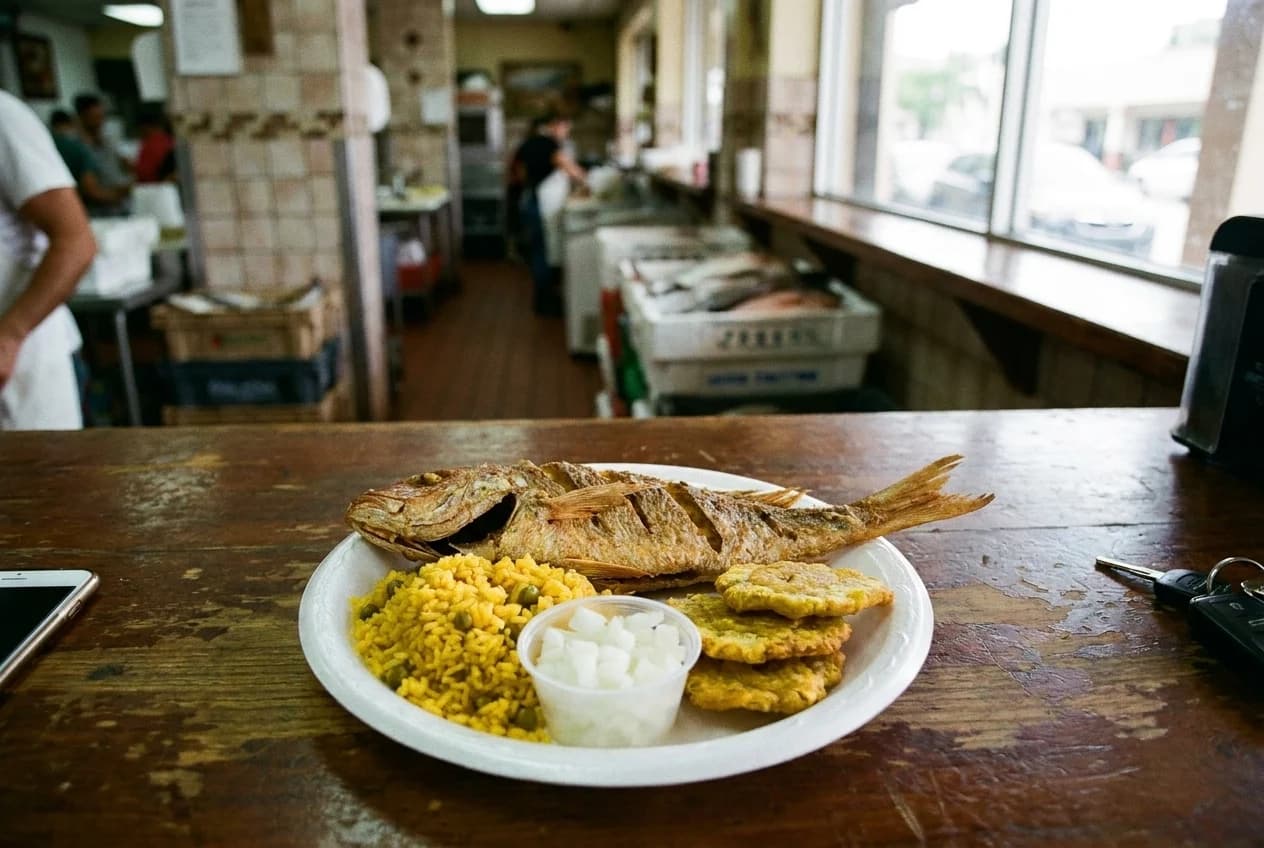
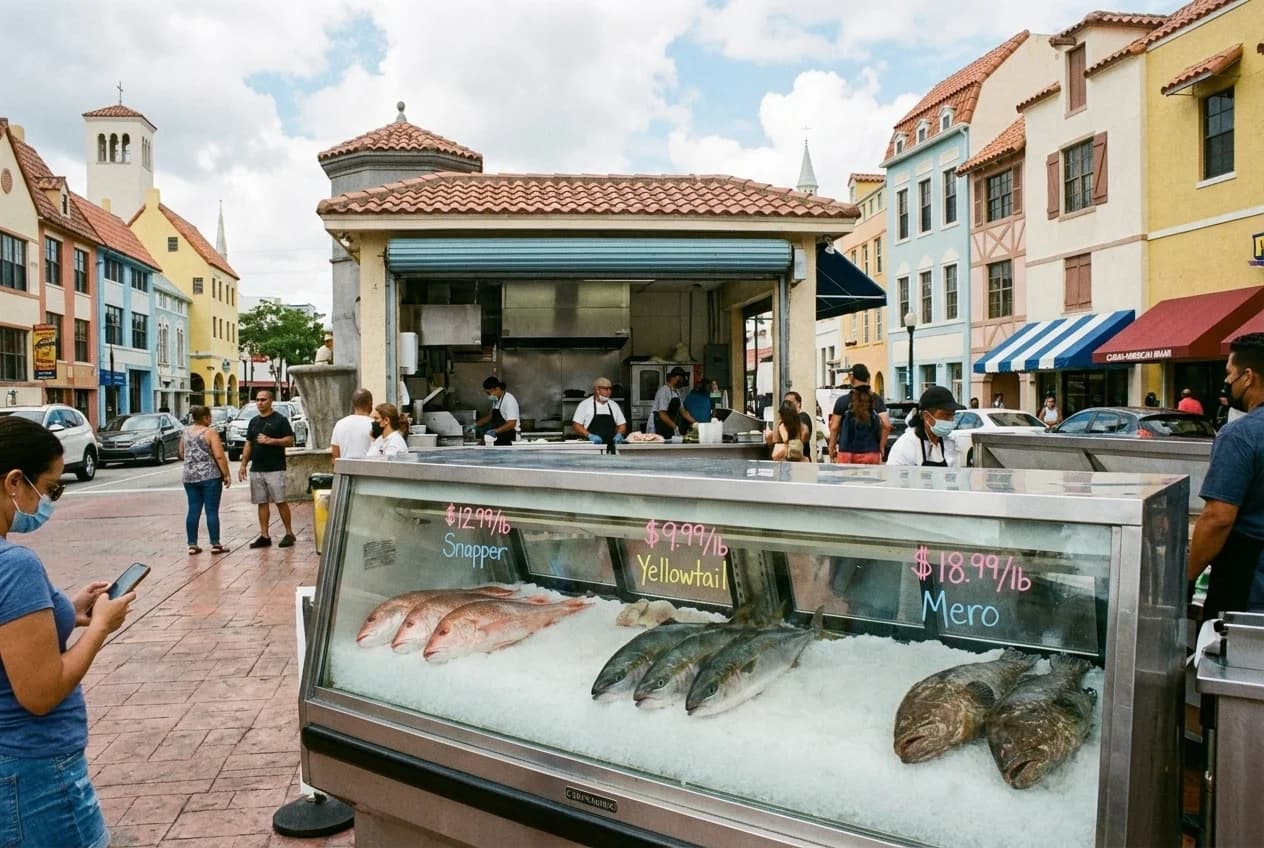
Searching "seafood near me" in Little Havana returns restaurants with printed menus and table service, but the neighbourhood's oldest seafood tradition runs through a different channel: pescaderías that sell whole fish by the pound from refrigerated cases, then clean, season, and fry your purchase in a kitchen five feet behind the counter. You pay the market price for the raw fish, a flat cooking charge that runs two to four dollars depending on the size and preparation, and you collect a styrofoam plate ten minutes later with rice, tostones, and a snapper or grouper still wearing its tail. The model keeps a fried-fish lunch under fifteen dollars even when whole yellowtail costs twelve dollars a pound, and it survives because Little Havana still has enough walk-in demand to move inventory before it sits an extra day.
Karpo maps every pescadería counter in Little Havana with current frying charges, Friday opening hours, and which markets stock bacalao year-round. Ask which corner sells the cheapest lane snapper this week.
How the counter transaction works
At La Camaronera, 1952 West Flagler Street, the process is explicit: walk to the refrigerated fish case on the left side of the room, choose a whole fish—lane snapper, yellowtail snapper, grouper, or whatever arrived that morning—and tell the counterperson you want it fried. They weigh it, write the price on a ticket, and send the fish to the kitchen. The cooking charge is separate and appears as a second line on the receipt. You pay at the register, take a numbered card, and wait at one of the stand-up counters or small tables. The kitchen fillets the fish if you ask, but the default is to scale, gut, score, season, and fry it whole. The result is a fish whose skin blisters and crisps while the meat stays wet, and the bones stay in so you work around them with a fork.
The same structure applies at Casavana Seafood Market, 1402 Southwest 8th Street, where the fish case runs along the back wall and the kitchen occupies a glassed-in corner. You point to the fish you want, the staff bags it, weighs it, and asks if you want it fried, grilled, or taken home raw. If you choose fried, they write a ticket and the fish goes straight into the fryer. Cooking time depends on the size—a one-pound lane snapper takes eight minutes, a two-pound grouper takes twelve—so the counter model works because the customer is already standing there and has no expectation of appetizers or cocktails while they wait.
What the cooking charge buys
The frying fee covers labor, oil, and the sides that arrive with the fish. At La Camaronera the charge is three dollars for most fish and includes yellow rice, tostones, and a small tub of onions with lime. At Casavana the cooking charge runs two-fifty to four dollars depending on the fish's weight and the preparation method—fried costs more than grilled because the oil has to be maintained at 350 degrees and changed regularly. The sides are similar: white or yellow rice, fried plantains, and sometimes a few leaves of iceberg lettuce with a wedge of tomato.
The fee does not include drinks. You order those separately from a cooler or a small bar area if the market has one. At La Camaronera, which added a dining room next door to the original standing-counter space, beer and soda come from a separate counter and cost two to three dollars. At smaller markets like El Tropical Supermarket, 3107 Southwest 8th Street, where a small pescadería counter operates inside a grocery store, you buy a can of Materva or Jupina from the refrigerator case near the register and bring it to the counter yourself.
Which species cost least and which do not
Lane snapper is the cheapest whole fish in Little Havana's pescaderías because it is smaller—usually three-quarters of a pound to one and a quarter pounds—and because commercial boats catch it in volume off the Florida Keys and the Dry Tortugas. At La Camaronera lane snapper runs eight to ten dollars a pound depending on the day's supply. Yellowtail snapper costs more, typically twelve to fourteen dollars a pound, because it is larger and because restaurant demand keeps the wholesale price higher. Grouper sits at the top of the price ladder, often sixteen to eighteen dollars a pound for a whole fish, and you see it less frequently in the cases because the quota system limits how much boats can land in a given season.
Shrimp pricing follows a different logic. Most of the shrimp in Little Havana markets is farmed and imported, so the per-pound price stays steadier than whole-fish prices—nine to eleven dollars a pound for large shell-on shrimp—but the final cost depends on whether you buy it raw to take home or cooked to order. If you buy a pound of raw shrimp and ask the counter to fry it, you pay the per-pound price plus a cooking charge that runs two to three dollars. If you order a fried shrimp plate from the menu board, the kitchen uses pre-portioned frozen shrimp and the plate costs twelve to fifteen dollars all in, which includes rice and tostones but no ability to inspect the raw product first.
The bacalao shelf and Friday demand
Every pescadería in Little Havana stocks bacalao, which is salt cod that has been split, salted, and dried until it is stiff and white and smells like a tidal flat at low tide. The bacalao shelf sits near the counter or in a dry-goods aisle, and the slabs are sold whole or in pieces by weight. Prices run six to nine dollars a pound. Bacalao requires an overnight soak to rehydrate and remove excess salt before you can cook it, so it is not a counter-fry product—you buy it to take home and turn into bacalao guisado or bacalao fritters.
Friday demand at Little Havana pescaderías spikes because of the Catholic convention against eating land meat on Fridays during Lent, and because Cuban families who are not observant still cook fish on Friday as a legacy habit. La Camaronera's Friday hours extend to 8:30 pm instead of the weekday close at 5:30 pm, and the fish case is restocked twice on Friday mornings to meet the higher turnover. Casavana runs the same hours on Friday and brings in extra whole snapper because snapper moves faster than grouper when the line is long and customers want a fish that fries in under ten minutes. Lenten Fridays, which run from Ash Wednesday through Holy Saturday, generate the highest weekly volume, and some counters sell out of lane snapper by 2 pm on those days.
What comes with a fried-fish plate
The standard composition is one whole fried fish, a mound of white or yellow rice, three or four tostones, and a plastic cup of diced white onion dressed with lime juice and sometimes a little vinegar. At La Camaronera the rice is yellow and cooked with a small amount of saffron or bijol, which is a cheaper annatto-based substitute. At Casavana the rice is white unless you ask for yellow, and the tostones are thicker—cut from green plantains in rounds about three-quarters of an inch thick, fried once, smashed, then fried a second time until the edges bronze.
Some counters add a small salad to the plate, but the salad is minimal: iceberg lettuce, one or two slices of tomato, and no dressing beyond what you pour from the bottles of olive oil and vinegar on the table. The plate arrives hot, the fish in the center, the rice on one side, the tostones on the other, and the onions in a separate cup so they do not wilt the fish skin. At counters that still operate with standing service only, the plate is styrofoam and you eat with a plastic fork over a chest-high counter or a tall metal table with no chairs.
Markets that operate full pescadería counters
La Camaronera remains the highest-volume example and the one most tourists find because it has been written up repeatedly since the 1970s. The original counter-service space still operates, and the dining room next door at 1950 West Flagler Street opened later to handle overflow. Both spaces share the same kitchen and fish case. The market opens daily at 9:30 am and closes at 8 pm Sunday through Thursday, staying open until 9 pm on Friday and Saturday.
Casavana Seafood Market at 1402 Southwest 8th Street runs a smaller operation with a fish case, a fry kitchen, and a handful of tables in the back. The market opens Monday through Saturday at 10 am and closes at 7 pm, and it does not open on Sunday. The fish selection is smaller than La Camaronera—typically lane snapper, yellowtail, and grouper when available—but the prices track closely and the cooking charge is slightly lower.
El Tropical Supermarket at 3107 Southwest 8th Street embeds a pescadería counter inside a full grocery store, so you can buy fish and have it fried while you shop for dry goods and produce. The fish counter opens at 9 am and closes at 6 pm Monday through Saturday, and the selection is limited to snapper and occasionally a few pieces of grouper. The cooking charge is two dollars for a whole fish under one pound, three dollars for larger fish, and the sides are rice and plantains only.
Garcia's Seafood Grille & Fish Market at 398 Northwest North River Drive operates a retail fish counter alongside its full-service restaurant. The market opens daily at 11 am and closes at 9 pm most nights, staying open until 10 pm Friday and Saturday. You can buy whole fish by the pound from the counter and have it prepared to order, though the emphasis leans more toward grilled preparations than the pure fry-counter model. The fish selection includes snapper, grouper, mahi-mahi, and seasonal catches, with prices running slightly higher than the pure pescaderías because the location draws a mixed tourist and local crowd.
Practical notes
La Camaronera, 1952 West Flagler Street, opens daily at 9:30 am, closes at 8 pm Sunday through Thursday and 9 pm Friday and Saturday. Cooking charge is three dollars, whole lane snapper runs eight to ten dollars a pound. Casavana Seafood Market, 1402 Southwest 8th Street, opens Monday through Saturday at 10 am, closes at 7 pm, closed Sunday. Cooking charge is two-fifty to four dollars depending on fish size and preparation. El Tropical Supermarket, 3107 Southwest 8th Street, fish counter open 9 am to 6 pm Monday through Saturday. Cooking charge is two dollars for fish under one pound, three dollars over. Garcia's Seafood Grille & Fish Market, 398 Northwest North River Drive, market counter open daily 11 am to 9 pm, until 10 pm Friday and Saturday. Expect cash or card accepted at all counters. Parking is street or lot. Arrive before 1 pm on Fridays during Lent if you want first pick of the case.
Tags: #LittleHavana #Pescaderia #SeafoodNearMe #FriedFish #LaneSnapper #YellowtailSnapper #Grouper #CalleOcho #CubanSeafood #FishMarket #Bacalao #LaCamaronera #Tostones #MiamiSeafood #CounterService
Please drink responsibly. Must be of legal drinking age.
All trademarks are the property of their respective owners.
Ask Karpo first
Ask Karpo which pescadería in Little Havana has the lowest per-pound price on lane snapper today, which markets restock their fish case on Friday mornings, and where to find bacalao by the quarter-pound if you are cooking for one. Karpo tracks cooking charges, opening hours, and which counters sell out earliest on Lenten Fridays.