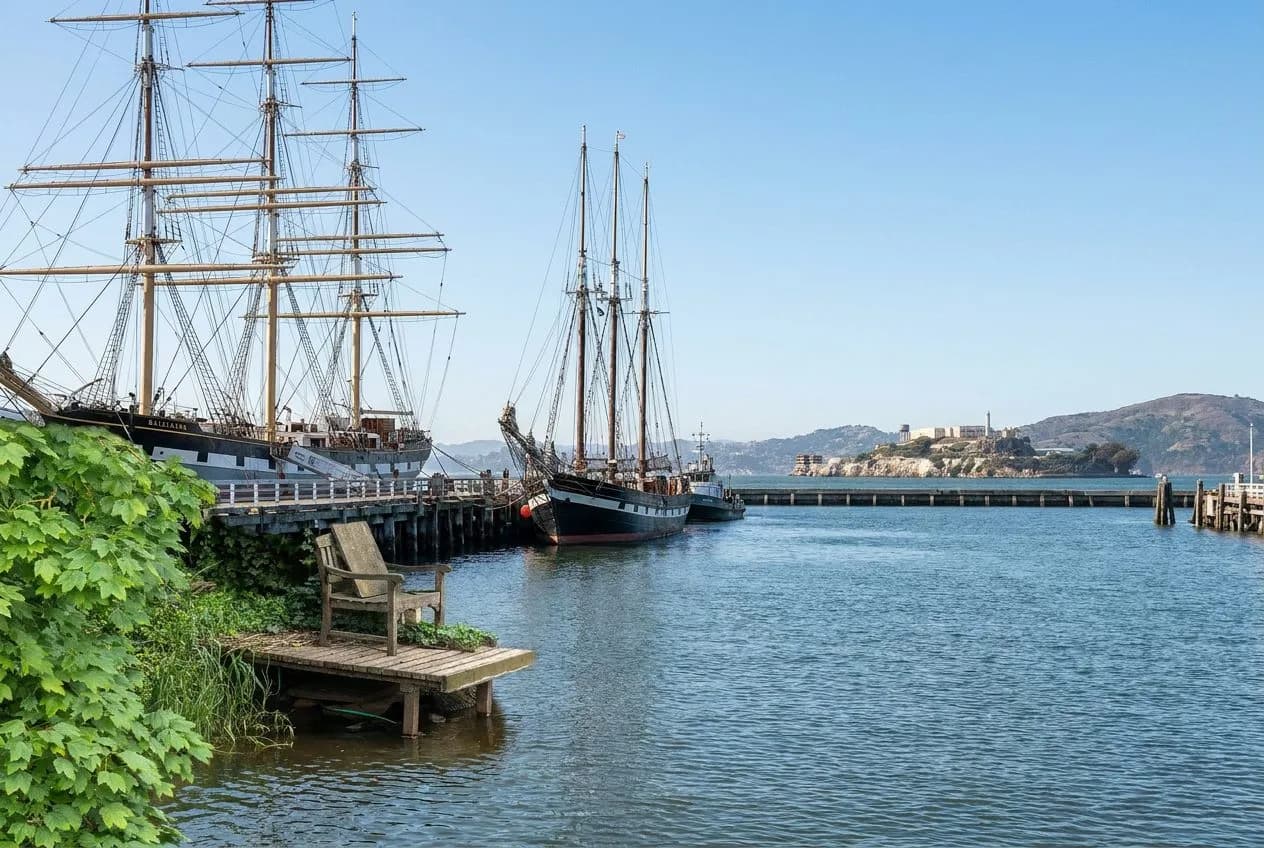
Hyde Street Pier juts into the bay like a bookmark pressed into the northern edge of Fisherman's Wharf, holding the place where San Francisco's maritime past meets its postcard present. Six historic ships dock along its weathered planks, their masts and rigging stitched against the sky. What most visitors miss: you can board three of them—walk their decks, grip their railings, stand where sailors once hauled line—without paying a cent. The belowdecks museum experience requires admission, yes, but the open-air privilege of standing on a square-rigger's planks while Alcatraz floats in the middle distance costs nothing but the walk down from Ghirardelli Square.
The architecture of access
The pier itself is a National Historical Park property, managed with the seriousness the designation implies: good signage, clean restrooms, rangers in flat-brimmed hats who actually know the difference between a brig and a brigantine. The main gate sits at the foot of Hyde Street, where the cable-car turnaround deposits tourists in chattering clusters. But the pier's real charm unfolds as you walk its length, past the ticket kiosk and information plaques, onto the wide planks that creak and sigh underfoot.
Three vessels allow free deck boarding: the 1886 square-rigger Balclutha, the 1895 schooner C.A. Thayer, and the 1891 ferry Eureka. Each offers a different vantage on nineteenth-century working life. The Balclutha, a Cape Horner that carried grain and coal, dominates the pier's center berth with her tall masts and graceful lines. The Thayer, a lumber schooner, feels more compact, her deck worn smooth by decades of redwood cargo. The Eureka, broad-beamed and stolid, once shuttled automobiles and foot passengers across the bay before the bridges rendered her obsolete.
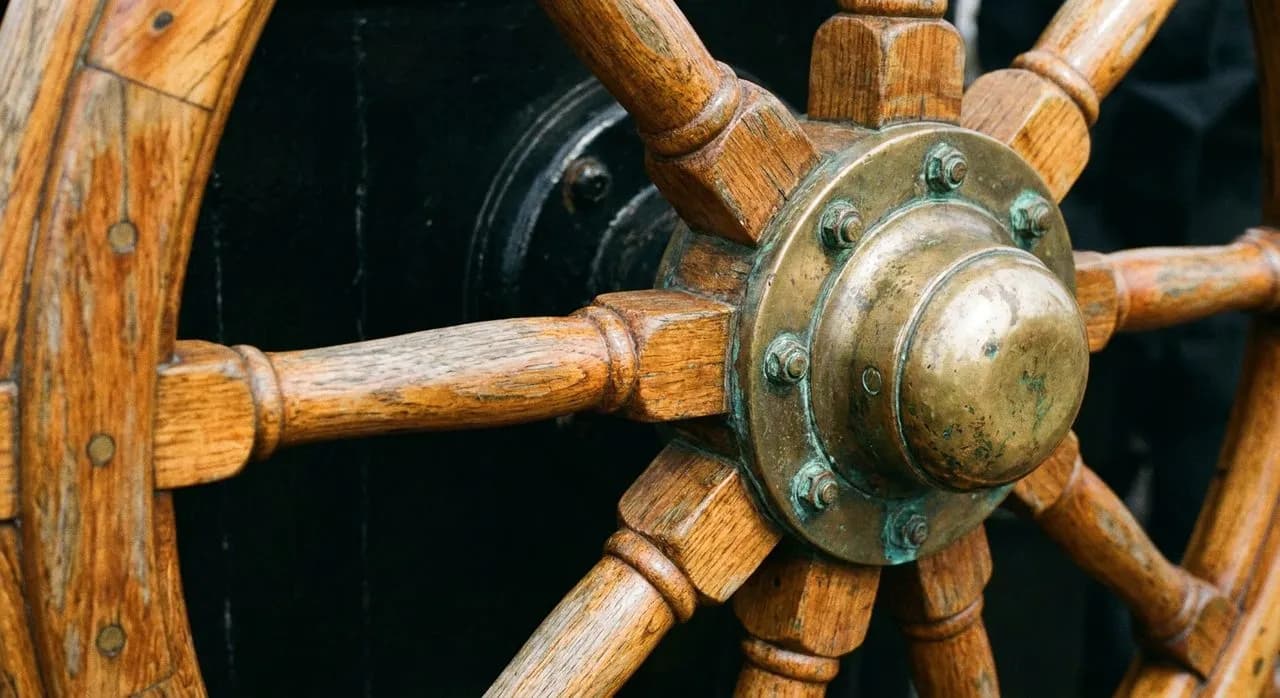
The bowsprit trick
The Balclutha's bowsprit extends over the pier's edge, a long spar pointing toward the Golden Gate like a compass needle. Viewing the bowsprit area is free from the pier, but access onto ship structures may be restricted; verify current visitor access rules.—you simply walk to the forward end of the pier and step onto the platform beneath it. From here, the city's maritime geography arranges itself in layers: Aquatic Park Cove curving below, the Municipal Pier stretching west, Alcatraz centered in the bay, the Marin Headlands rising beyond. It's the kind of free thing to do that feels like a loophole, though it's entirely intentional.
On clear summer days, late morning through mid-afternoon, the light turns the water a hard, gemstone blue. The fog typically burns off by ten and holds offshore until early evening, leaving a window when the bay performs its best work. Photographers cluster here with long lenses; couples lean against the rail; solo wanderers simply stand and watch the ferries churn past.
Decks and ranger wisdom
The C.A. Thayer's forward deck serves as an open-air amphitheater for the park's interpretive programs. Park rangers lead free deck talks on a seasonal schedule; verify current times with the park., rotating among the ships, covering maritime history and ship restoration. One afternoon it's the art of celestial navigation; another day, the economics of the lumber trade or the mechanics of sail rigging. The talks run twenty to thirty minutes, pitched at a level that satisfies both twelve-year-olds and the retired engineers who pepper rangers with technical questions.
The rangers themselves tend toward the type who chose the job for love rather than salary—former merchant mariners, wooden-boat restorers, historians who can recite the tonnage capacity of every vessel on the pier. Their enthusiasm is contagious, and the setting helps: there's something clarifying about learning maritime knots while standing on the actual deck where those knots once mattered.
The Eureka's automotive ghosts
The ferry Eureka's car deck stretches the length of a city block, a vast open space lined with vintage automobiles from her operating years. Model Ts and Packards sit in silent rows, as if waiting for a bridge that will never rise. It's an odd, melancholy exhibit—cars that once represented speed and modernity now museum pieces themselves, doubly obsolete. The deck catches the breeze and offers good sight lines toward the Hyde Street cable cars clanging past at the pier's entrance.
Children run the length of the deck, their footsteps echoing against the steel walls. The space has an industrial poetry: rivets and girders, the ghost-smell of engine oil, the sense of civic infrastructure rendered artifact. It's less picturesque than the sailing ships but no less interesting, a reminder that the bay's working life encompassed steam and steel as much as canvas and wood.
Microclimates and local knowledge
The pier's northern side catches morning sun and blocks afternoon wind; locals sit on the benches there with coffee from the Buena Vista Cafe across the street. By locals, I mean the regulars: retirees with newspapers, writers with notebooks, off-duty service workers on break. They've learned what summer travel guidebooks rarely mention—that the pier's geometry creates a microclimate, a pocket of warmth and calm even when the rest of the waterfront shivers under coastal wind.
The southern side, by contrast, takes the full force of the afternoon blow. Good for feeling alive, less good for lingering. The pier-end overlook, past the last ship berth, splits the difference: exposed but worth it. Aquatic Park Cove spreads below, its crescent beach dotted with the bright caps of cold-water swimmers. On weekends, the bay fills with sailboats tacking toward the Gate, their sails snapping taut in the breeze.
When to walk it
Late June through September offers the most reliable weather, though "reliable" in San Francisco terms still means layering. The afternoon window—roughly noon to four—gives you the best light and the fewest crowds. Mornings bring tour groups and school field trips; evenings, the fog creeps back in and the park winds down. But that midday stretch, especially on a weekday, belongs to whoever claims it: deck space, bench time, the long view out toward the Pacific.
The park's appeal lies partly in what it doesn't do. It doesn't pipe in period music or dress interpreters in costume. It doesn't over-explain. The ships sit in their berths, solid and self-evident, and you're free to walk their decks and draw your own conclusions about what it meant to round the Horn under sail or pilot a ferry through fog thick enough to lose the shoreline. The city's summer rhythm—tourists, tech shuttles, sidewalk negotiations—feels far away, even though you're barely a mile from Union Square.
Practical notes
San Francisco Maritime National Historical Park, Hyde Street Pier, is located at the foot of Hyde Street at Jefferson Street. The Powell-Hyde cable car line terminates steps away; metered street parking is scarce but the Anchorage Shopping Center garage (via Beach Street) offers paid parking. Pier access is free and generally available dawn to dusk; belowdecks museum tours require separate admission. The main deck areas are accessible, though historic ships have thresholds and uneven surfaces. Bring layers regardless of forecast, sun protection for clear days, and comfortable walking shoes. Verify current hours and ranger-talk schedules directly with the National Park Service before visiting.
Tags: #SanFranciscoMaritime #HydeStreetPier #FreeAndFine #SummerTravel #SFWaterfront #HistoricShips #AquaticPark #NationalParkService #SanFranciscoBay #MaritimeHistory #FreeThingsToDo #SFExploration #BayViews #BalcluthaSF #HiddenSanFrancisco
Sources consulted: San Francisco Maritime National Historical Park · National Park Service – SF Maritime · SFGate Travel · San Francisco Travel Association
All trademarks are the property of their respective owners.