 Pier 39 Spice Shop: 85 Hand-Mixed Blends, Open Until 9
Hidden Gems & Odd Finds
Finding Jenna Ortega's Kind of Night Out in San Francisco, Fog Willing
Searching for a moody, slightly strange evening route that echoes Jenna Ortega's darker aesthetic across Japantown and the Western Addition.
People looking up Jenna Ortega right now are often chasing the aesthetic she carries—gothic undertones, deliberate strangeness, a refusal to be cheerful on command. San Francisco, particularly the stretch between Japantown and the Fillmore corridor, has pockets that answer that mood without trying. The fog helps. So does the fact that the Western Addition never quite committed to being polished, and Japantown's mid-century architecture sits low and quiet instead of flashing neon.
Karpo watches for same-night openings, checks whether the fog has cleared enough for the Lyon Street climb, and gives you a live-timed route that accounts for Muni delays and early kitchen closures. Text it before you leave.
Why San Francisco suits the Jenna Ortega search
This is not about celebrity sightings or fabricated film-location tourism. It is about organizing an evening that feels like the tone people associate with Jenna Ortega's work—Wednesday's deadpan remove, the careful framing of Scream VI, the controlled unease of X. San Francisco has venues, blocks and routes that let you build that evening honestly, using real places that have been open for years and require no invention.
The friction here is logistical: fog makes the western hills colder and darker than you expect, Muni's 38 Geary can bunch or vanish after nine, and several good bars in the Lower Haight close their kitchens by ten. If you are coming from the East Bay on BART, the transfer at Civic Center adds fifteen minutes you will feel. The plan below assumes you are starting around six-thirty and want to be done by eleven, with an easy exit to either the N-Judah or the 5-Fulton depending on where the night lands you.
Start at the Japan Center courtyard as dusk arrives
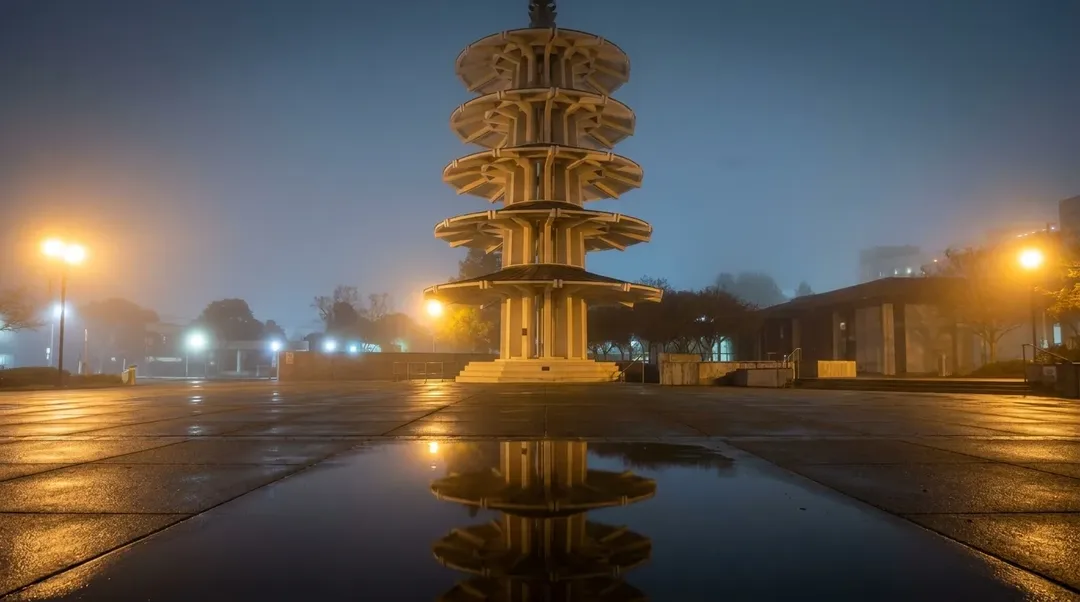
Japantown's Peace Plaza, anchored by the five-tiered pagoda, goes quiet around sunset in a way that suits the mood. The mall interior—Japan Center on Post Street—has low ceilings, narrow hallways and a carpet that has not changed since the seventies. Walk through slowly. The lighting is fluorescent and unforgiving, the shops sell ceramics and import snacks, and the whole space feels like it was designed for a different decade's idea of the future. That slight dislocation is the point.
If you want to sit, Benkyodo Company on Buchanan, just north of the mall, is a family-run mochi shop that has been there since 1906. The interior is small, the glass case is spare, and no one is performing hospitality. It closes early—check before you go—but if it is open, order mochi and eat it standing near the window. The sweetness is restrained, the texture is exact, and the transaction takes two minutes.
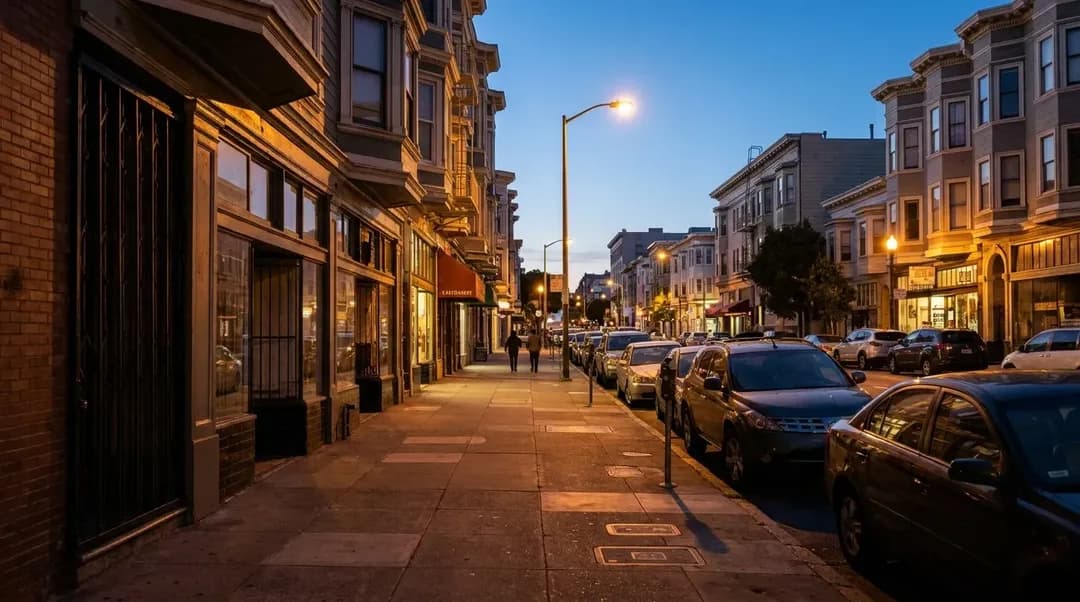
From there, walk west on Post toward Fillmore. The blocks between Laguna and Fillmore are residential, the sidewalks are uneven, and the light from the streetlamps is sodium-yellow and thin. You will pass the Cathedral of Saint Mary of the Assumption on Gough if you look south—it is a concrete hyperbolic paraboloid that looks like a washing machine agitator, and at night it glows from within in a way that reads more unsettling than sacred. You do not need to go inside; seeing it from the street is enough.
Fillmore, the New People building, and the vinyl hour
The New People building at 1746 Post, on the northwest corner of Fillmore and Post, is a white box with a ground-floor retail space that includes a small cinema and a manga library upstairs. The cinema, New People Cinema, programs Japanese film, anime and occasional genre retrospectives. Check their schedule in advance—they do not run shows every night, and when they do, seating is limited. If nothing is screening, the ground floor still has import goods, art books and a vending machine that dispenses capsule toys with more care than you expect from a machine.
Walk north on Fillmore toward Geary. This stretch has changed hands many times, but the building stock is old and the blocks still carry the memory of being the center of Black San Francisco before redevelopment and displacement. The mood is not nostalgic—it is watchful. If you want live music, check whether the Fillmore Auditorium at 1805 Geary has a show that night. The venue is famous, the sound is good, and the poster room upstairs is worth fifteen minutes if the doors are open early. Confirm ticket availability and timing before you assume you can walk in.
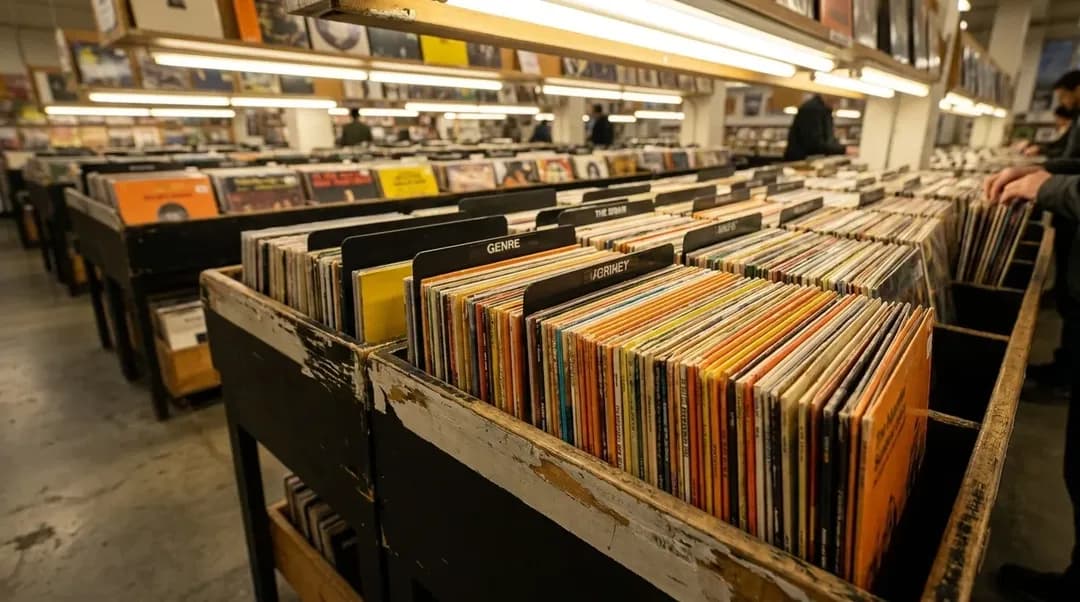
If you would rather stay smaller, Amoeba Music on Haight Street is a thirty-minute walk southwest, or a quick ride on the 6-Parnassus. It is a warehouse of used vinyl, CDs and DVDs, open until ten most nights, and the bins are organized with enough logic that you can lose an hour without trying. The lighting is industrial, the air smells like old cardboard, and the crowd is silent and focused. People looking for Jenna Ortega's vibe often want that kind of solitary hunting in a public space—surrounded but not obligated to perform sociability.
If the weather turns or transit stalls
Fog in San Francisco is not romantic; it is a cold, wet wind that comes off the Pacific and makes you regret your jacket choice. If it rolls in heavy after eight, the western neighborhoods become harder to navigate and less pleasant to walk. The N-Judah and the 5-Fulton both run to the Haight, but the N can be slow and the 5 stops running before midnight. If you are stuck, the fallback is to move east toward the Castro or the Mission, where the microclimates are warmer and the density is higher.
The Castro Theatre at 429 Castro Street is an anchor. It is a 1920s movie palace with a Wurlitzer organ, and while its programming has shifted over the years, it still runs rep screenings and special events. Check what is showing that night—sometimes it is a sing-along, sometimes it is a classic horror double feature. The interior is ornate in a way that feels like a stage set, and the crowd tends to be older and quieter than you expect for a weekend night.
If you want food and the kitchens in Japantown or the Fillmore have closed, the Mission is your best bet. Taqueria Cancún at 2288 Mission near 19th Street is open until midnight on weekends, the carnitas are correct, and the fluorescent lighting and bolted-down tables make it clear that this is not an experience restaurant. You eat, you leave, and you do not have to explain yourself. The 14-Mission bus runs frequently and will take you back toward BART or north toward the Haight if you need to reorient.
What to check the same day you go
San Francisco's evening transit is functional but not abundant. After nine, Muni lines slow down, and the 38-Geary—the main east-west line through Japantown—can bunch or skip stops. If you are relying on BART to get home, the last trains leave around midnight on weekdays and slightly later on weekends, but the Civic Center transfer is often slower than the map suggests because of track work or crowding. Build in fifteen extra minutes if you are catching the last train.
Venue hours shift without ceremony. The New People Cinema does not run shows every night, and the Fillmore Auditorium's calendar is sparse outside of weekends. Amoeba Music sometimes closes early for private events, and Benkyodo Company keeps traditional hours that do not stretch past six. Confirm everything the same day, either by checking the venue's own website or by texting Karpo for a live status check before you leave.
Weather in the western neighborhoods is not predictable from downtown. The fog can be clear at Civic Center and thick at Fillmore, or the reverse. Wind on the hills near the Presidio or along Geary can make a walk unpleasant even when the temperature is mild. If you are planning to walk more than ten blocks west of Van Ness, bring a second layer and assume you will need it. The same applies to any route that involves the Lyon Street steps or the trails around the Palace of Fine Arts—those areas are beautiful in theory and cold in practice after dark.
Practical notes
- Start around six-thirty if you want time in Japantown before shops close; most close by eight or nine.
- The 38-Geary runs frequently until nine, then slows; the N-Judah and 5-Fulton are your backups west.
- Fog and wind are real after sunset in the Western Addition and the Haight—bring a jacket even if downtown is warm.
- New People Cinema and the Fillmore Auditorium do not run events every night; check schedules the same day.
- Amoeba Music closes at ten most nights; Benkyodo Company closes much earlier, often by six.
- If you are coming from BART, assume fifteen extra minutes for the Civic Center transfer and plan your return before the last train.
Tags: #karpo #sanfrancisco #jennaortega #japantown #fillmore #theodddetail #sfnightlife #gothicaesthetic #sfmuni #newpeoplecinema #amoebamusic #castrodistrict #missiondistrict #sftransit #fogcity
Sources consulted: SF Japantown · New People Cinema · The Fillmore · Amoeba Music SF · Castro Theatre · SFMTA Muni
All trademarks are the property of their respective owners.
Ask Karpo first
Text Karpo the morning of your evening out to confirm which venues are actually open that night, whether the fog has settled over Japantown or the Haight, and what time the last N-Judah or BART train leaves from your exit point. It will give you a live-timed route that adjusts for Muni delays and kitchen closures, and suggest a fallback if the weather turns.
Ask Karpo for more information.
Keep reading
- Pier 39 Spice Shop: 85 Hand-Mixed Blends, Open Until 9
 San Francisco Herb Co. Spice Shop: Weekdays Only, 10 to 4
 Other Avenues Spice Shop by Ocean Beach: 150 Bulk Spices