There is a free museum in San Francisco where the exhibit you came to see is actively pulling the city's last manually operated cable car system up Powell Street fifty feet from where you're standing. The cable winding wheels are 14 feet across, painted dark red, and they have not stopped turning since 1984. The museum is open six days a week, charges nothing, and almost no one outside the rail-history crowd knows it exists.
The Museum That Is Also the Engine
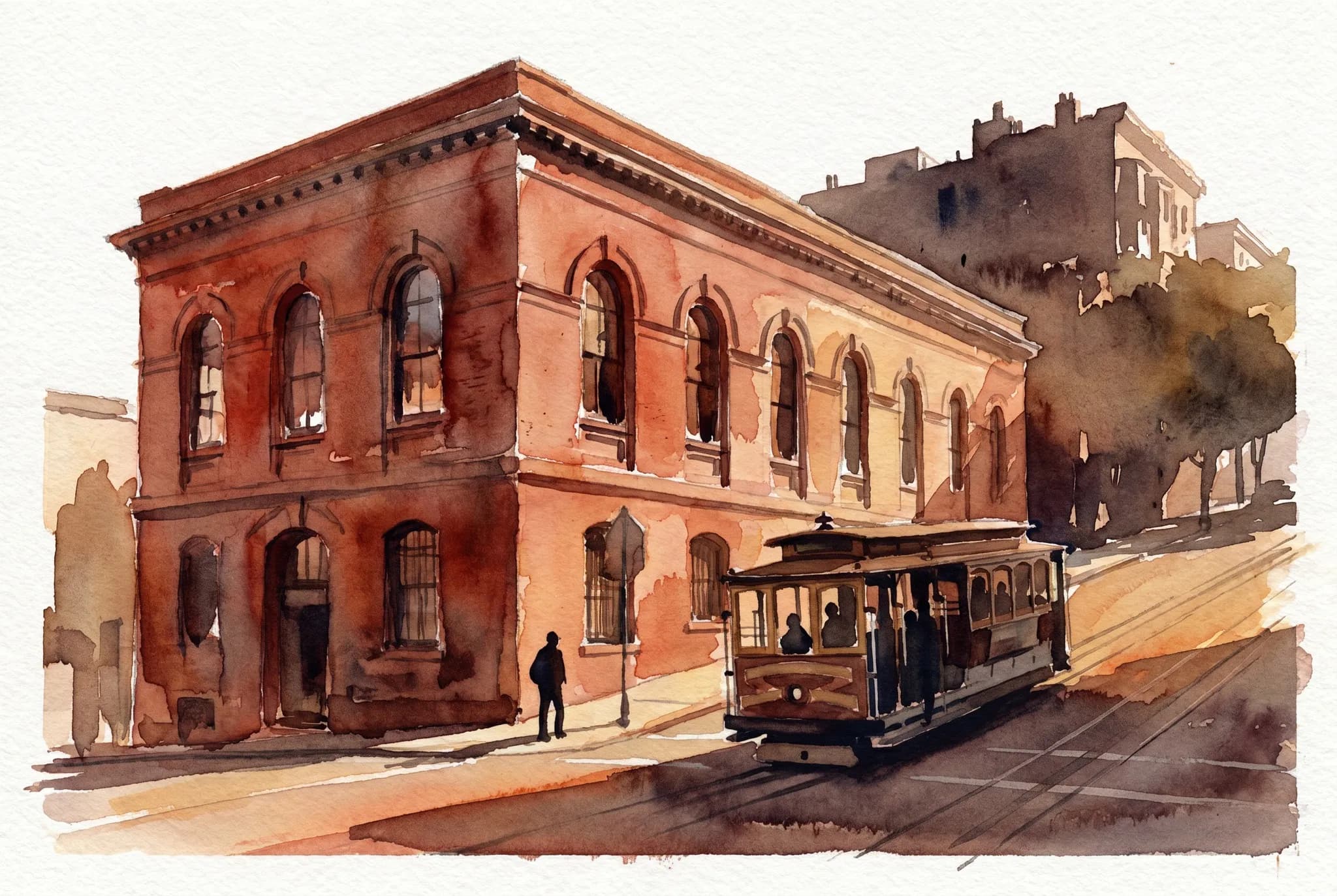
The San Francisco Cable Car Museum sits at the corner of Mason and Washington in Nob Hill — the upper-floor exhibit space and gift shop of a red-brick 1887 industrial building called the Washington–Mason Powerhouse and Carbarn. The museum was established in 1974, but the building it lives in is older than most American steam railways. Every cable car that runs on the Powell-Mason, Powell-Hyde, and California Street lines starts and ends each day inside the carbarn portion of this building. The cables that pull those cars run continuously through the powerhouse beneath your feet.
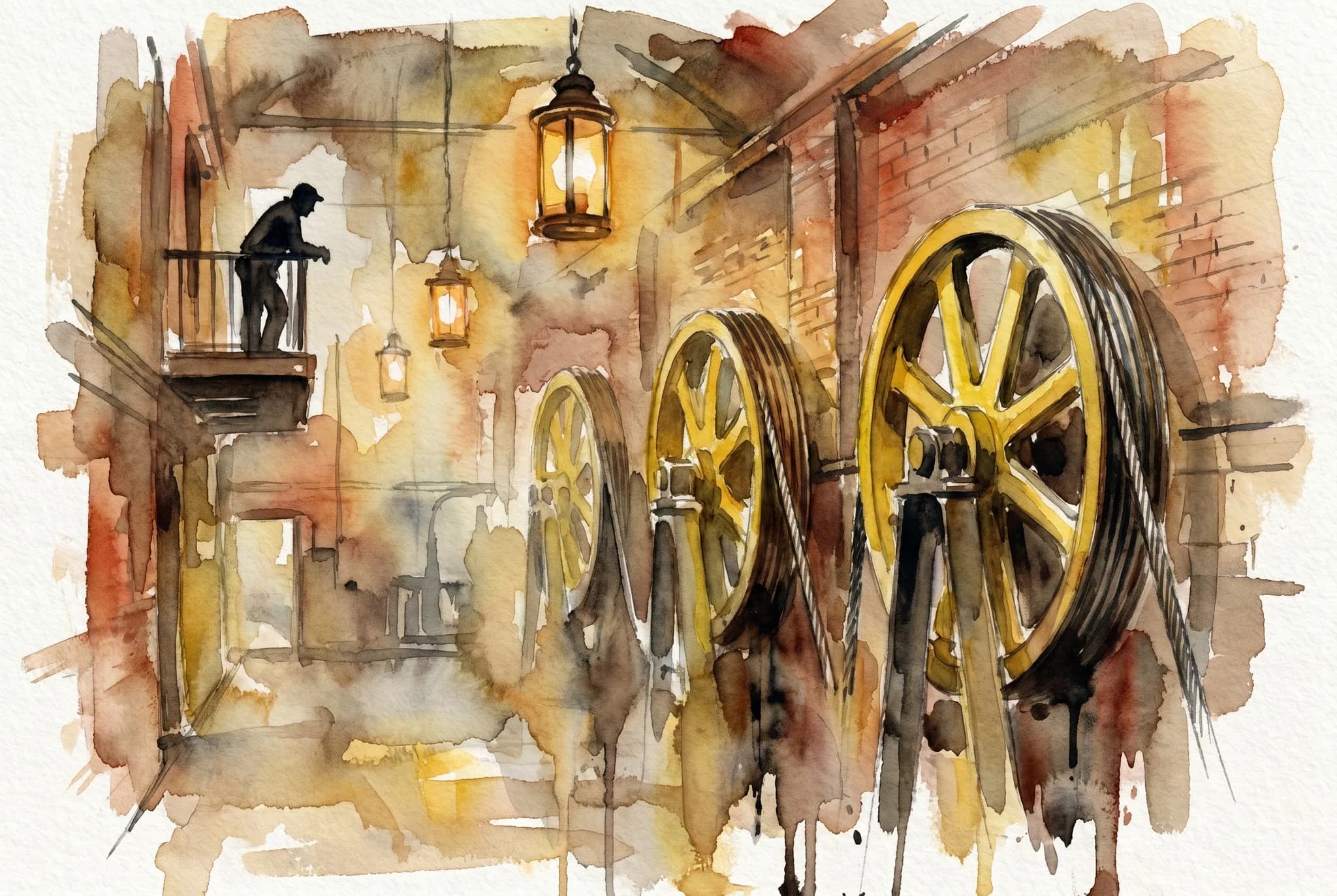
That is the museum's actual conceit: you walk in expecting historical exhibits and you find yourself standing on a steel walkway, looking down through a glass viewing well, watching four enormous iron sheave wheels turn — each one winding a different cable through the city's underground conduit network, each cable moving at exactly 9.5 miles per hour, all four together pulling roughly forty working cable cars across about ten miles of Nob Hill and Russian Hill streets. The wheels do not slow down for visitors. They run all day, every operating day, the way they have since 1984.
Why the Building Is on the National Register
The Powerhouse was built in 1887 by the Ferries and Cliff House Railway, three years before the entire San Francisco cable car system was rebuilt after the 1906 earthquake destroyed most of it. The building was rebuilt in 1907 in the same brick footprint, with the same arched industrial windows on Washington Street, and put back into service. It has been the operating heart of the surviving cable car system ever since.
In 1984, the entire system was rebuilt again — this time during a 21-month shutdown that replaced the cables, the tracks, and most of the propulsion equipment. The wheels you see today are from that rebuild. They are not original. They are also not new. The system has been continuously operating since the 1984 reopening, which makes the Cable Car Museum one of the very few "industrial museums" anywhere in the world that is also still an active piece of municipal infrastructure.
The building has been a designated San Francisco landmark since 1971, on the National Register of Historic Places since 1978, and a National Historic Landmark since 1964.
The Three Things to Look at, In Order
The museum is small — one large upper-floor gallery, the viewing balcony over the powerhouse, and a single side room with vintage cars — and the right way to walk it is in this order.
**First**, walk straight to the viewing balcony at the back of the main floor. Stand at the brass rail. Watch the four red sheave wheels turn for a full five minutes without reading anything. The mechanical scale of it — four 14-foot wheels, each weighing thousands of pounds, all turning silently because the cables they're pulling are tensioned to a level of precision that doesn't allow vibration — is the thing the museum was built around. Listen for the cable. There's a low, constant hum from the conduit channel that runs along the floor.
**Second**, walk down to the basement viewing area below. Through a glass wall you can see the underground sheave room — the level where the cables actually enter the building from the street and route through the wheel system. This is the part of the museum that explains what's happening physically: the cables come in from outside, route through the wheels, and head back out under the street to pull the cars.
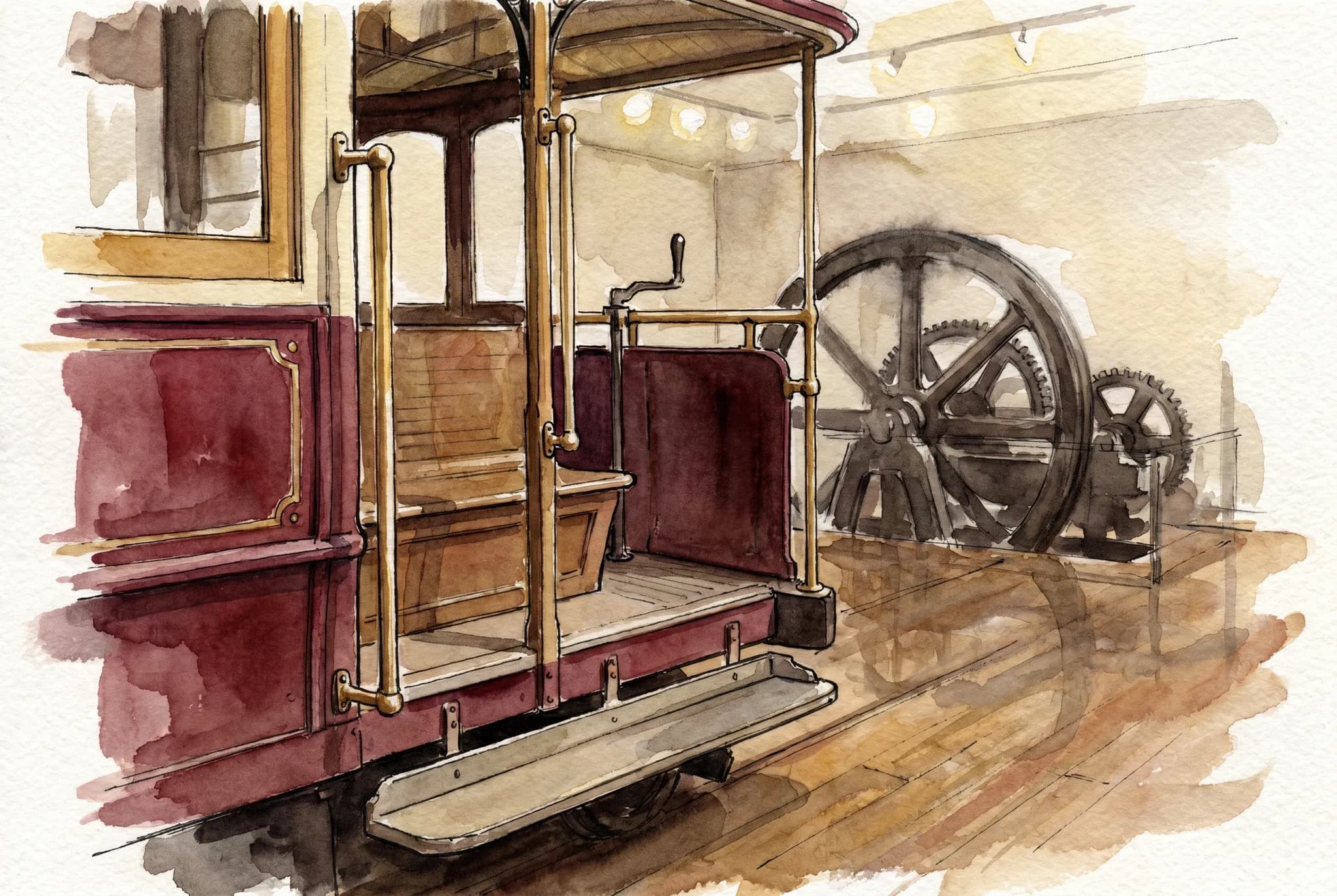
**Third**, walk to the side gallery to see the vintage cable cars. There are three on display — including Car No. 8 from 1873, one of the oldest surviving cable cars in the world, used on the original Clay Street Hill Railroad. The Clay Street Hill Railroad was the first commercially successful cable car system anywhere, opened by Andrew Smith Hallidie in August 1873. It ran for fifteen years and was demolished in 1891; Car No. 8 is one of the only physical artifacts that survived.
The Half-Hour That Works Best
The museum is open Tuesday through Sunday — 10am to 4pm Tuesday through Thursday, 10am to 5pm Friday through Sunday. It is closed on Mondays. The first half-hour after opening, 10:00 to 10:30, is when the upper viewing balcony has the fewest visitors. The 1:00pm window is the busiest — that's when the family-with-kids crowd has finished the cable car ride from Powell Street and walked the seven blocks to see how the cars actually work.
There is no admission fee. There is no ticket counter. You walk in the front door under the arched sign, climb a short flight of stairs, and you're in. The museum operates entirely on donations and on revenue from the small gift shop on the upper floor, which sells the predictable bell-and-postcard inventory plus a small selection of cable-car history books that are genuinely good.
What the Walk to the Museum Adds
The museum is at 1201 Mason Street, which is at the top of the Mason Street hill — eight blocks up from the Powell Street cable car turntable at Market Street. The right way to arrive is to take the Powell-Mason cable car itself, get off at Washington Street, walk one block east, and enter the museum from the corner. You will have just ridden one of the cars whose cable you're about to watch being pulled.
The alternative is to walk up from Union Square, which is steeper than it looks on a map. The climb is twelve blocks of San Francisco's signature 17% gradient, which is the point of the cable cars in the first place. Most visitors are pleased to discover, around block eight, why the city built a 1.5-mile underground cable network instead of just running streetcars.
Why It Works as "Nice but Free"
The conventional "free San Francisco museums" list will hand you the Wells Fargo History Museum (good, small), the Federal Reserve Bank of San Francisco's economic exhibits (good, weird), the Wave Organ in the Marina (good, but it's a sound installation, not a museum), and the SF Public Library's history room (good, small, very quiet).
The Cable Car Museum belongs at the top of that list and almost never appears on it. The reason is that it's a working museum — the exhibit is doing its job whether you're there or not — and the museum-tour version of San Francisco doesn't quite know how to handle that. It's not a museum about cable cars. It's a cable car powerhouse that allows you to walk inside it.
That is a specific, narrow, and unusual category. The closest analogues in other American cities are Pittsburgh's Carrie Furnaces (a former blast furnace open as a museum), Lowell's Boott Mills (a working textile museum), and the still-operating turbine room at Niagara Falls. The Cable Car Museum is in that category. The difference is that the equipment in those museums is preserved as historical artifact; the equipment in the Cable Car Museum is preserved as San Francisco's municipal transit system.
Practical notes
- Address / Location: 1201 Mason Street (at Washington Street), Nob Hill, San Francisco, CA 94108
- Hours: Tue–Thu 10am–4pm · Fri–Sun 10am–5pm · Closed Monday, New Year's Day, Thanksgiving, Christmas
- Admission: Free (donations accepted; the gift shop revenue helps fund the museum)
- Getting there: Take the Powell-Mason cable car from the Powell Street turntable at Market Street (downtown), get off at Washington Street, walk one block east. The 1 California or 30 Stockton buses also stop within four blocks.
- Best window: First half-hour after opening — Tuesday or Wednesday, 10:00 to 10:30am — for the quietest version of the viewing balcony.
- How long to stay: Forty-five minutes is plenty for the museum itself; the visit is unusually content-dense for the size of the space.
- What to do after: Walk three blocks south to Grace Cathedral (free) for the Labyrinth in the nave; or take the Powell-Hyde cable car back down to Fisherman's Wharf for the full SF transit experience; or walk five blocks east to the top of California Street for the Huntington Park rest-and-view.
The point
The free museums in most American cities are museums in the conventional sense — paintings on walls, objects in cases, didactic panels at hip height. The Cable Car Museum is a free museum about a piece of equipment that is, at the exact moment you're standing in it, doing the job it was built for in 1887. The wheels turn. The cables pull. The cars climb the hills. The whole system functions. And the building lets you stand on a steel walkway above the working machinery and watch a piece of 19th-century American urban engineering still doing what it was designed to do, 142 years later, for nothing.
#cablecarmuseum #cablecarsf #nobhillsf #sanfranciscocablecar #freemuseumsf #nicebutfree #sfhistory #industrialhistory #1887powerhouse #californiastreetline #masonstreet #freesf #sfmuseums #bayareafree #historicsf
Sources consulted: cablecarmuseum.org · en.wikipedia.org · sanfrancisco.net · storyhunt.io · sfstation.com
All trademarks are the property of their respective owners.