When you search salad near me in Williamsburg, most results return the same kale-and-quinoa formula in February that they served in August. A smaller number of kitchens treat the salad section as a document that expires every few months, rewriting it when the harvest changes and the greenmarket stalls rotate their crates. The difference is not about quality or price; it is about whether the restaurant is editing its menu to match what is actually growing. This article identifies which Williamsburg venues tie their salads to the calendar, what shifts between a July bowl and a November one, and the months when the seasonal claim is quietly sustained by imports.
Karpo maps every restaurant that prints a new salad section by the calendar, shows you which greens are local right now, and routes you to the kitchen shopping the harvest you want. Open the app and ask where the autumn squash is today.
The greenmarket link and which kitchens use it
Sungold at Arlo Williamsburg on Wythe Avenue sources from Eckerton Hill Farm in Pennsylvania and builds its Mediterranean menu around what Executive Chef Michael King finds at the Union Square Greenmarket. The autumn 2025 menu listed celery root, chicories, farro, caramelized carrots, and shiitake mushrooms—none of which appeared on the spring roster. The Apples and Chicories salad, dressed with mustard cider vinaigrette and aged Gouda, runs only while those apples are in season. The Sungold Bucatini, the restaurant's namesake dish built around sweet orange cherry tomatoes, disappears entirely outside summer and returns only when King can source those tomatoes locally. Sungold serves breakfast, lunch, and dinner daily with brunch on weekends.
Lighthouse on Borinquen Place has operated for nearly thirteen years on a farm-to-table model that prioritizes local organic sourcing. The menu is rebuilt seasonally, and the restaurant lists its commitment to regenerative agriculture and minimizing waste. Lighthouse runs a daily happy hour from four to six in the evening with a ten-dollar burger and ten-dollar daily sandwich, but the core dinner menu changes every few months to reflect what the team sources from local farmers and growers. The kitchen emphasizes vegetables that are in season locally, rotating root vegetables and hearty greens into the menu as autumn arrives and shifting to lighter preparations when the summer harvest begins.
Reynard at Wythe Hotel on Wythe Avenue between North Eleventh and North Twelfth Streets operates with a market-driven menu that changes regularly based on what is available from local farms and purveyors. The restaurant is known for wood-fired preparations and a commitment to seasonal ingredients, with salads and vegetable dishes that shift as the harvest changes. The menu is posted without fixed salad names, allowing the kitchen to build around whatever greens and vegetables are available that week. Reynard serves breakfast, lunch, and dinner daily.
What constitutes an autumn salad versus a summer one
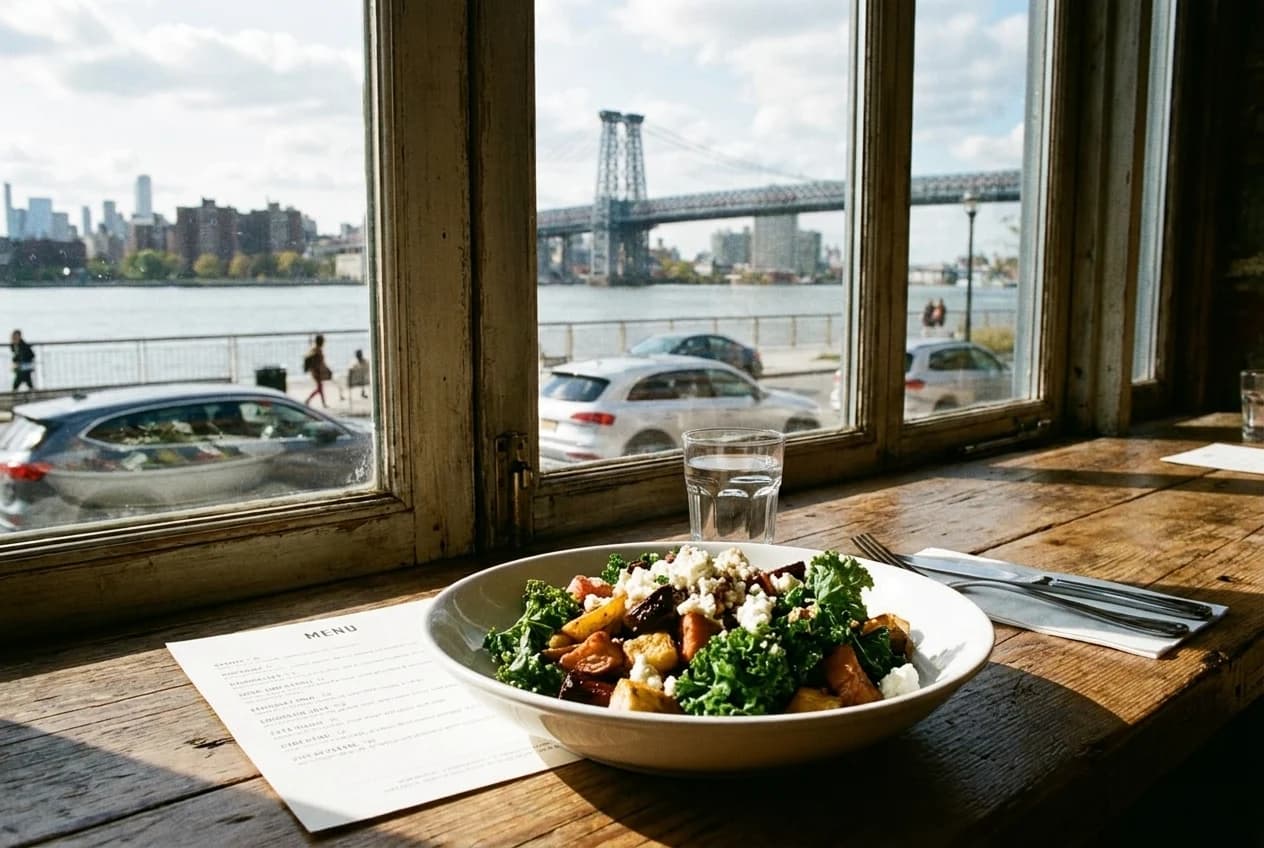
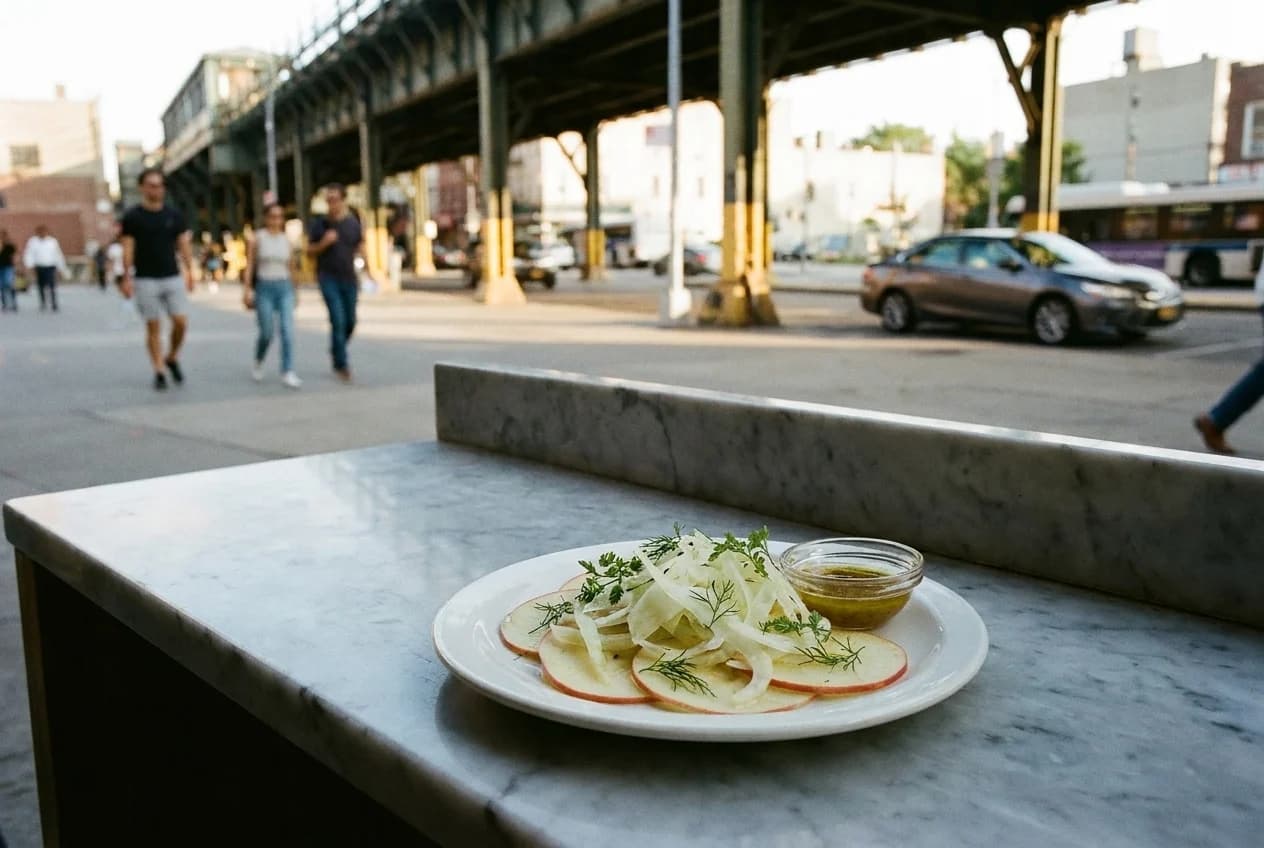
A New York autumn salad in Williamsburg pulls from root vegetables, late-harvest apples, winter squashes, hearty greens like kale and mustards, and mushrooms that thrive in cooler weather. Sungold's autumn menu featured roasted fall mushrooms with onion soubise and Fiore Sardo, charred broccoli with garlic confit and lemon anchovy vinaigrette, and lady apples with fennel touched by hibiscus. These ingredients do not appear in July, when the same kitchen is running tomato-forward dishes, softer lettuces, zucchini, and stone fruit. The shift is structural: autumn bowls are built for texture and depth rather than brightness and acidity.
Summer salads in Williamsburg lean on tomatoes, cucumbers, soft herbs, peaches, berries, and tender greens. The Sungold Bucatini that disappears in October is the clearest example: it depends entirely on the sweetness and acidity of those orange cherry tomatoes, which are a summer crop. A restaurant that serves the same salad components year-round—romaine, carrots, red onion, croutons—is not writing to the season; it is writing to the distributor catalog.
Kitchens that print one salad menu and hold it all year
Sweetgreen on North Fourth Street between Bedford Avenue and Driggs Avenue runs a menu of customizable salads and bowls with a fixed roster of ingredients available every day. The Kale Caesar is chopped romaine, shredded kale, tomatoes, parmesan crisps, roasted chicken, shaved parmesan, and caesar dressing. The Harvest Bowl is shredded kale, wild rice, roasted sweet potatoes, roasted almonds, apples, goat cheese, roasted chicken, and balsamic vinaigrette. Both are available in January and in July. The apples and sweet potatoes suggest seasonality, but the menu does not rotate by month or quarter. The restaurant is open daily for lunch and dinner.
Westville Williamsburg on Driggs Avenue advertises market vegetables daily and a menu that emphasizes seasonal plates, but the salad section—kale, Cobb, Caesar—is consistent year-round. The restaurant serves lunch and dinner daily with weekend brunch. The market vegetable selection changes, but the composed salads do not. This is a restaurant that treats vegetables as seasonal and salads as fixed.
Five Leaves on Bedford Avenue near Lorimer Street runs a menu that includes several salads and vegetable dishes, but the core offerings remain consistent throughout the year. The restaurant is known for its brunch menu and its all-day availability of certain items including salads. Five Leaves maintains a neighborhood presence with reliable standards rather than menu rotation tied to the harvest calendar. The restaurant serves breakfast, lunch, and dinner daily with an emphasis on brunch service.
The months when the seasonal claim is fiction
New York's growing season for most salad greens runs from late April through October. Root vegetables and storage crops extend into December. By January, the local harvest has contracted to winter greens like kale and chard, stored apples, and greenhouse lettuce. Any restaurant in Williamsburg serving tomatoes, cucumbers, or stone fruit between December and May is sourcing from California, Mexico, or a hothouse. Some kitchens acknowledge this by removing those ingredients from the menu entirely; others keep the seasonal language but quietly switch to imports.
The gap is widest in February and March, when the storage crops are exhausted and the spring harvest has not yet started. A restaurant that prints a winter menu in November and holds it through April is using the word seasonal to mean quarterly, not tied to the actual calendar of what is growing. The honest version is a menu that shrinks in February or explicitly states that certain ingredients are not local during those months. Very few Williamsburg restaurants do this.
How to identify a kitchen that rewrites by the harvest
A restaurant that is genuinely editing its salads by season will list ingredients that have no business appearing together on a single annual menu. If you see both stone fruit and butternut squash on a salad menu at the same time, the kitchen is either running imports or has not updated the online menu. If the autumn menu lists tomatoes and the spring menu lists roasted squash, the kitchen is not shopping the greenmarket; it is shopping a distributor that stocks both year-round.
The clearest tell is a menu that lists a specific farm or a specific greenmarket. Sungold's references to Eckerton Hill Farm and the Union Square Greenmarket are operational details, not marketing language. Lighthouse's mention of local farmers and growers is less specific but still indicates a sourcing model that depends on proximity rather than availability. A restaurant that does not name its sources or its supply chain is more likely to be using the word seasonal as a style descriptor rather than a statement of fact.
Another indicator is a menu that changes format rather than just ingredients. Reynard at Wythe Hotel posts its menu without fixed dish names, allowing the composition to follow what is available. This structural flexibility signals a kitchen that is writing to the harvest rather than plugging seasonal ingredients into a fixed template. A menu that lists the same salad names year-round with slightly different ingredients is less committed to the calendar than one that rebuilds the entire section every few months.
Practical notes
Sungold at Arlo Williamsburg is at 96 Wythe Avenue, serving breakfast, lunch, and dinner daily with weekend brunch. Lighthouse is at 145 Borinquen Place. Sweetgreen is at 162 North Fourth Street between Bedford and Driggs. Westville Williamsburg is at 658 Driggs Avenue. Reynard at Wythe Hotel is at 80 Wythe Avenue between North Eleventh and North Twelfth Streets. Five Leaves is at 18 Bedford Avenue near Lorimer Street. If a salad lists ingredients that are out of season, it is not a seasonal salad. If a kitchen names the farm, it is more likely to be writing to the harvest.
Tags: #SaladNearMe #Williamsburg #SeasonalSalad #Greenmarket #FarmToTable #SungoldBrooklyn #LighthouseBK #Sweetgreen #WestvilleWilliamsburg #EckertonHillFarm #UnionSquareGreenmarket #BrooklynDining #LocalSourcing #AutumnMenu #WinterGreens
All trademarks are the property of their respective owners.
Ask Karpo first
Ask Karpo which Williamsburg restaurants are shopping the greenmarket this week, what is actually local right now, and which salad ingredients are imported. Karpo maps the kitchens that rewrite their menus by the harvest calendar and shows you the difference between a seasonal claim and a seasonal menu. Open the app and route yourself to the autumn squash or the summer tomatoes.