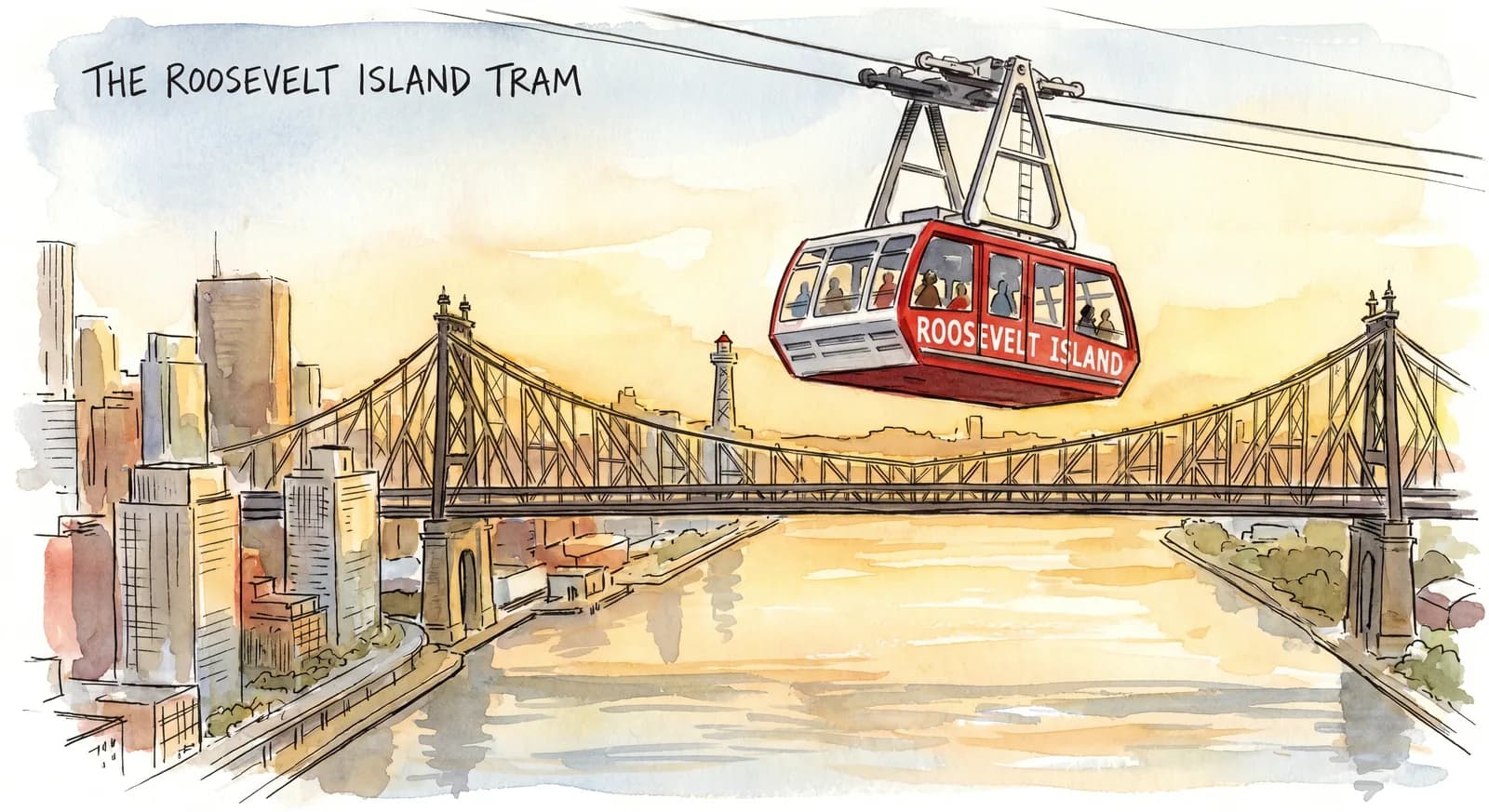
The tram, briefly
The Roosevelt Island Tramway opened in 1976 as a temporary commuter solution while the F train's Roosevelt Island station was being built. It was never decommissioned. It is now the only commuter aerial tram in North America, operating on the same OMNY tap as the subway: $2.90 each way, free transfers within two hours. The Manhattan station is at Second Avenue and East 60th Street; the Roosevelt Island station is on Main Street near the island's middle. Two cabins run on parallel cables, leaving Manhattan and the island simultaneously every seven to fifteen minutes from 6 a.m. to 2 a.m. (later on weekends).
Sit at the front of the eastbound cabin, on the right (south) side. The view climbs as the cabin rises out of the Manhattan station — first the rooftops of the Upper East Side, then the bridge towers, then a wide-open vista of the East River with the United Nations and Midtown East skyscrapers along the western bank. The cabin pauses at the high point above the bridge for about three seconds. That is the photograph.
The three-mile perimeter walk, north to south
From the tram station, walk three blocks north on Main Street to Lighthouse Park at the northern tip. The Roosevelt Island Lighthouse, a fifty-foot gothic stone tower built in 1872, sits in a small grass park at the island's northernmost point. Walk the loop counterclockwise: down the west promenade, past the residential blocks (Mitchell-Lama co-ops built between 1974 and 1989 by the New York State Urban Development Corporation, in a layout designed by Philip Johnson and John Burgee), past Coler Hospital on the right, past the FDR Four Freedoms entrance on the left, and on to the southern tip.
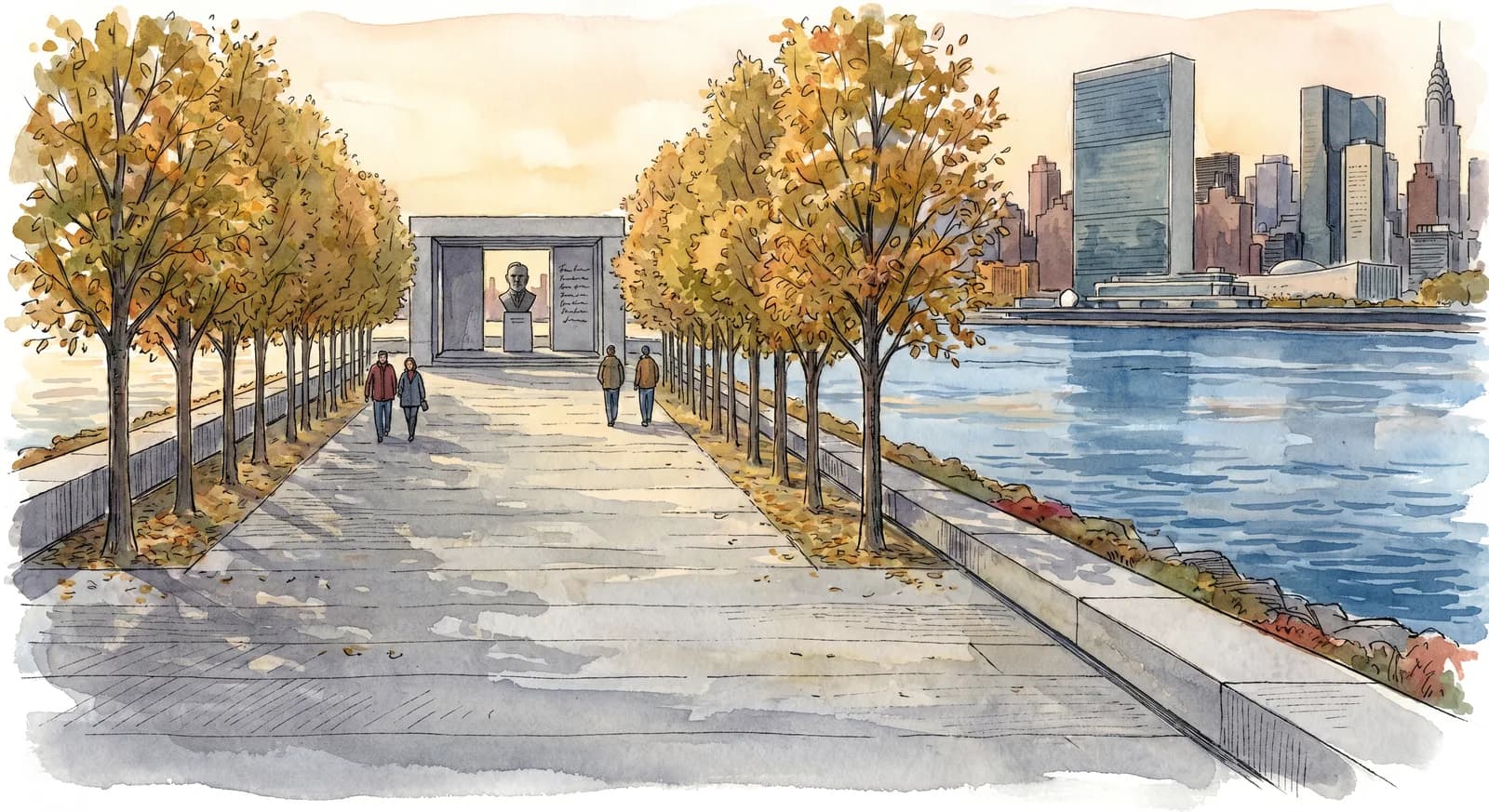
The Four Freedoms Park at the southern tip is the destination. It was designed by Louis Kahn in 1973, completed posthumously in 2012 (Kahn died in 1974 in a Penn Station bathroom; the drawings sat for thirty-six years), and opened on FDR's 130th birthday. It is a long granite plaza framed by two converging rows of little-leaf linden trees, sloping toward an open granite 'room' at the river's edge where a bronze bust of Roosevelt looks out across the East River toward the UN. Kahn called it a 'room and a garden.' The park is small (four acres), free, and quiet.
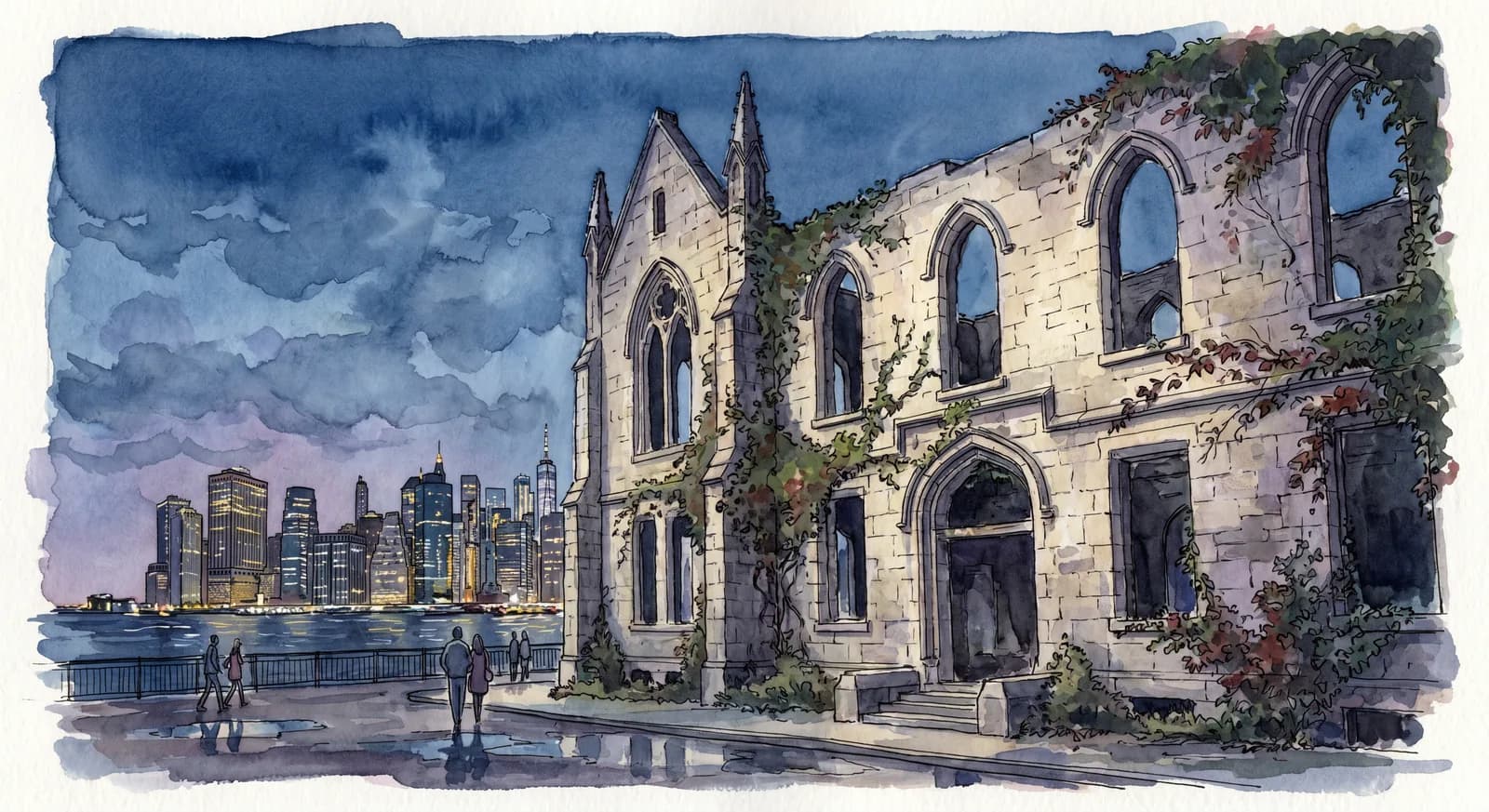
Just north of Four Freedoms sits the Smallpox Hospital — a Gothic Revival stone shell designed by James Renwick Jr. (the same architect who designed St Patrick's Cathedral) and completed in 1856 as the first hospital in the United States dedicated to smallpox treatment. The hospital closed in 1875, was used as a nurses' dormitory until the 1950s, and has been a designated ruin since 1976. It is one of the few landmarked ruins in New York City. Floodlit at twilight, the shell is genuinely beautiful and slightly unsettling.
The east promenade and the trip back
Walk north from Four Freedoms along the east promenade. The view from this side is across the smaller, eastern branch of the East River toward Long Island City: the Pepsi-Cola sign, the curve of Hunters Point South Park, the Anable Basin, the Citi Tower at Court Square. This view is slower than the west side. The current pushes the river north under the Queensboro Bridge at this hour, and the wake from the ferries is the only motion you see.
Pass under the Queensboro Bridge again — the steel cantilever roars roughly forty feet over your head — and back to the tram station. The full loop, from tram station around the south tip and back, is roughly 3.1 miles. At a normal walking pace, that is ninety minutes; with a sit at Four Freedoms, two hours. Time the loop so you board the westbound tram between 7:00 and 8:00 p.m. in summer, when the sun has just dropped behind Manhattan and the city's lights are coming on across the water.
Where to eat (briefly) on the island
Roosevelt Island is not a restaurant destination, and that is its second-best feature. The two genuinely good spots: Granny Annie's at 504 Main Street (an Irish pub with a back patio, hot wings, and a working fireplace in winter) and Wholesome Cafe at 521 Main (Yemeni breakfast — try the malawah and lentil soup). Both are ten minutes' walk from the tram. The Riverwalk's Starbucks is what it sounds like. Most island residents go to Manhattan for dinner.
The route in twenty minutes if you are short on time
If you only have ninety minutes total: take the eastbound tram, walk straight south on Main and then onto the west promenade for fifteen minutes to Four Freedoms Park, spend twenty minutes sitting at the southern granite 'room,' walk five minutes north to the Smallpox ruin, and either grab the F train back from Roosevelt Island station or hike fifteen minutes north back to the tram. That is enough.
Practical notes
- Tram station Manhattan: 2nd Avenue + East 60th Street.
- Tram station Roosevelt Island: 506 Main Street.
- Tram hours: 6:00 a.m. - 2:00 a.m. weekdays; 6:00 a.m. - 3:30 a.m. weekends.
- Tram fare: $2.90 each way, OMNY or MetroCard. Free transfers to subway within two hours.
- Perimeter walk: 3.1 miles, paved promenade, fully ADA-accessible.
- Four Freedoms Park hours: 9 a.m. - 7 p.m. spring/summer; 9 a.m. - 5 p.m. fall/winter. Free.
- Best ride time: weekday late afternoon (4:30-6:00 p.m.) eastbound; sunset (varies by season) westbound.
- Alt transit: F train to Roosevelt Island station, or NYC Ferry from East 34th Street.
The long way home through Roosevelt Island is the half-day in the middle of the city that no New Yorker has actually done. A four-minute tram ride for $2.90, a Louis Kahn memorial that took thirty-six years to build, a Gothic ruin from the 1850s lit by floodlight at dusk, and a westbound tram cabin at sunset that gives you the Manhattan skyline the way the back of a postcard ought to look. Tap your OMNY twice. Take the long way home.
Sources consulted: rioc.ny.gov · fdrfourfreedomspark.org · en.wikipedia.org · en.wikipedia.org · ferry.nyc
All trademarks are the property of their respective owners.


