There are subway journeys that feel like obligation, and then there are the handful of New York transits that unfold as something closer to ritual. The Broad Channel transfer belongs to the latter category. Here, at the narrow elevated platform suspended above Jamaica Bay, the A train deposits passengers into open air and salt wind, and the wait for the Rockaway Park Shuttle becomes a lesson in paying attention. The journey stops being about destination. It becomes, instead, about the liminal stretch—the crossing itself, the quality of light on water, the slow rattle over the Marine Parkway trestle as the city recedes into wetland and sky.
The Platform as Threshold
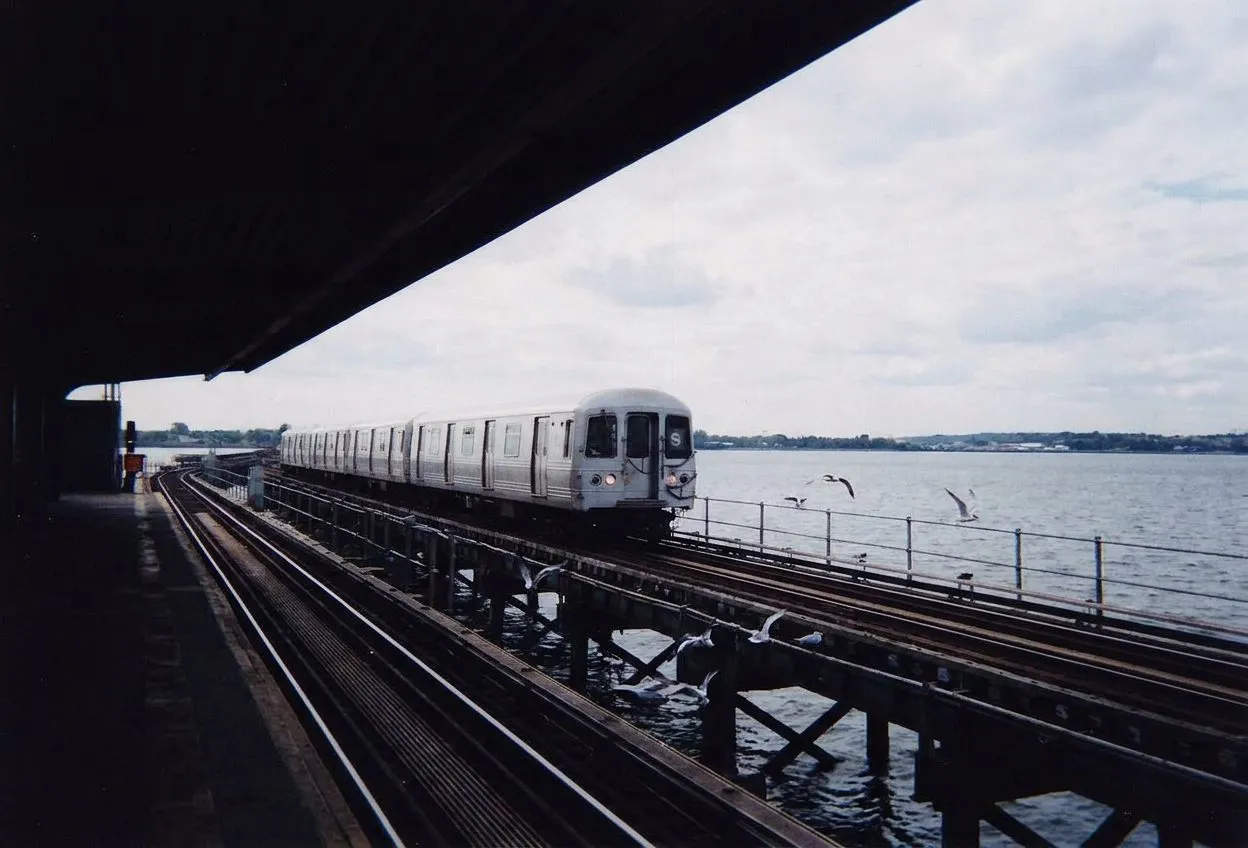
Broad Channel station occupies a singular position in the subway system: a slender ribbon of concrete and steel hoisted above the marshland, exposed on all sides. There is no windbreak here, no heated waiting area, no illusion of shelter. In winter months, the bay winds cut through layers without ceremony. The center platform section near the stairwell offers the only partial wind shelter, a small pocket of relative stillness where regulars instinctively gather when the temperature drops. By late fall, you learn to read the platform's microclimates—where to stand, which bench offers the least exposure, how to orient your body against the gusts.
But exposure is also the point. This is not a station designed for comfort; it is a station designed for transit through landscape. The aluminum-clad station house glints against the gray-blue sweep of water. Cormorants dry their wings on wooden pilings below. The distant hum of jet engines threads through the air as planes bank toward JFK, their approach paths visible across the southern horizon. To wait here is to feel the city's edges soften, to sense the shift from urban density to something wilder and less contained.
The Shuttle Interval
The Rockaway Park Shuttle runs every 20 minutes during much of the day, and that interval matters. It is long enough to discourage impatience, brief enough to keep you tethered to the platform rather than wandering into the narrow residential blocks of Broad Channel itself. The wait becomes its own small meditation. Some passengers stay near the center, scrolling through phones or studying the tide line below. Others walk south along the platform, drawn toward the unobstructed bay views that open up near the far end.
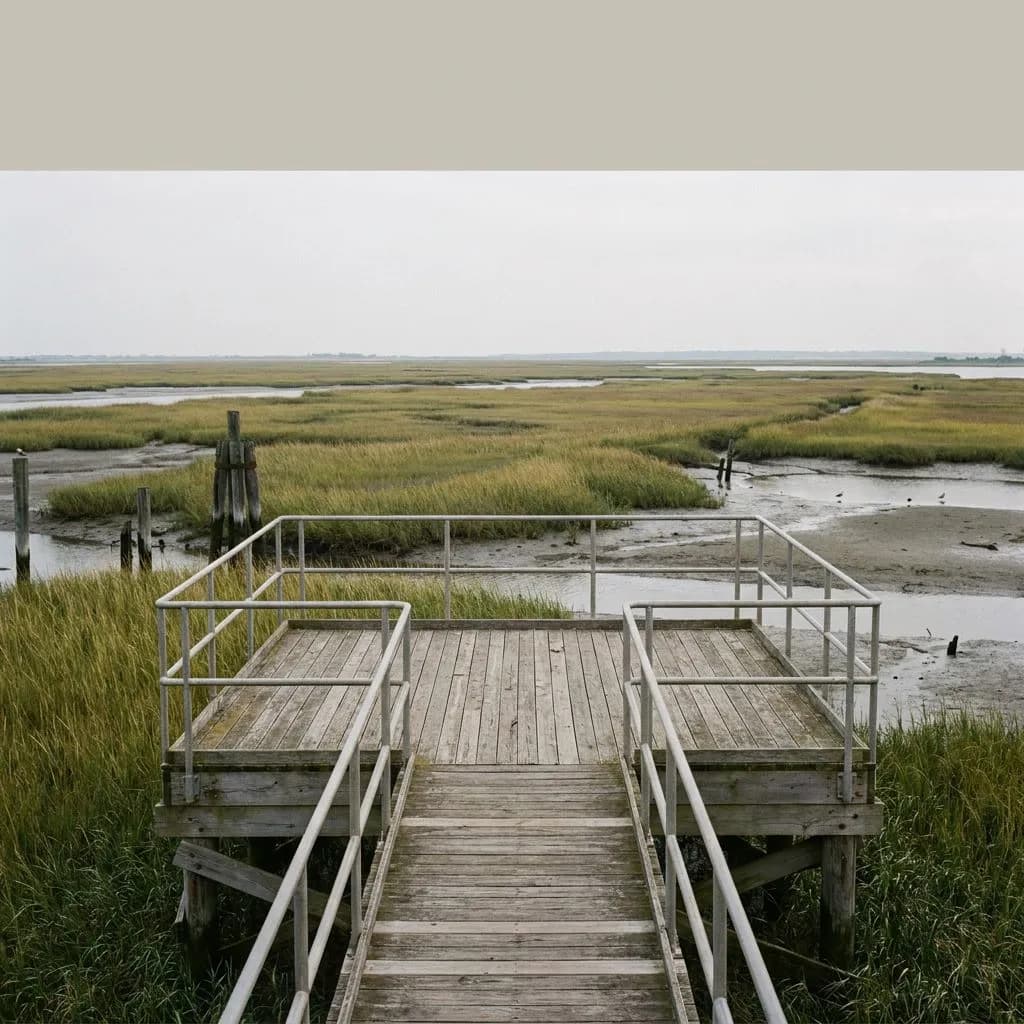
From the southern platform edge, the geometry of Jamaica Bay reveals itself. The marshland spreads wide and flat, stitched with channels that catch the afternoon light. To the west, the low silhouette of the Rockaway peninsula stretches across the horizon. To the east, the JFK runways materialize in sharp relief—concrete and navigation lights interrupting the wetland expanse. On clear days, the air traffic patterns become a kind of ambient theater: planes descending in slow succession, their metal bellies flashing as they drop toward the tarmac. It is a view that rewards the time spent waiting, a compensation for the schedule's looseness.
The Marine Parkway Crossing
When the shuttle finally arrives—a modest two- or three-car train, often less crowded than the A trains that feed it—the crossing begins in earnest. The shuttle departs Broad Channel and almost immediately swings onto the Marine Parkway trestle, the elevated track that carries passengers south across Jamaica Bay toward the Rockaways. This is where the journey earns its reputation. The shuttle crosses the trestle at reduced speed due to track conditions, extending the water crossing to approximately four minutes. Four minutes does not sound like much until you are suspended above open water, the bay stretching out on both sides, the train moving at a crawl that feels almost ceremonial.
The optimal window views are on the southern side, where the exposure is broadest and the sightlines least interrupted by structural elements. On summer travel days when the light turns golden and the water takes on a hammered-metal sheen, the crossing feels unhurried in the best sense—deliberate, almost meditative. The trestle itself is a relic of early twentieth-century engineering: steel girders, weathered beams, the faint metallic groan of the train negotiating curves. Below, the bay teems with birdlife. Egrets stalk the shallows. Gulls wheel overhead. The city recedes into backdrop, a distant arrangement of towers and bridges rendered abstract by distance.
Arrival and Return
The Rockaway Park Shuttle terminates at Rockaway Park–Beach 116th Street, a modest end-of-the-line station that feels less like a destination than a punctuation mark. Some passengers disembark here with purpose—locals heading home, beachgoers in warmer months shouldering towels and coolers. Others, the detourists and the idly curious, step off simply to acknowledge the terminus before doubling back. There is no shame in this. The point was never really Rockaway Park itself; the point was the crossing, the platform wait, the slow unspooling of the journey across water and wetland.
The return trip offers the same crossing in reverse, though the light inevitably shifts. Late afternoon transforms the bay into a study in blues and silvers. Early evening brings the warm glow of sunset, the western sky streaked with color as the shuttle retraces its path north. By the time you transfer back to the Manhattan-bound A train at Broad Channel, the trip has taken on the texture of a small pilgrimage—a journey undertaken not for efficiency but for the textures it reveals along the way.
Why Late 2026 Matters
As of late 2025, the Broad Channel transfer remains largely unchanged, though its status as an overlooked gem may not hold indefinitely. Transit enthusiasts and urban explorers have begun to circulate field notes about the crossing, praising its accidental beauty and the slow-motion theatrics of the trestle ride. There is talk, always talk, of infrastructure upgrades and schedule adjustments, the kind of bureaucratic chatter that follows any aging transit corridor. For now, the shuttle runs as it has for decades—reliably unhurried, stubbornly scenic, a pocket of analog transit in a city increasingly optimized for speed. Catch it while it still feels like a secret, or at least before the secret becomes common knowledge.
Practical Notes
The Broad Channel transfer point is located at Broad Channel station (Rockaway Line, IND), accessible via the A train. The station is elevated and fully exposed; dress for weather and bring wind protection in colder months. The Rockaway Park Shuttle runs regularly, with off-peak intervals of 15–20 minutes. No restrooms or enclosed waiting areas are available on the platform. The Marine Parkway trestle crossing offers best views from the southern side of the train. For parking, limited street parking is available in the surrounding residential neighborhood; verify local regulations. The station is ADA-accessible via elevators at the station Verify current shuttle schedules via MTA.info before traveling, as service can be affected by weather and track work.
Tags: #BroadChannel #RockawayParkShuttle #TheLongWayHome #JamaicaBay #NYCSubway #CoastalQueens #MarineParkwayTrestle #TransitAsDestination #UrbanExploration #NYCTravel #HiddenNewYork #SubwayDiaries #RockawayLine #FallTravel #SlowTravel
Sources consulted: Broad Channel station (Wikipedia) · Rockaway Park Shuttle (Wikipedia) · NYC Subway System (MTA) · Jamaica Bay Wildlife Refuge · NYC Planning - Rockaway Peninsula
All trademarks are the property of their respective owners.