A Private Library Built Like a Roman Villa
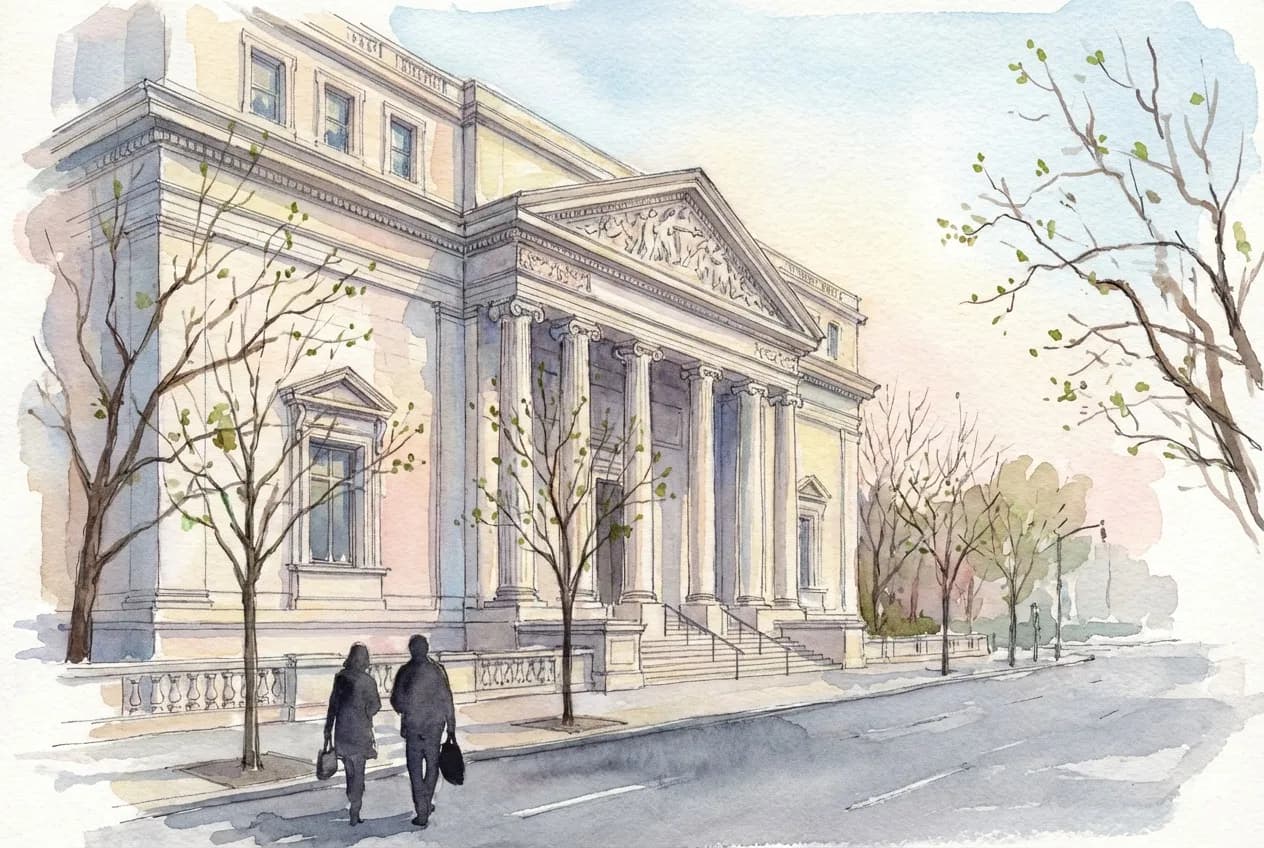
In 1902, J. Pierpont Morgan engaged architect Charles Follen McKim of McKim, Mead and White to build a library adjoining his Murray Hill mansion. McKim drew from the Italian Renaissance — specifically from villas near Rome — producing a structure faced in Tennessee marble with classical columns and a carved pediment. Morgan was deeply involved in the interiors, sourcing materials and supervising the decorative program himself. The building was completed in 1906, and Morgan began spending the majority of his time there, in a room surrounded by things he had spent his life acquiring.
He died in 1913 in Rome. His son, J.P. Morgan Jr., donated the library to a public trust in 1924. Since then, the East Room has been open to visitors — first by appointment, now as the historic core of a functioning museum. The exterior has not changed. The bookshelves have not changed. The Persian rug on the floor is a late-19th-century replacement installed during the 2010 restoration, closely matched to the original. Everything else is the room it was.
The Seat in the Middle of It
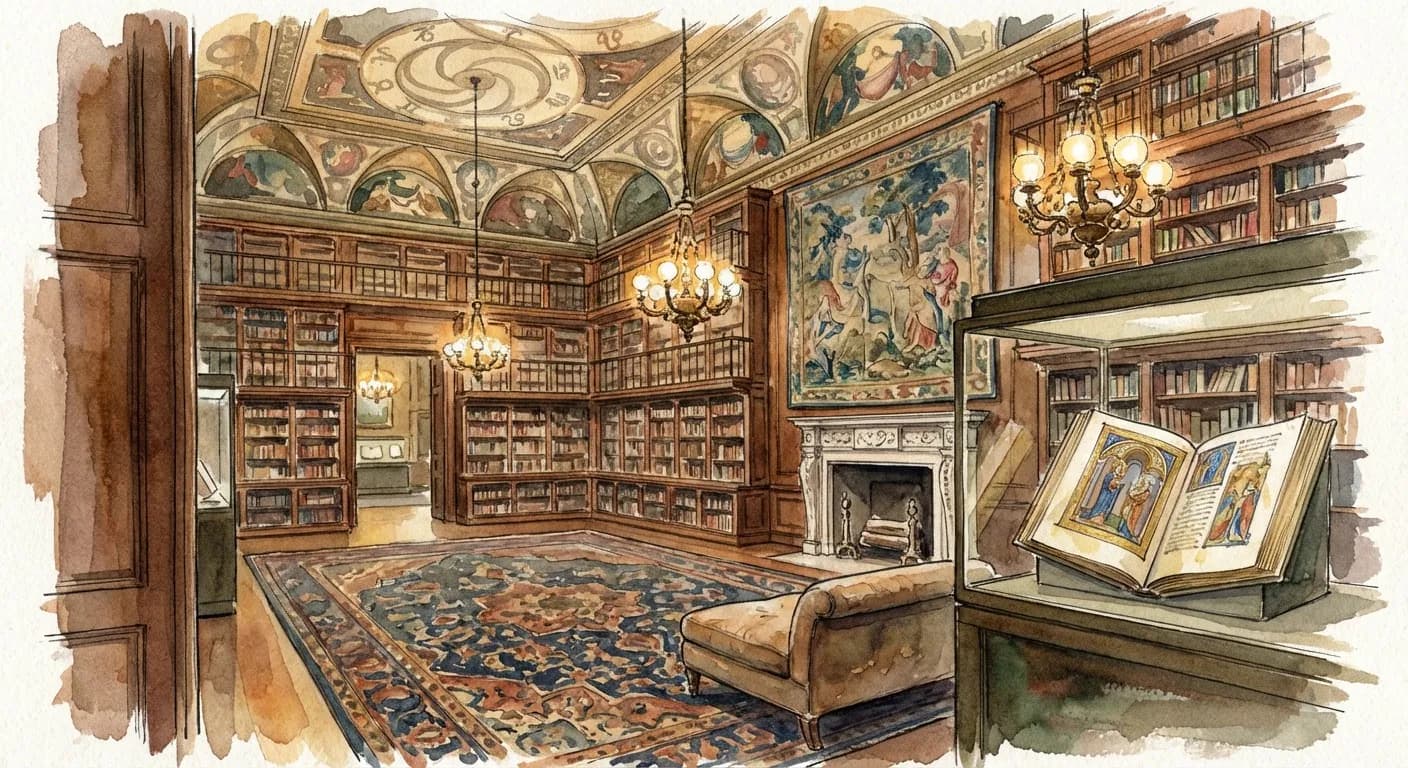
The East Room has a central ottoman, positioned on the Persian rug so that when you sit on it, you are equidistant from all four walls of bookshelves. The shelves rise three stories, accessible by two hidden staircases behind the cases. At the top of each tier, the spines are close enough in age and binding that the wall reads as texture before it reads as books. At eye level, the individual volumes become legible: hand-lettered spines, gilded tooling, leather in various stages of darkening.
The ottoman is not the kind of seat that invites you to stay indefinitely. It is firm. But it is the right seat for this room — the one position from which the proportions of the East Room resolve correctly, from which the ceiling painting (zodiac medallions in hexagonal spandrels, figures of the arts and sciences by Harry Siddons Mowbray) sits at the angle it was designed to be seen from.
From here you can also see the 1455 Gutenberg Bible in its glass case. It is always on display. Morgan acquired it in 1896; it is one of approximately 49 copies that survive.
What the Rotunda Does to You Before You Get There
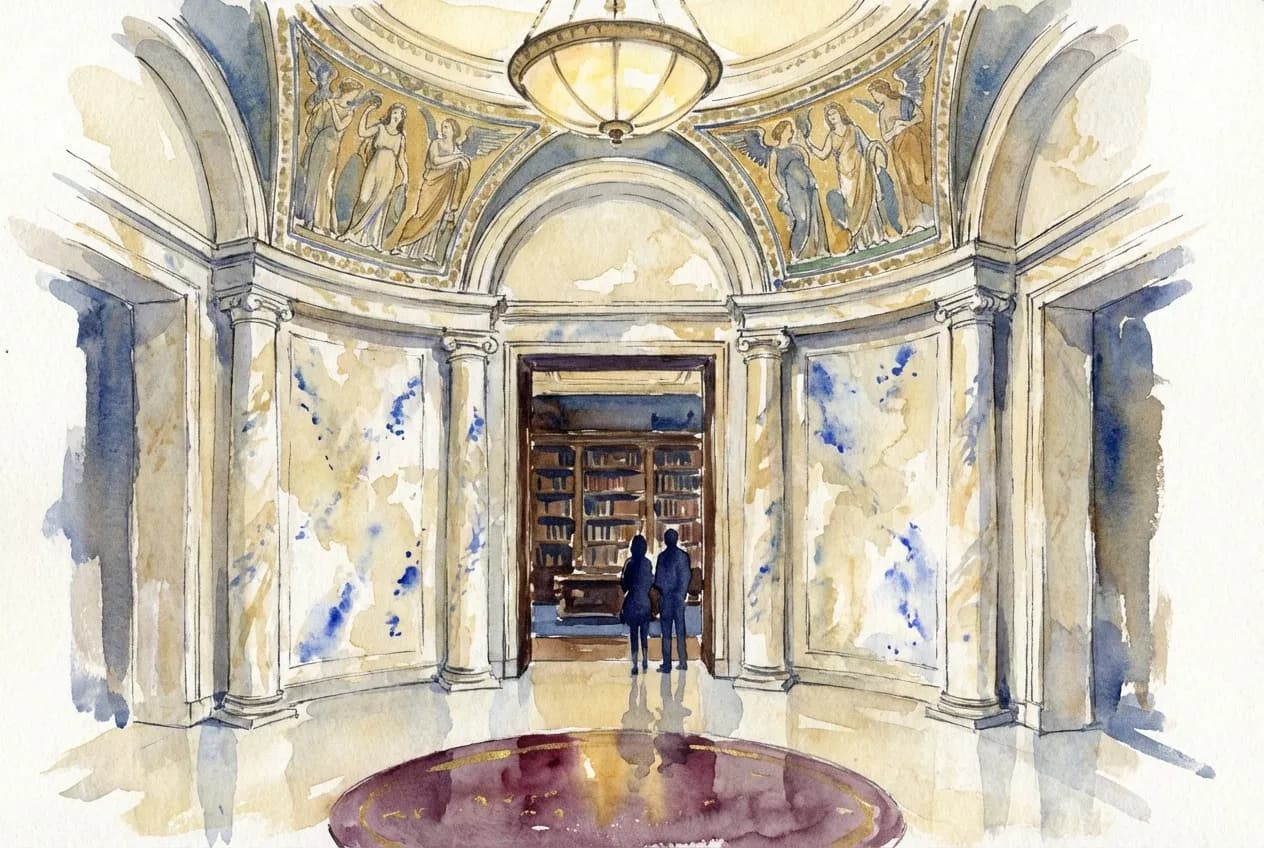
The East Room is reached through the Rotunda — a vaulted marble foyer connecting Morgan’s library, his personal study (the West Room), and the former office of his librarian Belle da Costa Greene. The Rotunda is deliberately excessive: variegated marble on every surface, lapis lazuli-colored pilasters, mosaic ceiling panels, a porphyry disc set into the floor. Mowbray’s murals personify Religion, Philosophy, Science, and Art in the lunettes above. It is a transitional space designed to perform preparation — to make whatever room you enter next feel earned.
The Free Window Nobody Talks About
The Morgan’s full-price admission is $25 for adults. But the historic rooms — the East Room, the West Room, the Rotunda, and Morgan’s librarian’s office — are free to enter on Tuesdays and Sundays from 3pm to 5pm. No reservation required. You arrive, say you are visiting the historic rooms, and you go in.
On a Tuesday afternoon in April, the East Room is typically occupied by a dozen people at most. The room is small enough that it never feels crowded, and the late-afternoon light through the exhibition cases picks up the amber in the walnut shelves. The ottoman is usually unoccupied. The Gutenberg Bible is in its case. Nobody is in a hurry. Free Fridays (5 to 8pm) also exist but require advance reservation and draw larger crowds. The Tuesday and Sunday window is quieter.
Why the Room Still Works as a Room
The Morgan has expanded twice since 1906 — once in 1928 and again in 2006 when Renzo Piano designed a glass-and-steel atrium connecting the historic buildings. The Piano addition is good architecture. It also makes the McKim building feel like a museum rather than a private library, which is what it now is. That shift happens at the Rotunda threshold: once you cross into the historic rooms, the museum falls away and the 1906 building reasserts itself. The scale is residential. The furniture is period. The books are the books Morgan actually owned.
Most rooms preserved for 120 years feel like preservation. The East Room feels like use.
Practical notes
- Address: 225 Madison Avenue (between 36th and 37th Streets), New York, NY 10016
- Hours: Tue–Thu & Sat–Sun 10:30am–5pm; Fri 10:30am–8pm; closed Monday
- Free historic rooms: Tuesdays and Sundays 3–5pm, no reservation required
- Free Fridays: 5–8pm, reservation required at themorgan.org (one week in advance)
- Full admission: $25 adults; $17 seniors (65+); $13 students; children 12 and under free
- Getting there: 33rd Street on the 6 train (3-minute walk north); 34th Street–Herald Square on B/D/F/M/N/Q/R/W (7-minute walk)
- Best window: Tuesday 3–4:30pm — least busy; the central ottoman is almost always free
- What to do after: South on Madison to the mid-30s galleries; north to the New York Public Library main branch at 42nd and Fifth
The point
Most of what passes for a good place to sit in New York is designed around turnover: the seat holds you for one drink, one coffee, one chapter, and then the pressure to leave begins. The East Room ottoman is different. It was not designed for public use at all — it was designed for one man’s private reading life, in a room built to the scale of one man’s ambition. That ambition turned out to be large enough to accommodate strangers. The chair is still there. The books are still around it. Tuesday afternoon it is yours.
Tags: #morganlibrarynyc #eastroom #gildedageinterior #rarebooks #gutenbergbible #murrayhill #nycmuseum #freefridays #readingroom #quietnyc #historyofbooks #karpofinds #pullupachairkarpo #nycindoor #weekdayafternoon
Sources consulted: themorgan.org · themorgan.org/eastroom · themorgan.org/rotunda · wikipedia.org
All trademarks are the property of their respective owners.