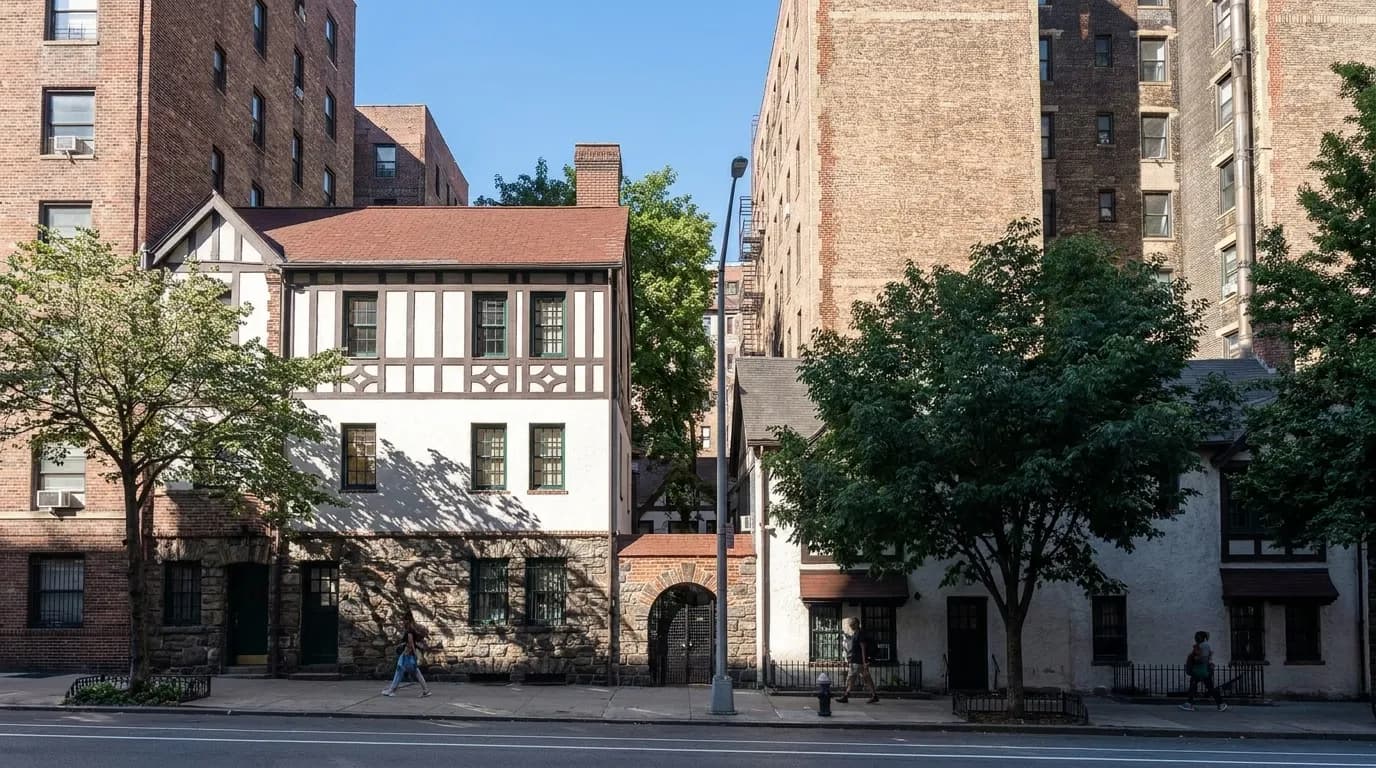
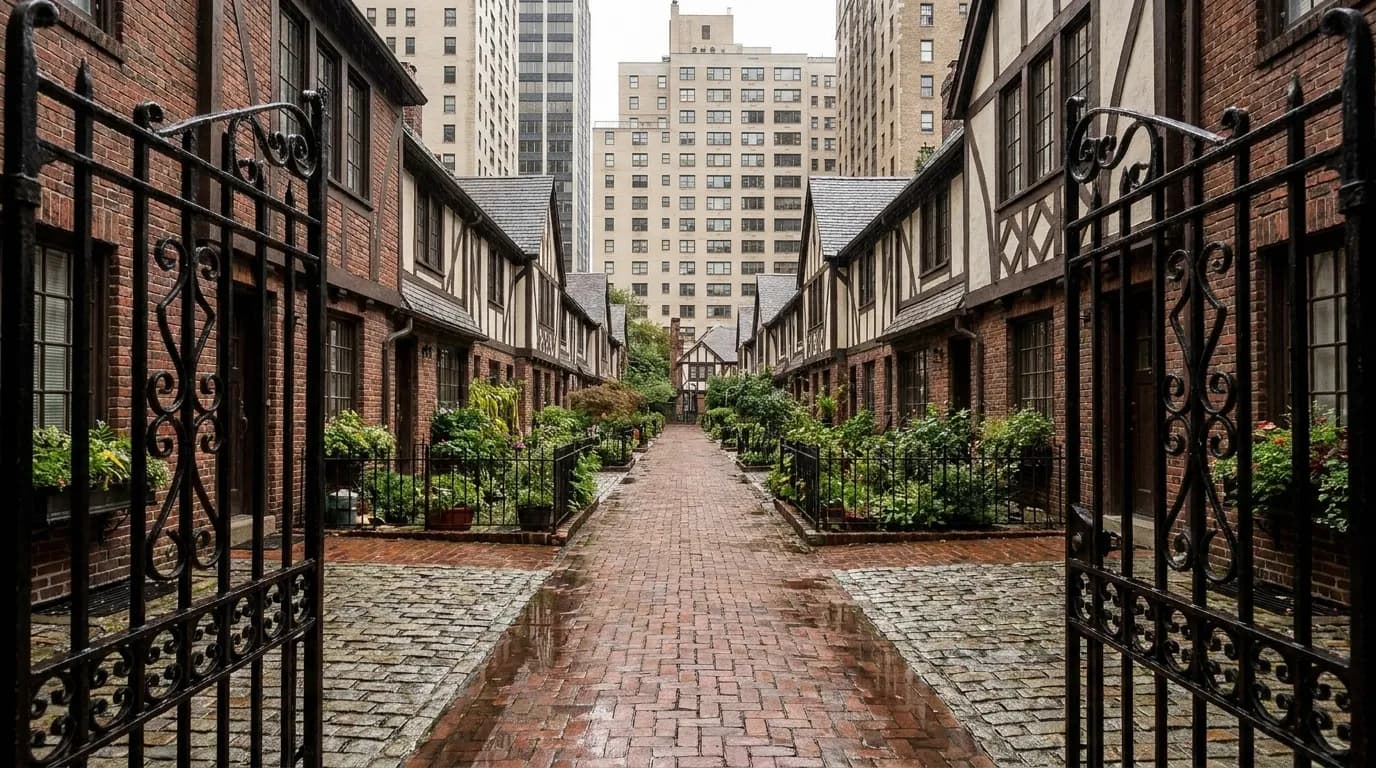
New York rewards walkers who notice the gaps between destinations. Pomander Walk is one of those gaps: a gated, pedestrian-scale row of Tudor Revival houses hidden mid-block on the Upper West Side, between West 94th and West 95th Streets and between Broadway and West End Avenue. From the sidewalk, it looks less like a conventional Manhattan address than a stage set that somehow survived the surrounding apartment boom. The surprise is real, but the lane is also a private residential community, so the right way to experience it is as a respectful architecture stop rather than an attraction to enter.
Text Karpo for a low-key Upper West Side architecture walk that fits Pomander Walk between nearby public stops, with a rain backup and coffee option that match your timing.
Why Most Upper West Side Walks Miss It
Pomander Walk does not sit on a corner, announce itself with a plaza, or open into a public courtyard. Its entrances are set into the street walls on West 94th and West 95th, and the lane runs through the middle of the block. If your route stays on Broadway or heads directly toward Riverside Park, you can pass within a minute of it without seeing more than a low, half-timbered facade beneath much taller brick buildings. That scale contrast is the whole reveal: Manhattan keeps rising around a narrow domestic passage that was designed to feel deliberately small.
The London Reference Is More Than a Vibe
The name came from Louis N. Parker's 1910 play Pomander Walk, set on a secluded London lane. Developer Thomas J. Healy hired the architectural firm King and Campbell for the New York complex, which was built in 1921–22. The city landmark report describes an intentionally picturesque ensemble rather than a literal copy of a single English street: varied rooflines, stucco panels crossed by dark half-timbering, brick and stone bases, and small planted spaces facing the walk. In other words, the theatrical quality was part of the original brief, not a nickname added later by social media.
That origin also explains why the place reads so quickly in photographs. Repeated house forms are broken up by changing gables, window groupings, timber patterns and setbacks. The lane feels irregular even though it was planned as one development. Look past the broad 'English village' label and the more interesting story is how the architects used controlled variation to make a compact Manhattan site appear older, slower and less uniform than it really is.
Three Details Worth Looking For From the Gate
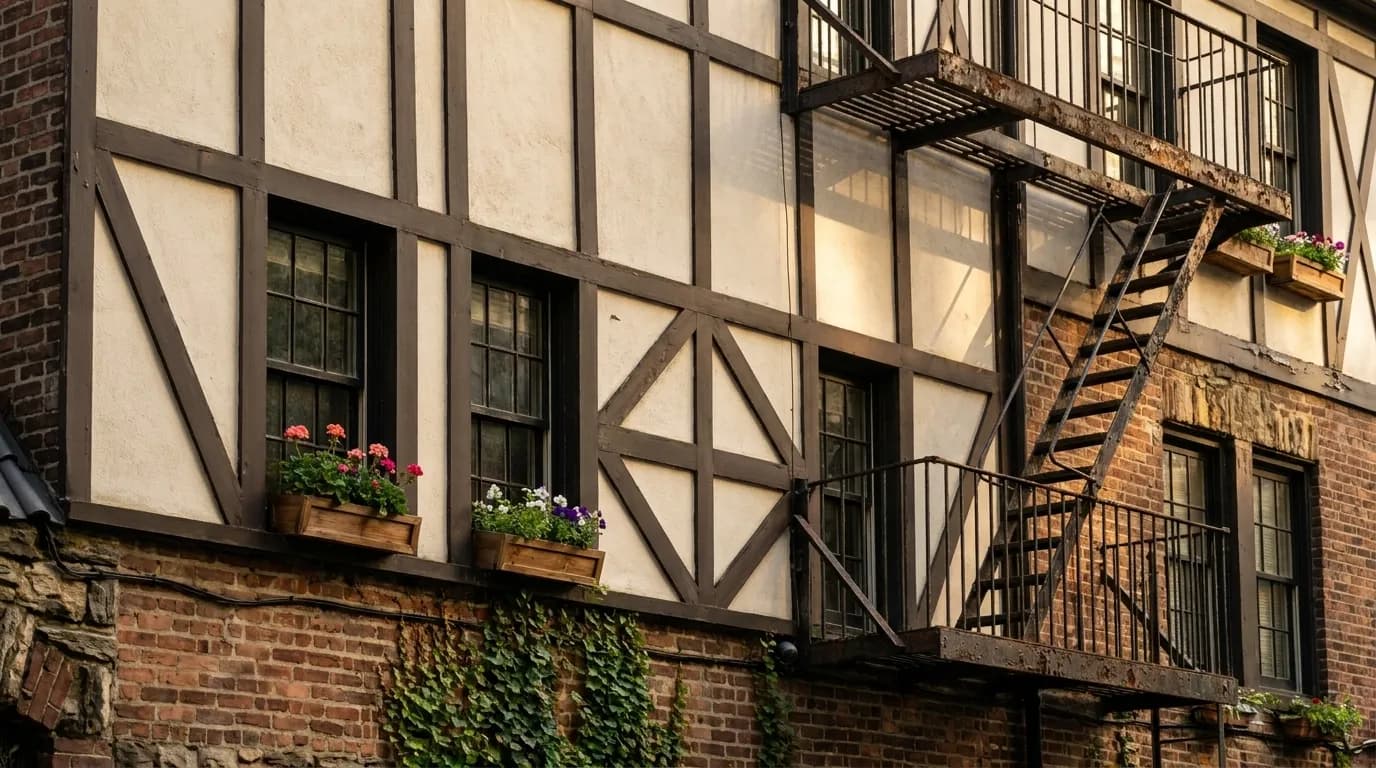
First, notice the gate buildings at the street ends. The passage is not simply a gap in a fence; the architecture continues above and around it, making the entrance feel like a threshold between two different urban scales. Second, scan the lower walls. Rough stone, brick arches and textured masonry give the cottages visual weight before the lighter stucco-and-timber upper stories begin. Third, compare neighboring facades rather than searching for one perfect cottage. Some timber patterns are geometric, some window bays are tighter, and some roof edges project farther than others. Those small changes are why a quick glance becomes a five-minute study.
How to See Pomander Walk Without Treating It Like a Set
Pomander Walk is private residential property. The useful public experience is from West 94th Street and West 95th Street, where you can study the entrances and sightlines without entering. Do not follow a resident through a gate, hold the gate for yourself, photograph through windows, or block the sidewalk while composing a shot. A normal lens is better than a long telephoto here: it keeps the image about the architecture and its relationship to the street, not about the people who live behind it.
For the clearest reading, visit in daylight and look from both ends. The north and south approaches reveal different combinations of gate, facade, trees and neighboring apartment walls. Cloudy weather is not a loss; softer light can make the dark timber grid and pale infill easier to read. If the sidewalk is busy, step aside and wait rather than turning the entrance into a photo queue. This is a hidden gem precisely because it still functions as a home address.
Build It Into a Better UWS Architecture Loop
Pomander Walk works best as a ten-minute pause inside a longer neighborhood walk, not as a cross-city destination on its own. Approach from the 96th Street subway area, make the two gate views, then continue west toward Riverside Drive for grand apartment-house facades and river-facing streets. Alternatively, head south and compare the lane's compressed cottage scale with the broad residential blocks around West 90th Street. Keeping the route architecture-led makes the stop feel connected rather than gimmicky.
The practical advantage is flexibility. There is no ticket window, tour schedule or opening-hour gamble because you are observing from public sidewalks. The trade-off is that access is intentionally limited. If your idea of a satisfying stop requires walking inside, choose a publicly accessible historic interior elsewhere and treat Pomander Walk as the exterior prologue. The point is the urban contrast: a private, low-rise lane embedded in one of Manhattan's most legible street grids.
Why It Survived
By the late twentieth century, the complex had become unusual enough that preservation mattered at the city level. The New York City Landmarks Preservation Commission designated Pomander Walk a landmark on July 19, 1982, identifying its architectural character and the rare sense of place created by the walk and its surrounding buildings. That protection helps explain why today's view still has a coherent identity rather than one surviving cottage surrounded by unrelated infill.
The designation does not freeze the lane outside ordinary city life. Fire stairs, window air conditioners, repairs, mature planting and the taller buildings behind it keep the scene recognizably New York. That tension is more compelling than the fantasy version. Pomander Walk is not London transported whole to Manhattan; it is a New York development that borrowed theatrical English cues, aged inside a dense block, and became more distinctive as the city around it changed.
Practical Notes
- Location: Mid-block between West 94th and West 95th Streets, between Broadway and West End Avenue, Upper West Side, Manhattan.
- Access: Private residential lane; view respectfully from the public sidewalks at either gated entrance.
- Best use: A 10–15 minute architecture stop folded into a broader Upper West Side walk.
- Photography: Daylight or soft overcast light; avoid photographing residents or interiors and keep entrances clear.
- Transit: The 96th Street subway complex is the simplest nearby starting point; verify live service changes before leaving.
Ask Karpo First
Tell Karpo how much time you have, your nearest subway line and whether you want architecture, coffee or riverside walking next. Karpo can turn this tiny landmark stop into a realistic neighborhood plan instead of sending you across town for one gate photo.
Tags: #PomanderWalk #UpperWestSide #NYCArchitecture #HiddenNYC #SecretArchitecture #ManhattanWalks #TudorRevival #HistoricNYC #UrbanExploration #NYCWalkingRoute #LandmarkArchitecture #LocalKnowledge #NewYorkCity #ArchitectureWalk #Karpo
Sources consulted: NYC Landmarks Preservation Commission — Pomander Walk Designation Report · Historic Districts Council — Pomander Walk · Wikimedia Commons — Pomander Walk reference photography
All trademarks are the property of their respective owners.