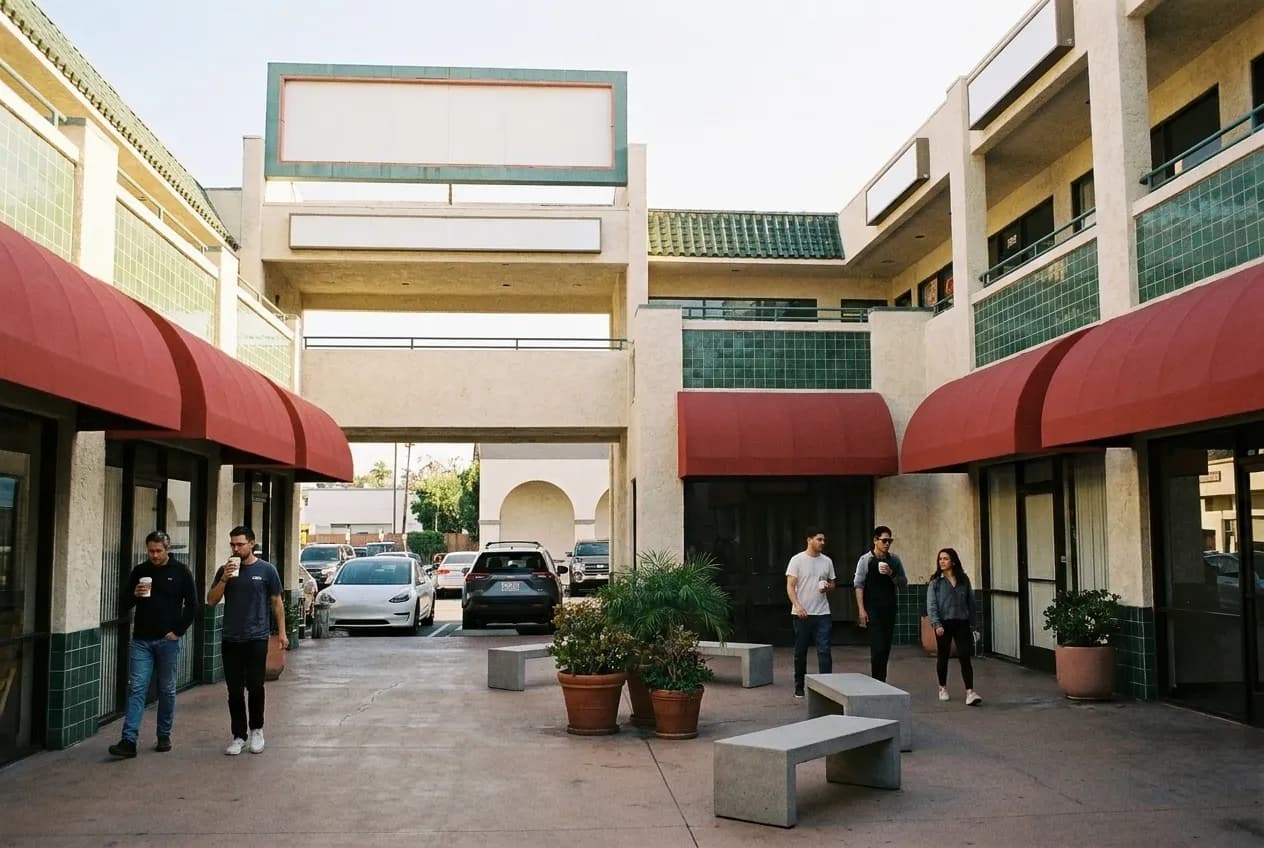
Los Angeles Chinatown does not work the way visitors expect. The stretch of North Broadway and the ornamental Central Plaza look like the centre of things, but a large share of the neighbourhood's genuinely good eating is inside a single 1950s shopping court: Far East Plaza at 727 N Broadway, a two-level concrete courtyard with a dozen small units around it. It looks like nothing from the street. That is the point of this article.
The plaza's units keep their own hours, several close early, and the good ones sell out of things. Tell Karpo what time you are arriving and it will tell you what is realistically still serving.
Inside the plaza
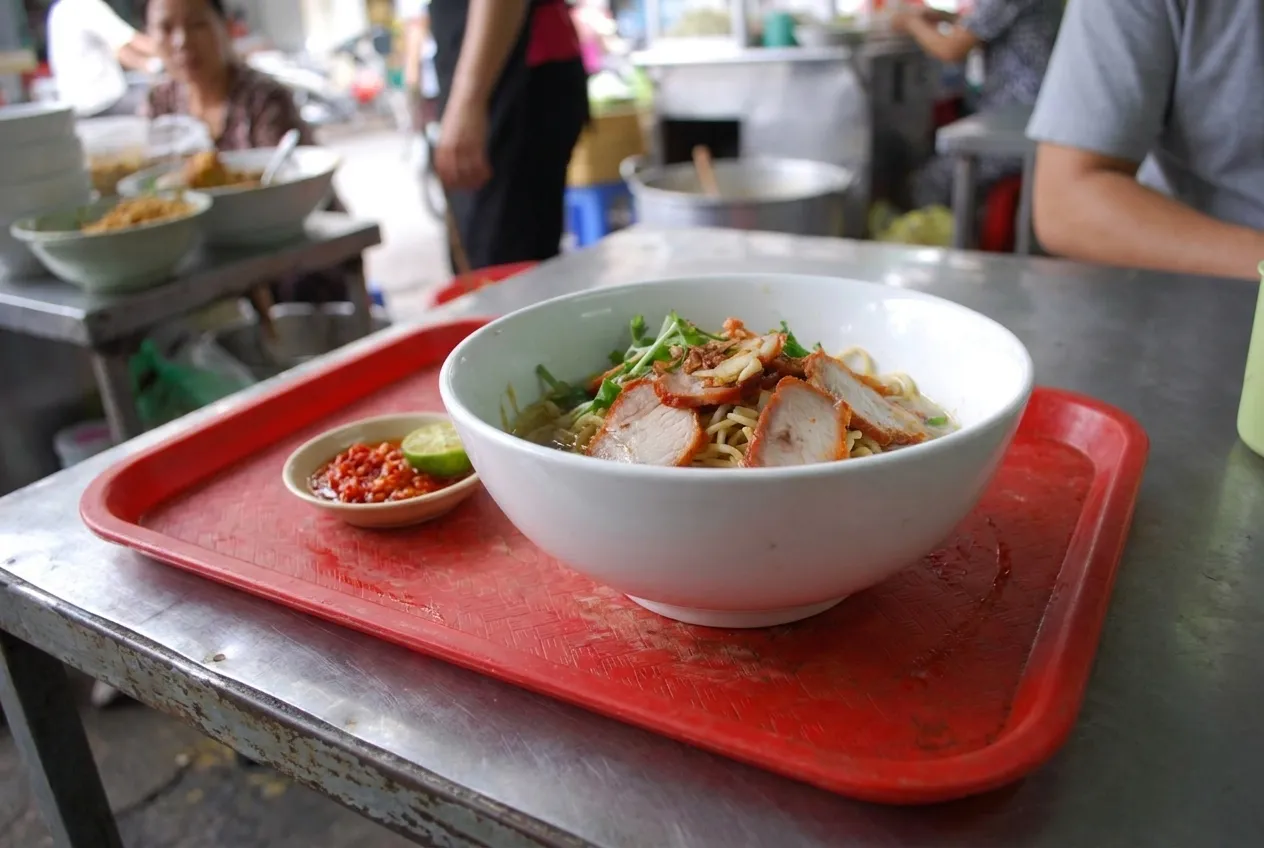
The mix rotates, which is part of what has kept the plaza interesting for a decade — small operators can afford a unit here in a way they cannot afford a Broadway frontage, so new kitchens appear and established ones grow out of it and leave. What stays constant is the format: counters, trays, shared courtyard seating, and a range that runs from Sichuan to Thai to sandwiches without anyone pretending it is a coherent food hall concept.
Go with a group and split up. The plaza only makes sense if three people queue at three counters and meet at a table. Attempting a linear meal at one unit is the least interesting way to use it.
The rest of the neighbourhood
Central Plaza on North Broadway, with its neon gate and the wishing well, is the postcard Chinatown and worth ten minutes even though it is not where you should eat. Chego and the Broadway frontage restaurants cover the sit-down end. Along Hill Street and Ord Street you will find the bakeries and the older banquet halls, and Philippe the Original at 1001 N Alameda — claimed birthplace of the French dip, opened 1908 — sits just outside the neighbourhood's edge near Union Station.
It is also worth knowing that this Chinatown is not where most of the region's Chinese population eats. The San Gabriel Valley took that role decades ago. What LA Chinatown has instead is history, a walkable core, and a plaza full of small operators — which is a different and more interesting proposition than a regional food centre.
Timing
The plaza is a lunch-first place. Several units close in the afternoon or early evening, and Sunday and Monday closures are common. Weekend lunch is the peak and it is busy in a pleasant way rather than an oppressive one. If you want the neighbourhood at its quietest, a weekday mid-afternoon works, with the caveat that fewer counters will be open.
Chinese New Year, in late January or February, brings the Golden Dragon Parade through the neighbourhood and is the single busiest day of the year here.
Getting there
Chinatown has its own Metro A Line station on College Street, which is the simplest possible arrival — no parking decision at all. If you drive, Far East Plaza has a lot behind it and there is metered street parking on Broadway and Hill, but the neighbourhood fills quickly on weekends and during events at nearby Dodger Stadium and Union Station.
Practical notes
Far East Plaza, 727 N Broadway, is a two-level courtyard with roughly a dozen small units and shared seating; tenants change over time and individual units keep their own hours, with afternoon and Sunday or Monday closures common. Central Plaza with the neon gate is on North Broadway. Philippe the Original, 1001 N Alameda St, dates from 1908. Metro's A Line stops at Chinatown station on College Street. There is a lot behind Far East Plaza plus metered street parking; expect it to fill on weekends and Dodgers game days. The Golden Dragon Parade runs at Chinese New Year.
Tags: #PlacesToEatNearMe #ChinatownLA #FarEastPlaza #LosAngeles #NorthBroadway #Restaurants #DTLA #PhilippeTheOriginal #CentralPlaza #LAFood #MetroALine #ChineseNewYear #FoodCourt #LAEats
All trademarks are the property of their respective owners.
Ask Karpo first
Far East Plaza's units run on their own hours and the good ones sell out, so timing is the whole game. Ask Karpo what is open right now, whether it is a lunch or a dinner trip, and whether the Metro is faster than parking today.