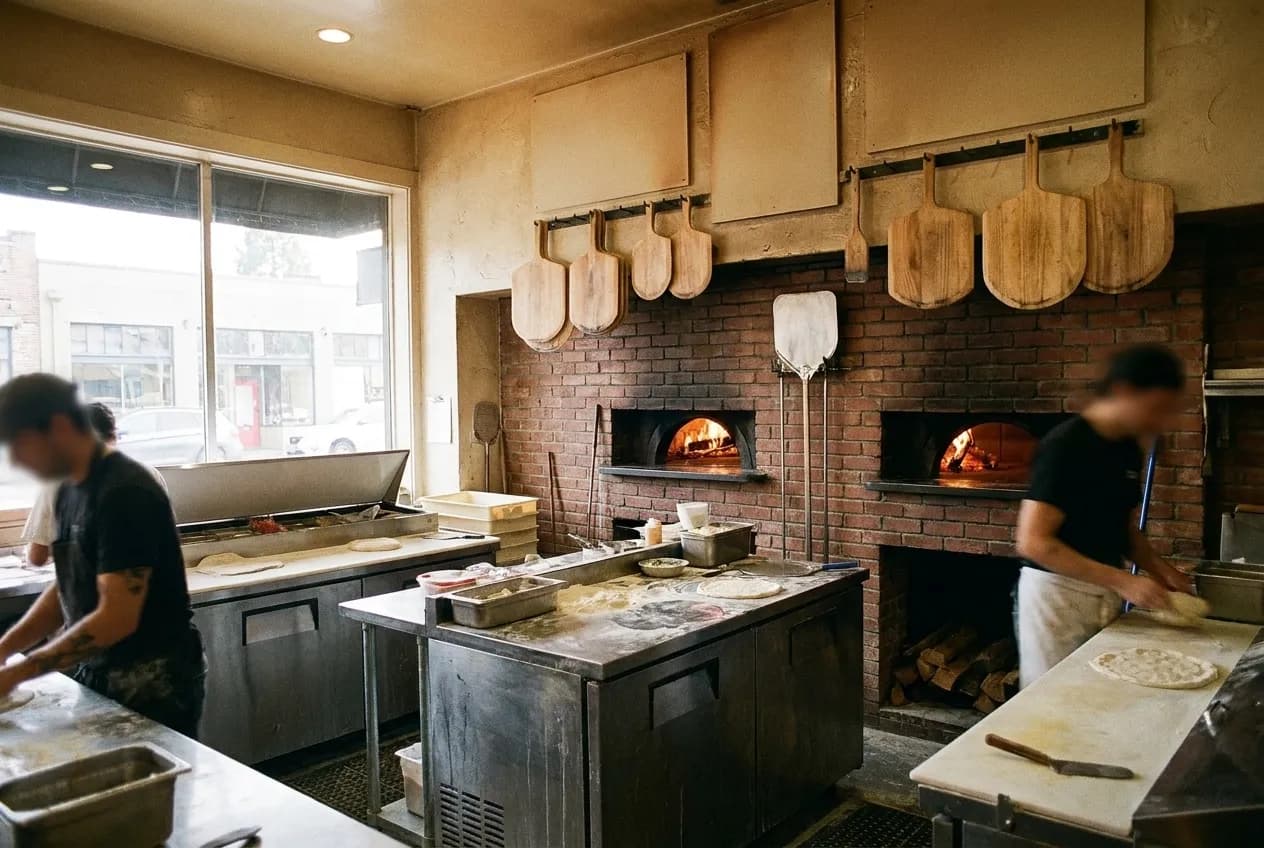
Most cities make you choose a camp. San Francisco does something more useful: it has a kitchen in North Beach that runs several ovens at different temperatures and fuels under one roof, which means you can order Neapolitan, New York and Sicilian at the same table and taste them within ten minutes of each other. That single fact turns an argument people usually conduct from memory into something you can settle empirically in one sitting. What follows is what to look for, and then how to extend it into a route across the city.
A three-style comparison needs one busy room that takes bookings and two counters that keep different hours. Tell Karpo which evening you are doing this and let it order the stops so nothing has closed by the time you arrive.
The three, in one paragraph each
Neapolitan: soft wheat flour, water, salt, a little yeast, around sixty percent hydration, hand-shaped so the rim keeps its gas, baked in a wood-fired dome at roughly four hundred and thirty degrees for sixty to ninety seconds. The bake is too fast to dry out the base, so the centre stays soft and slightly wet. Toppings are restrained. It is eaten immediately and it does not travel.
New York: high-protein bread flour, usually a little oil and sugar, lower hydration but far stronger gluten, baked in a deck oven at about two hundred and seventy degrees for ten to fifteen minutes. The long bake drives out moisture and produces a base that can be cut into wedges, held in a case, reheated and folded in one hand. Sicilian: much wetter dough at seventy percent or more, proved in an oiled pan, baked twenty to thirty minutes at moderate heat so the underside fries while the crumb steams. Tall, open, bready, often with the cheese under the sauce.
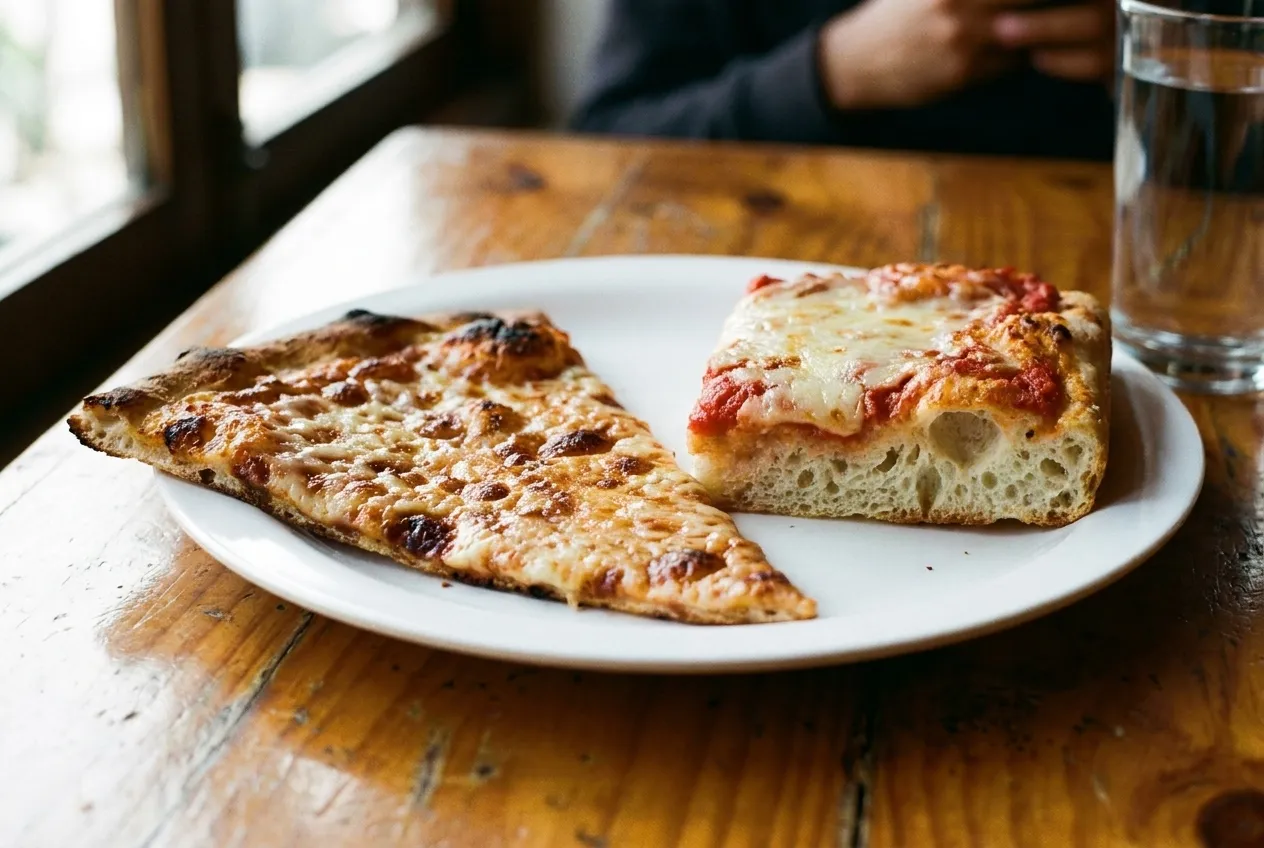
The single-room comparison
Tony's Pizza Napoletana at Stockton and Union, on the edge of Washington Square, is the address that makes this easy. It operates multiple ovens - wood, coal, gas and electric at different temperatures - specifically so it can produce styles that require incompatible conditions. Order a margherita from the wood oven, a plain New York slice or small pie, and a Sicilian square, and put them on the table together.
Taste in that order. Neapolitan first, while your palate is clean, because it is the most delicate and the easiest to overwhelm. Sicilian second. New York last, because its salt and fat will flatten whatever follows it. Pay attention to three things each time: the smell of the crust before you bite it, the resistance in the rim, and whether a slice holds itself horizontal when you lift it by the crust. That last test alone separates all three.
Extending it across the city
The single-room version is efficient but slightly artificial, because each style is best in a room built entirely around it. The citywide route is more work and more instructive. For Sicilian, Golden Boy Pizza on Green Street, three minutes' walk away - a window, a case of squares, cash, no seats, and a clam and garlic slice with its own following. It has been doing exactly one thing since the seventies.
For Neapolitan at its most committed, the wood-fired rooms in the Mission and the Del Popolo lineage are the reference - very thin, dramatically blistered, long-fermented, served whole and eaten fast. For New York style, the pickings are thinner in this city than in most, which is itself informative: San Francisco is a whole-pie town with very little slice infrastructure, so the New York style here lives mostly inside restaurants rather than at counters.
What the city's own accent adds
One local variable cuts across all three styles. San Francisco has an unusually deep bread culture - a commercial sourdough tradition going back to the Gold Rush and a modern natural-leaven movement rebuilt here - and a number of the people making pizza in this city came out of bakeries. That shows up as long cold ferments, sometimes with a natural starter, which give the base a faint tang and a more irregular open crumb than the same style would have elsewhere.
You will notice it most in the rim of a Neapolitan-style pie and least in a New York slice, where the salt and oil dominate. It is not a fourth style, it is an accent applied to the existing three. If a pizzeria also sells bread, or mentions its ferment on the menu, expect that accent to be pronounced.
Ordering rules that apply regardless
Order the plainest version. A margherita, a plain cheese slice, a plain square. Toppings are noise when you are trying to taste dough, and the kitchens that are proud of their base put a marinara on the menu specifically so you can taste it without cheese. Eat each one within a few minutes of it arriving - the Neapolitan in particular has about five good minutes and then it becomes a different, sadder object.
And match the style to the situation rather than to a ranking. Sitting down with people: Neapolitan. Walking, late, alone, cold: Sicilian square from a window. Taking it home over two hills: New York style, because it is the only one of the three engineered to survive the trip.
Practical notes
Quick reference: Neapolitan sixty to ninety seconds at about four hundred and thirty degrees, soft centre, eat in the room. New York ten to fifteen minutes at about two hundred and seventy, foldable, reheats well. Sicilian twenty to thirty minutes in an oiled pan, tall and bready, arguably better at room temperature an hour later. Booking: Tony's is busy at weekends and does not take reservations for all of its formats, so go early or on a weeknight. Golden Boy runs late and is cash-friendly. North Beach parking is bad; take Muni along Columbus or Stockton, or use a garage. Prices: four to seven dollars a slice or square, twenty to thirty for a whole pie. And do the whole comparison in one evening rather than across a week - memory is a terrible palate.
Tags: #PizzaNearMe #SanFrancisco #NeapolitanPizza #NewYorkPizza #SicilianPizza #NorthBeach #TonysPizzaNapoletana #GoldenBoyPizza #WashingtonSquare #MissionDistrict #SFEats #PizzaStyles #WoodFired #Sourdough
All trademarks are the property of their respective owners.
Ask Karpo first
A three-style tasting only works if all three are open when you get there, which in this city is not a safe assumption after nine. Ask Karpo which of these rooms is serving tonight, how long the wait at the busy one is right now, and whether the window three streets over has sold out of squares.